Priya, a software professional from Bengaluru, had a personal loan of ₹3 lakh and a credit card outstanding of ₹1.5 lakh. Every month, she had just enough money to pay one of them fully and only the minimum on the other. She kept switching between the two, unsure which one deserved priority. After a few months, her credit card interest had quietly grown bigger than her original personal loan balance.
This is a common dilemma for Indian borrowers. When you have both a personal loan and credit card debt, and money is tight, deciding which one to clear first can save you thousands of rupees or cost you thousands more. This article breaks down exactly how to make that decision, using real numbers and simple logic.
What is a Personal Loan and Credit Card Debt?
A personal loan is a fixed-amount loan you borrow from a bank or NBFC, repaid through a fixed EMI over a set tenure. The interest rate and repayment schedule stay the same throughout, so you know exactly what you owe each month.
Credit card debt is revolving debt. You do not have a fixed EMI unless you convert it. If you pay only the minimum due, the remaining amount keeps attracting high interest, and the debt can grow faster than you expect.
The core difference is structure. A personal loan has a clear end date. Credit card debt, if left unmanaged, has no natural end point.
Benefits of Paying Off Each Type of Debt
Paying off credit card debt first usually gives you:
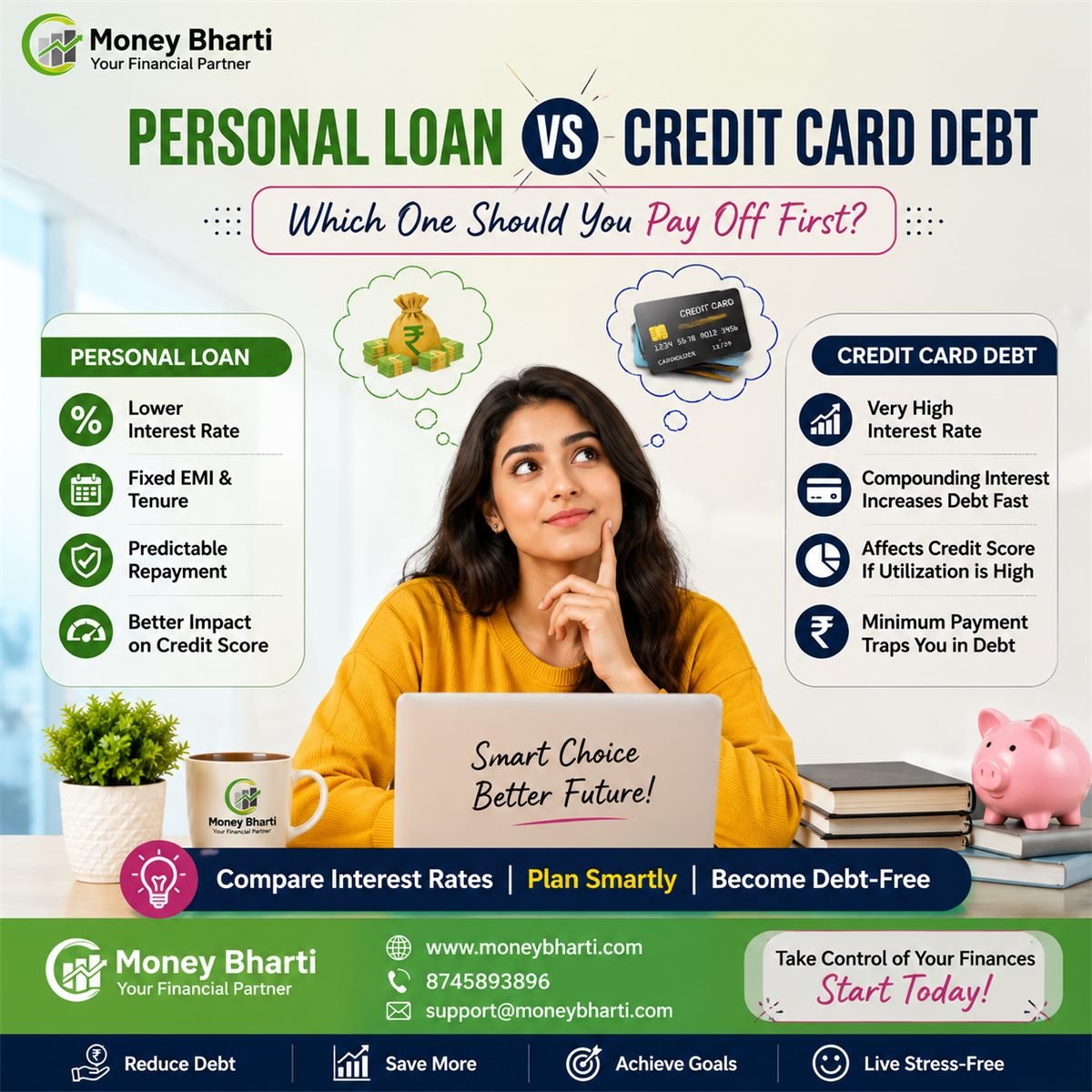
- Immediate relief from very high interest rates (often 30-40% per year)
- Lower risk of your outstanding balance snowballing
- Better credit utilisation ratio, which improves your credit score faster
Paying off a personal loan first can help when:
- The loan has a shorter remaining tenure and closing it removes a fixed monthly commitment
- You want to reduce the number of active loan accounts before applying for a bigger loan, like a home loan
- The personal loan interest rate is actually higher than your card's promotional rate (this happens occasionally with old loans)
Features That Affect Your Decision
| Feature | Personal Loan | Credit Card Debt |
| Interest Rate | 10.5% to 24% per annum | 30% to 42% per annum |
| Repayment Structure | Fixed EMI | Minimum due or revolving |
| Tenure | Fixed (1-5 years) | No fixed end date |
| Impact on Credit Score | Moderate, if paid on time | High, if utilisation stays above 30% |
| Prepayment Charges | Sometimes applicable | Usually none, but interest keeps adding |
Eligibility to Restructure or Consolidate
If you are thinking of taking a fresh loan to pay off card debt, lenders typically check:
- Age between 21 and 60 years
- Minimum monthly income of ₹20,000 to ₹25,000
- CIBIL score of 650 or above (you can check your score directly on the CIBIL website)
- Stable employment for at least 1 year
You can check detailed criteria on the debt consolidation loan eligibility page before applying.
Documents Required
- PAN card and Aadhaar card
- Last 3 months' salary slips
- Bank statements for 6 months
- Credit card statements showing outstanding balance
- Existing personal loan statement, if any
Interest Rate Comparison
This is where the real decision usually gets made. Credit card interest is almost always higher than personal loan interest.
| Debt Type | Typical Annual Interest Rate |
| Credit Card (revolving) | 30% to 42% |
| Personal Loan | 10.5% to 24% |
| Debt Consolidation Loan | 10.5% to 22% |
Because of this gap, credit card debt usually costs you more per rupee, per month, than a personal loan does. You can check current ranges on the debt consolidation interest rates page, and for official guidelines on lending rates and borrower rights, the Reserve Bank of India (RBI) website is a reliable reference.
Real-Life Example
Let's go back to Priya's numbers to see the actual cost difference.
Priya's outstanding debts:
| Debt | Amount | Interest Rate | Monthly Interest Cost |
| Personal Loan | ₹3,00,000 | 14% | ₹3,500 approx |
| Credit Card | ₹1,50,000 | 36% | ₹4,500 approx |
Even though her credit card balance is half the personal loan amount, it is costing her more in interest every month. If Priya has extra funds available, paying down the credit card first saves her more money, faster.
If she wants to simplify things further, she could also look at a personal loan for debt consolidation to bring both debts under one lower-interest EMI.
Step-by-Step Process to Decide What to Pay First
- List every debt with its outstanding amount and interest rate
- Calculate the monthly interest cost for each debt, not just the total balance
- Prioritise the highest interest rate debt, usually the credit card
- Pay the minimum due on lower-priority debts so you avoid penalties
- Put extra funds toward the highest-interest debt until it is cleared
- Consider consolidating if juggling multiple debts becomes hard to manage; explore a debt consolidation loan or a credit card debt consolidation loan
- Track your credit utilisation monthly to see improvement
- Automate payments to avoid missing due dates on either debt
Pros and Cons of Paying Off Credit Card Debt First
Pros:
- Stops the highest interest cost immediately
- Improves credit utilisation ratio quickly
- Reduces risk of the balance spiralling out of control
Cons:
- Personal loan EMI still needs to be paid on time
- May feel slower if the credit card balance is small compared to the loan
Pros and Cons of Paying Off Personal Loan First
Pros:
- Removes a fixed monthly obligation completely
- Useful if you plan to apply for another loan soon and want fewer active accounts
Cons:
- You keep paying high credit card interest in the meantime
- Total interest cost across both debts is usually higher with this approach
Comparison: Which One Should You Pay First?
| Situation | Recommended Priority |
| Credit card interest rate is much higher than personal loan rate | Pay credit card first |
| Personal loan has only 2-3 EMIs left | Clear personal loan first, then attack the card |
| You are struggling to manage multiple EMIs | Consider multiple EMI to single EMI loan |
| Credit card balance keeps growing due to minimum payments | Pay credit card first, and stop using it for new spends |
| You want fixed monthly payments and predictability | Consolidate both using a balance transfer loan or consolidation loan |
If you are a salaried employee juggling both types of debt, it also helps to check options built specifically for your income profile on the debt consolidation for salaried employees page.
FAQs
1. Should I always pay off credit card debt before a personal loan? In most cases, yes, because credit card interest rates are usually much higher. But check your personal loan's remaining tenure and rate before deciding.
2. Can I use a personal loan to pay off credit card debt? Yes, many borrowers use a personal loan or a dedicated credit card debt consolidation loan to clear high-interest card dues and move to a lower, fixed EMI.
3. Does paying only the minimum due on a credit card hurt my credit score? Yes, over time. It keeps your credit utilisation high, which negatively affects your CIBIL score, even if you never miss a payment.
4. What happens if I miss an EMI on my personal loan? You will likely face a late payment fee and a negative mark on your credit report, which can affect future loan approvals.
5. Is it better to consolidate both debts into one loan? It can be, especially if you are struggling to track multiple due dates. You can compare your existing EMIs against a new one using a debt consolidation EMI calculator.
6. How quickly can I get a loan to pay off credit card debt? Some lenders offer fast approval through an instant debt consolidation loan, often within 24 to 48 hours for eligible applicants.
7. Will closing my credit card after paying it off affect my credit score? It might cause a small, temporary dip due to reduced overall credit limit, but it is usually better than carrying high-interest debt.
8. Can self-employed individuals also consolidate credit card and loan debt? Yes, self-employed applicants can apply, though they typically need to submit income tax returns and bank statements as income proof.
9. What is the safest way to compare loan offers online? Look for RBI-registered lenders (you can verify this on the RBI website) and compare offers through platforms like online debt consolidation services before finalising one. For general financial literacy resources, India.gov.in is also a useful government source.
10. Should I stop using my credit card while repaying debt? Yes, it is best to pause new spending on the card until the outstanding balance is fully cleared, so the debt does not keep growing.
Checklist Before You Decide
- [ ] List all debts with interest rates and outstanding amounts
- [ ] Calculate monthly interest cost, not just total balance
- [ ] Identify which debt has the highest interest rate
- [ ] Check remaining tenure on your personal loan
- [ ] Decide if consolidation makes sense for your situation
- [ ] Compare at least 2-3 lenders if consolidating
- [ ] Set up auto-debit to avoid missed payments
- [ ] Track your credit utilisation ratio monthly
- [ ] Avoid new spending on credit cards until debt is cleared
Conclusion
Priya eventually chose to attack her credit card debt first, since it was costing her nearly ₹1,000 more in monthly interest despite a smaller balance. Within eight months, she cleared the card completely and redirected that EMI amount toward her personal loan, finishing it a year ahead of schedule.
The right choice depends on your actual numbers, not just which balance looks bigger. Sit down, calculate the real interest cost of each debt, and let that guide your repayment order. If managing two separate debts feels overwhelming, a consolidation option is worth exploring to bring everything under one manageable EMI.
Confused about which debt to tackle first? Use a debt consolidation EMI calculator to compare your options and see which repayment plan actually saves you more money.