 Debt Loan
Compare. Choose. Save.
Get Instant Loan
Up to ₹50 Lakh
Compare offers from top banks & NBFCs and get the best loan for your needs.
- Lowest Interest Rates
- Quick Approval
- Minimal Documentation
- 100% Safe & Secure
Loan AgreementDirect with lender
Active Partners100+ Banks
Eligibility CheckNo CIBIL impact
Money Bharti
Loan Approved
Congratulations!
₹50,00,000
Approved Amount
- Low Interest Rates
- Quick Approval
- Minimal Documents
- Flexible Tenure
Personal Loan EMI Calculator
₹
₹50,000₹50,00,000
%
6%36%
12 Months7 Years
Your Monthly EMI
₹16,368
15% interest of total payment
- Principal₹5,00,000
- Interest₹89,252
- Total₹5,89,252
Compare live offers from 4 lenders
Indicative rates for illustration. Your final rate depends on credit profile, income and lender policy.
2 minTo check eligibility
100+Banking Partners
₹0Our fee to compare
SoftEnquiry · no CIBIL impact
256-bit SSLSecure & Safe
Explore Our Loan Categories
Compare live offers from 100+ RBI-registered banks & NBFCs — one application, no impact on your credit score.
10.49%* p.a. onwards
Personal Loan
Instant funds for a wedding, medical emergency, travel or anything else — no collateral and no restriction on how you use it.
- Loan Amount₹50 K – ₹50 Lakh
- Tenure12 – 84 months
- ApprovalWithin 24 hrs
Debt Consolidation Loan
Merge every credit card bill and EMI into one lower instalment. Customers cut their monthly outgo by up to 40%.
- Loan Amount₹1 L – ₹40 Lakh
- Interest10.99%* p.a.
- EMI SavingUp to 40%
Home Loan
8.5%* p.a. onwards · up to ₹5 CrBusiness Loan
14%* p.a. onwards · up to ₹75 LakhLoan Against Property
9.50%* p.a. onwards · up to ₹5 CrCredit Card
Lifetime-free options · instant approval*Indicative starting rates from our lending partners. Your final rate depends on your credit profile, income and the lender’s policy.
Personal Loan by City
View All CitiesDebt Consolidation Loan by City
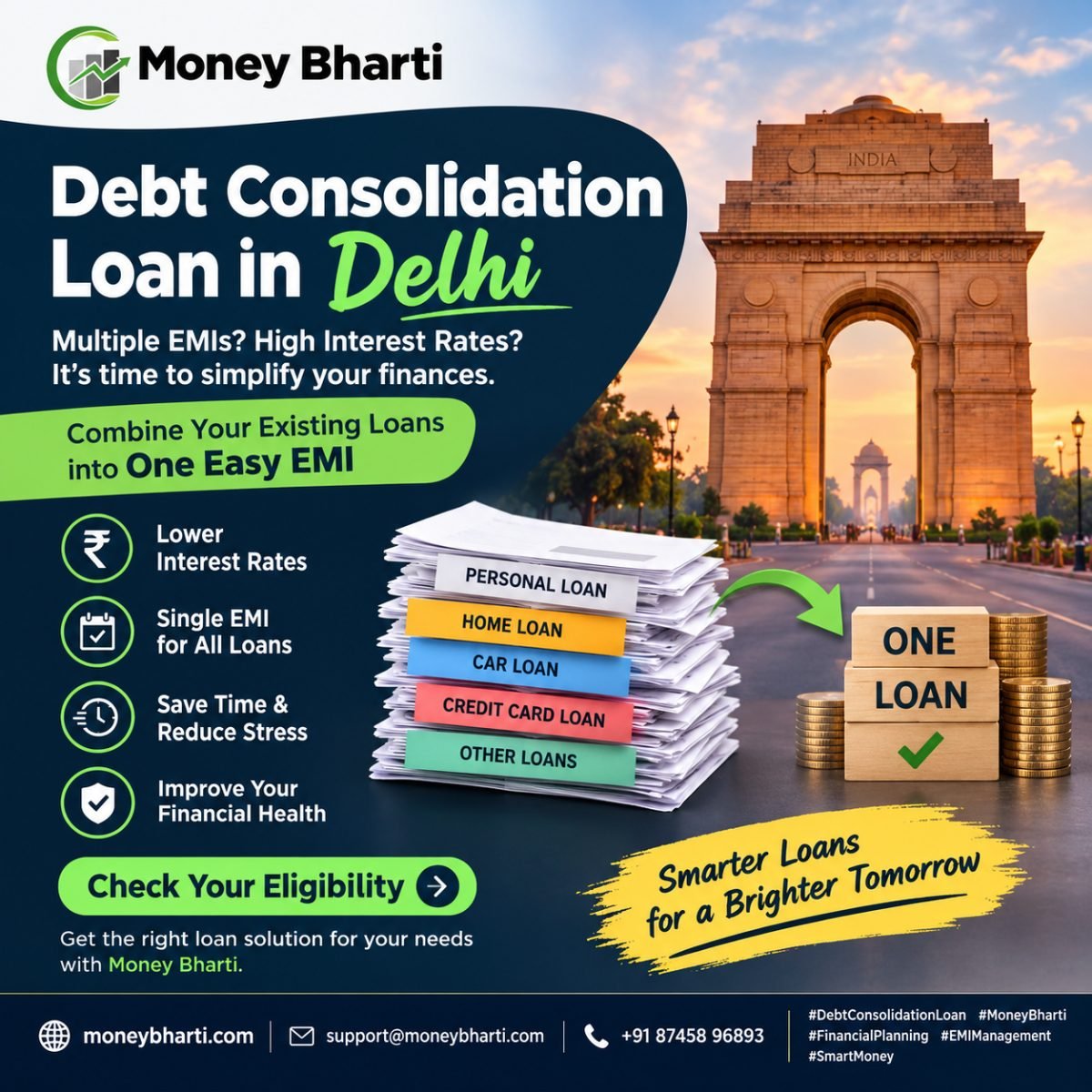
View All Cities Debt Consolidation Loan inDelhi
 Debt Consolidation Loan inMumbai
 Debt Consolidation Loan inBangalore
 Debt Consolidation Loan inHyderabad
 Debt Consolidation Loan inChennai
 Debt Consolidation Loan inPune
 Debt Consolidation Loan inJaipur
 Debt Consolidation Loan inAhmedabad
 Debt Consolidation Loan inGurgaon
 Debt Consolidation Loan inNoida
Our Banking & NBFC Partners
- HDFC BANK
- SBI
- ICICI Bank
- AXIS BANK
- kotak
- PNB
- IDFC FIRST
- TATA CAPITAL
- BAJAJ FINSERV
- Hero FinCorp
Smart Calculators for Smarter Decisions
Run the numbers before you apply — free, instant, and no sign-up needed.
EMI Saving Calculator
See how much your monthly outgo drops when you merge your existing loans and credit-card dues into one consolidated loan.
₹
₹1 Lakh₹50 Lakh
10%45%
6 Months7 Years
9%24%
12 Months7 Years
Your monthly EMI drops by
₹0
- Total interest — now
- ₹0
- Total interest — after
- ₹0
- Lifetime interest saved
- ₹0
Eligibility Criteria
Basic requirements across our lending partners. Meeting these does not guarantee approval — each lender applies its own credit policy.
Salaried Applicants
- Age
- 21 – 60 years
- Minimum Net Income
- ₹25,000 / month
- Work Experience
- 2+ years, 6 months in current job
- CIBIL Score
- 700 and above preferred
- Employer Type
- Private, Public or MNC
- Loan Amount
- ₹50,000 – ₹50 Lakh
Self-Employed Applicants
- Age
- 25 – 65 years
- Minimum Annual Turnover
- ₹12 Lakh
- Business Vintage
- 3+ years in the same business
- CIBIL Score
- 700 and above preferred
- ITR Filing
- Last 2 years, audited
- Loan Amount
- ₹1 Lakh – ₹50 Lakh
Documents Required
Keep soft copies ready — most applications are approved the same day when documents are complete.
Identity Proof
- PAN Card (mandatory)
- Aadhaar Card
- Passport
- Voter ID
- Driving Licence
Address Proof
- Aadhaar Card
- Electricity / Gas bill
- Rent agreement
- Passport
- Ration card
Income Proof — Salaried
- Last 3 salary slips
- Form 16 (2 years)
- Employment certificate
- Appointment letter
Income Proof — Self-Employed
- ITR with computation (2 yrs)
- Audited P&L and balance sheet
- GST returns
- Business proof / registration
Bank Statement
- Last 6 months, salary account
- Last 12 months for self-employed
- PDF with bank seal or net-banking export
Other
- 2 passport-size photographs
- Existing loan statements (for consolidation)
- Credit card outstanding summary
- Signed application form
Ready to Get Your Loan in Minutes?
Get the best loan offers from top banks & NBFCs in just 2 minutes!
- 100% Online
- Quick Approval
- Minimal Documents
Compare Our Lending Partners
Side-by-side view of what our partner banks and NBFCs offer on personal and debt consolidation loans.
Each lender's page carries its interest rate, processing fee, maximum amount and tenure — quoted against your own profile rather than a generic table.
| Lender | Apply |
|---|---|
| HDFC Bank | View |
| SBI | View |
| ICICI Bank | View |
| Axis Bank | View |
| Kotak Bank | View |
| IDFC First | View |
| IndusInd Bank | View |
| Yes Bank | View |
Rates and charges change frequently and differ by applicant, so no figure here would be true for long or true for everyone. Interest rate, processing fee, sanctioned amount and tenure are decided by each lender from your credit profile, income and its own policy. Check your eligibility above to see what these lenders actually offer you — it is a soft enquiry and does not affect your credit score.
Why Choose Money Bharti?
- Instant Approval
- RBI Registered Partners
- Lowest Interest Rates
- No Hidden Charges
- Minimal Documentation
- 24×7 Customer Support
What Our Customers Say
★
See the live rating
Borrowers rate our service on Google. Read what they say before you apply — every review there is verified by Google, not written by us.
Read reviews on GoogleWe publish customer stories only with written consent. Nothing on this page is a paid or invented review.
Latest Articles & Guides
View All Articles



Frequently Asked Questions
Everything people ask us before applying for a personal or debt consolidation loan.
What is a debt consolidation loan?
A debt consolidation loan is a single loan that pays off all your existing credit card bills, personal loans and other dues. Instead of tracking several EMIs at different interest rates, you repay one lender at one rate on one date. Because card interest often runs 36–42% a year while a consolidation loan starts near 11%, most borrowers see their monthly outgo fall sharply.
How much can I borrow, and for how long?
Our partners sanction between ₹50,000 and ₹50 Lakh with tenures from 12 to 84 months. The amount you personally qualify for depends on your net monthly income, existing EMIs and credit score — lenders usually keep your total EMIs under 50–55% of your take-home pay.
What CIBIL score do I need?
700 and above gets you the widest choice and the best rates. Between 650 and 700 you will still receive offers, though at a higher rate. Below 650 the options narrow considerably, but some NBFC partners do lend against a strong income profile or with a co-applicant. Checking your eligibility on Money Bharti is a soft enquiry and does not reduce your score.
How long does approval and disbursal take?
Eligibility results are instant. Once you submit complete documents, most partners approve within 24 hours and credit the amount in 24–72 hours. Incomplete bank statements or income proof are the most common cause of delay, so upload clear, full-page PDFs.
Does a longer tenure actually save me money?
It lowers your monthly EMI, but not necessarily your total cost. Stretching repayment over more months means interest accrues for longer, so the lifetime interest can end up higher even at a lower rate. Our EMI Saving Calculator shows both numbers — the monthly reduction and the lifetime interest difference — so you can judge the trade-off honestly.
What charges apply apart from interest?
Expect a processing fee of roughly 1–3% of the sanctioned amount, plus GST. Some lenders levy foreclosure or part-prepayment charges if you close early, and a penalty on bounced instalments. Ask for the complete schedule of charges in writing before you sign — Money Bharti charges you nothing for comparing offers.
Can I prepay or foreclose the loan?
Yes. Most partners allow foreclosure after 6–12 EMIs. Charges vary from nil to about 4% of the outstanding principal depending on the lender and whether the loan is at a floating or fixed rate. If you expect a bonus or lump sum, choose a lender with low prepayment charges upfront.
Do I need collateral or a guarantor?
No. Personal and debt consolidation loans are unsecured, so no property, gold or security is pledged. A guarantor or co-applicant is optional and is usually suggested only when your income or credit score is borderline, where it can improve both approval odds and the offered rate.
Is Money Bharti a lender?
No. Money Bharti is an online loan marketplace. We compare offers from 100+ RBI-registered banks and NBFCs and connect you with the one that fits. The loan agreement is always between you and the lender, and all lending terms are set by them.
Personal Loan & Debt Consolidation Loan in India — A Practical Guide
A personal loan is the most flexible form of credit available in India. It is unsecured, which means you pledge no property or gold, and the lender places no restriction on how the money is used — a wedding, a medical bill, home renovation, tuition fees or clearing older debt. Because there is no security, the lender prices the loan on your credit profile alone, which is why your CIBIL score and income stability matter more here than for any other product. What you can borrow is decided by your salary against your existing EMIs, and what it costs is decided by how lenders set your rate.
When a debt consolidation loan makes sense
Credit card revolving balances in India typically carry 36–42% annual interest. If you are paying the minimum due each month on two or three cards, most of that payment goes to interest and the principal barely moves. A debt consolidation loan at 11–14% replaces those balances with a single instalment at a far lower rate, and gives you a fixed end date instead of an open-ended balance.
It is worth doing when the interest on your existing debt is meaningfully higher than the rate you are offered, when you are managing three or more separate EMIs, or when a missed due date has become a real risk. It is not a good idea if you intend to keep using the cards you just paid off — you would then be servicing both the new loan and fresh card debt. If your problem is a single expensive loan rather than several, a balance transfer is usually the cheaper move, and the difference between the two is worth ten minutes of your time.
How lenders assess your application
Three things drive the decision. First, your credit score and repayment history — a score above 700 opens the widest set of offers, and we keep a separate guide for borrowers at exactly that threshold. Second, your fixed obligation to income ratio: lenders want your total EMIs, including the new one, to stay under roughly 50–55% of net monthly income. You can work out your own ceiling with the eligibility calculator, which applies that same test and counts credit card balances the way lenders do. Third, the stability of your income — salaried applicants are assessed on employer category and job tenure, self-employed applicants on business vintage and filed ITRs. If your income is genuine but hard to document, the routes that still work are set out for applicants without a salary slip and those without ITR.
A score below 650 narrows the field but does not close it. Some NBFC partners lend against a strong income profile or a co-applicant, usually at a higher rate; the practical options are set out in our note on borrowing with a low CIBIL score. What you should avoid is applying to several banks at once to test the water — each direct application logs a hard enquiry, and a cluster of them pushes the score down further.
What you need, and how long it takes
For a salaried applicant the paperwork is short: PAN and Aadhaar, three months of salary slips, six months of bank statements for the salary account, and one address proof. Self-employed applicants are asked for two years of ITRs with computation, business proof and twelve months of bank statements. Eligibility results are instant; once complete documents are in, most partners approve within 24 hours and disburse in 24–72 hours. Incomplete or cropped bank statements are the single most common reason an application stalls, so send clear, full-page PDFs the first time. The full checklist, with the mistakes that cause delays, is on our documents required page.
Choosing between offers
The headline interest rate is not the whole cost. Compare the processing fee, which commonly runs 1–3% plus GST, along with foreclosure and part-prepayment charges, late payment penalties and any insurance bundled into the loan. A loan at 11.5% with a 1% fee and free prepayment can easily cost less overall than one at 10.99% with a 3% fee and a 4% foreclosure charge. Every charge is broken down on our processing fee and charges page, and if you already hold a loan, the prepayment and balance transfer calculators show whether acting on it actually pays.
Tenure deserves the same scrutiny. A longer tenure lowers the monthly instalment, which helps cash flow, but interest accrues over more months and the lifetime cost rises. The EMI calculator shows the monthly figure, and the interest savings calculator shows what the same choice costs you across the full term. Look at both numbers before you commit to a tenure — they often point in opposite directions.
What your salary actually supports
Lenders do not work in multiples of salary, whatever the adverts imply. They cap your total EMIs at roughly half your take-home pay, subtract what you already pay, and lend against whatever is left. That is why two colleagues on identical pay are offered very different amounts. On ₹50,000 with no other EMIs that is roughly ₹10.7 lakh; add an ₹18,000 card EMI and it falls to about ₹3 lakh. We have worked the arithmetic through for every income level from ₹15,000 to ₹1 lakh a month.
What your credit score is worth in rupees
The score does not usually decide whether you are approved; it decides what you pay. On a ₹6 lakh loan over five years, the gap between a weak file and a strong one is around ₹1.6 lakh in interest — roughly a third of the total cost. Almost all of that gain sits between 650 and 750, and above 750 the returns flatten sharply. Our guide by score band sets out what each level is worth, including the two situations people find hardest — a score below 650 and no credit history at all, which are different problems with different answers.
Whether you qualify at all
The eligibility criteria are broadly the same everywhere, but what they mean in practice varies a great deal. There are separate guides for government employees, women and borrowers who already have a loan running. Before applying anywhere, it is worth putting your own figures through the EMI calculator so you know what the instalment looks like over the full term rather than just in month one.
Guides for your situation
Lending is not one rule applied evenly, and we keep a guide for each of the main professions. Doctors and chartered accountants get dedicated professional programmes with higher limits; for engineers the employer's grade moves the rate more than the degree does; for teachers it is the school rather than the salary. Police and defence personnel hold two of the strongest salaried profiles a lender sees, and pensioners are better served than most people expect.
Lenders differ just as much. SBI and PNB want the salary or pension account with them; Axis asks its own customers for roughly 40% less income than an outsider; Poonawalla Fincorp needs only a month with your current employer where most want six. We keep a guide for each of the major lenders — the full set is on our banks and NBFC pages. Reading the right one first is worth ten minutes, because applying to a lender whose criteria you do not meet costs you a hard enquiry and lowers the score you will need for the next attempt.
How Money Bharti fits in
Money Bharti is a marketplace, not a lender. You fill one form, we run it past 100+ RBI-registered banks and NBFCs, and you see the offers you actually qualify for. Checking eligibility with us is a soft enquiry, so it leaves your credit score untouched. There is no fee for comparing, and the loan agreement is always signed directly between you and the lender you choose. If you would rather start from a specific bank, the comparison table above links to what each partner offers; if you would rather start from where you live, the city pages carry local documentation and branch detail.
Disclaimer: All interest rates, fees and loan amounts shown on this page are indicative and for illustration only. Final terms are determined solely by the lender based on its credit policy and your profile, and may change without notice. Nothing here is financial advice — please read your loan agreement and schedule of charges carefully before signing.
Still deciding? See what you actually qualify for.
One short form, offers from 100+ RBI-registered lenders, and a soft enquiry that leaves your credit score untouched.