Why the file is harder, and why that is not unfair
There is a common complaint that lenders treat business owners worse than salaried applicants. The rate is usually higher, the paperwork longer, and the sanctioned amount smaller for the same headline income. It can feel like a penalty for not having a boss.
It is not really about fairness. A salary is a promise from a company with its own credit record. Business income is a promise from you about yourself. The lender has to build confidence out of evidence rather than take it from an employer's name, and evidence takes more pages.
The practical consequence is worth stating plainly: your eligibility as a self-employed applicant is largely fixed by decisions taken one to three years ago — what you declared, how you banked, whether you registered. Very little of it can be improved in the month before you apply. The main eligibility page covers the universal rules; this page covers what applies only to you.
Your ITR — the number the loan is built on
Lenders assess declared profit. Not turnover, and not what the business "really" makes. For a proprietor that is net profit on the return; for a partner it is profit share plus remuneration; for a director it is salary drawn plus declared dividend.
| Business structure | What counts as your income | Usually asked for |
|---|---|---|
| Proprietorship | Net profit after expenses, from the ITR | ITR-3 or ITR-4 with computation |
| Partnership | Your profit share plus partner remuneration | Firm ITR, partnership deed, your ITR |
| Private limited | Salary drawn plus declared dividend | Company ITR, your ITR, shareholding proof |
| Professional practice | Net professional receipts after expenses | ITR, degree or practice certificate |
Most lenders average the last two or three years rather than taking the best one. A year of ₹9 lakh followed by a year of ₹5 lakh is generally read as ₹7 lakh, not ₹9 lakh. Growth helps your case; a decline gets questioned.
Filed late? It usually still counts
A belatedly filed return is generally accepted. But a return filed a few weeks before applying, for a year that closed long ago, is treated with suspicion — it looks like it was filed for the loan rather than for the tax. If you are behind on filings and expect to borrow, file early and let the return age.
The trade-off nobody explains until it is too late
This is the most consequential paragraph on this page.
Good tax planning minimises declared profit. Loan eligibility is calculated on declared profit. The two goals pull in opposite directions, and you cannot optimise both in the same year.
Take a business genuinely earning around ₹14 lakh a year. After legitimate expenses, depreciation and a well-planned return, declared profit is ₹5 lakh. The owner thinks of himself as a ₹14 lakh earner. A lender assesses him as a ₹5 lakh earner — roughly ₹42,000 a month — and sizes the loan accordingly.
If borrowing matters more
- Declare closer to actual profit for two years before you plan to borrow
- Route every receipt through the business account
- Keep drawings visible and regular rather than lumpy
- Treat the extra tax as the price of credit access
If tax saving matters more
- Expect eligibility on the declared figure, not the real one
- Plan for a smaller loan, or a secured one against property
- Consider a co-applicant with documented salaried income
- Do not expect an underwriter to accept "the real profit is higher"
Neither column is wrong. What causes disappointment is choosing the second and expecting the first.
Twelve months of banking — where the file is really won
Salaried applicants send six months of statements. You will be asked for twelve, and they carry more weight than the ITR does. The return tells a lender what you declared. The statements tell them whether it is actually happening.
- Are credits regular, or three big ones a year? Steady inflow reads as a working business. Lumpy inflow reads as risk, even at the same annual total.
- Do cheques bounce? Inward returns on a current account are taken seriously — more so than for a salaried applicant, because it suggests the business runs tight.
- Is the overdraft permanently drawn? An OD that never returns to zero is a warning sign, not a facility being used well.
- Does the average balance match the declared profit? ₹12 lakh declared with an average balance of ₹8,000 invites questions.
- Are personal and business accounts separate? Mixed accounts make the file harder to read and slower to approve.
A profitable business can lose to a modest one
Between a business declaring ₹15 lakh with erratic banking and cheque returns, and one declaring ₹8 lakh with twelve clean months of steady credits, underwriters frequently prefer the second. Predictability is what an unsecured lender is buying.
Business vintage — the gate before the gate
Most lenders want the business running at least three years, evidenced by registration date, GST history or the oldest ITR. Under two years, mainstream banks generally decline regardless of profit.
The logic is survival rates. A large share of new businesses do not last five years, and an unsecured five-year loan is a bet on the business outliving the tenure.
If you are under three years, the realistic options are a co-applicant with salaried income, a secured loan against property or deposits, or simply waiting. Some NBFCs lend at two years' vintage on strong banking, at a clearly higher rate.
If your income is seasonal
Traders around festival months, wedding-season businesses, agriculture-linked trade, tourism — all earn most of the year's money in a few months. This is normal and lenders know it, but it has to be shown rather than left to be discovered.
Send the full twelve months so the pattern is visible as a pattern. If you send six and they happen to be the quiet ones, you are assessed on the quiet ones. A short covering note explaining the cycle costs nothing and stops an underwriter guessing.
What you will be asked for
| Category | Document | Why it is asked for |
|---|---|---|
| Identity | PAN and Aadhaar | KYC and credit report lookup |
| Income | Last 2 – 3 years' ITR with computation | The figure eligibility is calculated on |
| Income | Audited P&L and balance sheet, where applicable | Scale and health of the business |
| Banking | 12 months' current account statement | Whether the declared income is really flowing |
| Business | GST returns, Shop & Establishment licence, or deed | That the business exists and is registered |
| Business | Proof of continuity — about 3 years | Vintage |
| Premises | Address proof for the business | Physical verification, where the lender does it |
The full checklist, including the salaried version, is on the documents page.
Mistakes that cost self-employed applicants the most
| Mistake | Why it hurts | Better move |
|---|---|---|
| Applying on turnover, not profit | Asking for several times what the file supports | Work from declared net profit |
| Filing back-year returns just before applying | Reads as filed for the loan | File on time and let the return age |
| Mixing personal and business accounts | Underwriter cannot separate income from transfers | Keep a clean current account |
| Sending six months instead of twelve | Seasonal pattern invisible, assessed on the worst months | Send the full year unprompted |
| Saying "my actual income is higher" | Cannot be underwritten, and weakens credibility | Apply on documented income, or add a co-applicant |
Please note
The thresholds here are indicative and reflect common practice. Each lender applies its own credit policy, weighs these factors differently, and may decline without giving a reason. Nothing on this page is a guarantee of approval or of a particular rate.
Two neighbouring situations are covered separately, because the answers genuinely differ. If you have not filed returns at all, see borrowing without an ITR. If your requirement is for the business rather than for you personally, a business loan is usually the better instrument. For the product itself, start with the personal loan guide, and use the affordability calculator to see what your declared profit supports before you apply.
Questions this page gets asked
Can I get a personal loan if I am self-employed?
Yes. Most banks and NBFCs lend to self-employed applicants with about three years of business vintage, two to three years of filed ITRs and twelve months of current account statements. The assessment is on declared profit rather than turnover.
How much loan can I get on a ₹10 lakh annual turnover?
Turnover is not what is assessed. If ₹10 lakh of turnover produces ₹3 lakh of declared profit, you are treated as earning about ₹25,000 a month, and the loan is sized against that after existing EMIs are deducted.
How many years of ITR do lenders want?
Usually the last two, often three. Most average the years rather than taking the highest, so a strong year followed by a weak one is read as the average of the two.
Can I get a loan with only one year of ITR?
Rarely from a bank. Some NBFCs will consider one year alongside strong GST filings and clean banking, at a higher rate. A co-applicant with salaried income is usually the more practical route.
Does saving tax reduce my loan eligibility?
Yes, directly. Eligibility is calculated on declared profit, so a well-optimised return lowers the number a lender works from. If you expect to borrow, declare closer to actual profit for two years beforehand.
Do I need GST registration?
Not always, but it helps considerably. Where GST applies to your business, the filings are among the strongest available proof of genuine turnover, and some lenders assess primarily on them.
My income is seasonal. Will that count against me?
Not if you show it. Send twelve months of statements so the cycle is visible, and add a short note explaining it. Sending six risks being assessed on your quietest quarter.
Is the interest rate higher for self-employed applicants?
Usually a little, because business income is less predictable than a salary. The gap narrows with longer vintage, clean banking and a strong credit score, and for established professional practices it often disappears.
See which lenders suit a self-employed profile
Vintage rules, ITR requirements and banking expectations differ sharply between banks and NBFCs, which is exactly why comparing beats applying blind. Money Bharti checks your profile against 100+ RBI-registered lenders with a soft enquiry, so your credit score is untouched and comparing costs nothing.
Check my eligibilityRelated reading
More Personal Loan Guides
Where This Page Sits
This is one page in a larger guide. The pillar covers the whole subject end to end — rates, eligibility, documents and the process — and links to every page in the silo.
Comparing products rather than digging into one? These are the main guides.
From Our Blog
 Personal Loan in Delhi: Eligibility, Rates and How to Apply
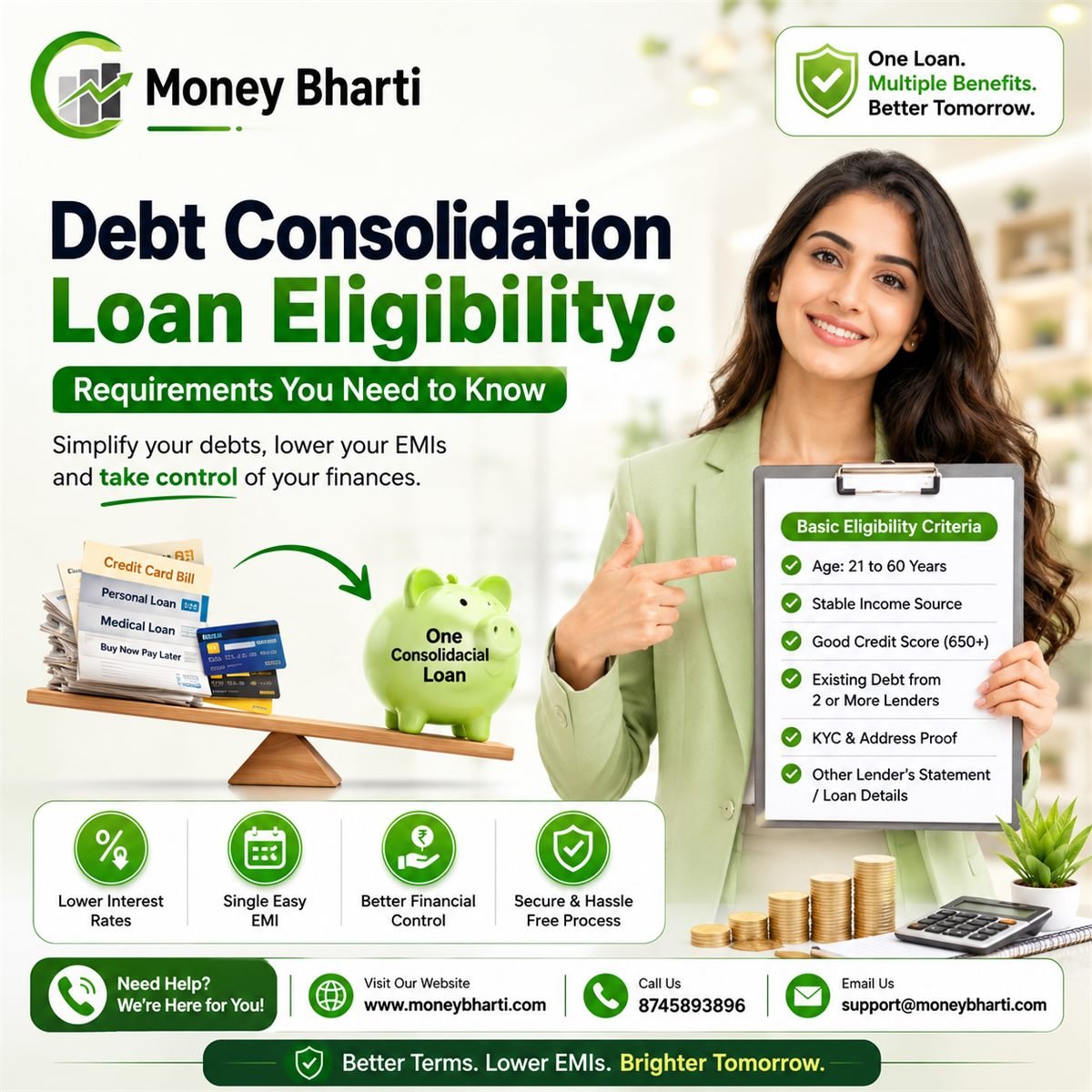 Debt Consolidation Loan Eligibility Requirements
 What Is a Debt Consolidation Loan? Benefits and Eligibility
 Debt Consolidation Loan in Chennai: Turning a Monsoon of Monthly Dues into One Steady EMI
Responsible borrowing note
All rates, fees and eligibility figures on this page are indicative market ranges for illustration and are not an offer. Approval, pricing and the sanctioned amount rest entirely with the bank or NBFC. Money Bharti is a loan marketplace, not a lender. Assess your repayment capacity honestly and read the sanction letter in full before signing. This content is general information, not financial advice.