Why a blank file makes lenders cautious
If you have never held a loan or a credit card, your credit report exists but has nothing in it. The score field shows NA, NH, or −1 depending on the bureau. None of those means bad — they mean unknown.
An unsecured lender is buying evidence that you repay borrowed money. A salary slip proves you receive money; only a credit record proves you return it. With nothing to read, the lender falls back on what it can see — income, employer, job tenure, account behaviour — and prices in the uncertainty.
The practical result is a smaller first loan at a higher rate than your income alone would suggest. That is not a judgement. It is the cost of being unknown, and it disappears with the first six months of clean repayment.
Did you know?
A score of −1 is frequently mistaken for a terrible score. It is a code, not a number: it means the bureau has no credit information on you at all. Some lenders treat it more favourably than a genuine 600, because nothing negative is on record. Others decline it outright for exactly the same reason. This is why comparing matters more for a thin file than for almost any other profile.
Who lends to a first-time borrower
| Route | Likelihood | Why |
|---|---|---|
| Your salary account bank | Best | It can see a year of credits and spending, which substitutes for a score |
| NBFCs and digital lenders | Good | Many run models built for thin files, priced accordingly |
| Loan against FD or gold | Very high | Security replaces the missing history entirely |
| With a co-applicant | High | Their record carries the file |
| A large bank, walk-in | Low | Nothing to underwrite and no relationship to fall back on |
The first row deserves emphasis. A bank that has watched your salary arrive for twelve months knows more about you than any score would tell it. That is the single most useful application you can make with a blank file.
Building a record worth having
Six months is enough to move from unknown to assessable. The order below is what works, fastest first.
- A secured credit card against a fixed deposit. The bank issues it against your own money, so approval is near-certain with no history. Use it lightly, clear it in full each month, and it reports like any other card. This is the single fastest way to create a file.
- A small loan against an FD. Same principle, and it reports as a loan rather than a card — useful because a mix of account types helps.
- A consumer durable EMI. The phone or appliance you were buying anyway, taken on a no-cost EMI, creates a small repayment record.
- Being added as an authorised user. On a family member's long-standing card. It has limited effect in India compared with some markets, but it is not nothing.
What does not work is waiting. A blank file does not improve on its own — it stays blank. The record has to be created deliberately.
Expert insight
Use a new card lightly and clear it in full, but do use it. A card that sits unused reports a zero balance and builds almost nothing. Spending roughly 10 to 20% of the limit each month and clearing it entirely produces the pattern lenders want to see: regular activity, always repaid. Six cycles of that turns a blank file into a workable one.
If you need a loan before the record exists
Secured, against your own asset
An FD, gold or an insurance policy. Cheapest by a wide margin, near-certain approval, and it builds the history while you repay. The obvious first choice if you have the asset.
Co-applicant with a record
A parent, spouse or sibling with a good score. Their history carries the assessment. Liability is joint and genuine, so agree upfront who repays if something goes wrong.
Smaller first loan
Ask for less than your income supports. A modest sanction is far easier to approve on a thin file, and once six clean EMIs are on record a top-up is straightforward.
One thing to be careful about
A blank file attracts the same predatory offers a low score does, and for the same reason — you are assumed to be inexperienced and short of options.
The rules do not change. No RBI-registered lender asks for money before approval. No genuine lender guarantees approval without assessing you. Any app demanding access to your contacts or photo gallery is not a lender, whatever its listing says. And "no CIBIL check" is not a feature — it is a warning.
Please note
How each lender treats a thin file is its own policy and varies widely — some price it near a 700 profile, others decline outright. Timelines here are indicative. Nothing on this page is a guarantee of approval or of a particular rate.
Questions this page gets asked
Can I get a personal loan with no credit history?
Yes, though usually a smaller amount at a higher rate. Your best route is the bank holding your salary account, followed by NBFCs that run models built for thin files. A secured loan against an FD or gold is near-certain.
What does a CIBIL score of −1 or NA mean?
That the bureau has no credit information about you. It is not a low score — it is the absence of one. Some lenders treat it more kindly than a genuine 600, others decline it outright.
How long does it take to build a credit score?
About six months of reported activity produces a usable score, and twelve months produces a solid one. It requires an active account — a blank file does not improve by waiting.
What is the fastest way to start?
A secured credit card against a fixed deposit. Approval is near-certain because the bank holds your own money, and it reports exactly like a regular card.
Should I take a loan just to build history?
Not an expensive unsecured one. A secured card or an FD-backed loan achieves the same thing at a fraction of the cost, and you keep the deposit.
Will a co-applicant's good score become mine?
No. Their record supports the application, and the loan then reports on both files — so repaying it well builds your history from that point. It does not transfer their score to you.
Is no history better or worse than a bad score?
Better, in the sense that nothing negative is recorded and it is fixed in months rather than years. Worse, in that some lenders will not assess you at all, whereas they would price a 620.
Does having a bank account or salary build credit?
No. Savings accounts, deposits and salary credits are not reported to credit bureaus. Only borrowing — cards, loans, EMIs — creates a credit record.
Conclusion
A blank credit file is the easiest of the difficult starting points. Nothing has to be undone, only built, and six months of deliberate activity is usually enough.
If you can wait, open a secured card against a deposit, use it lightly, clear it in full, and apply properly in six months at a materially better rate. If you cannot wait, borrow against an asset or with a co-applicant, keep the amount small, and let those six clean EMIs do the work for the next loan.
Related reading: borrowing with a low score, at 650, the eligibility criteria, and the personal loan guide. If you are salaried, the salaried guide covers what your employer and tenure contribute when a score cannot.
See who assesses a thin file, and who does not
Policies on no-history applicants differ more than on almost any other profile — some lenders price you near a 700, others will not look. Money Bharti checks your profile against 100+ RBI-registered lenders with a soft enquiry, so nothing is recorded against you and comparing costs nothing.
Check my eligibilityRelated reading
More Personal Loan Guides
Where This Page Sits
This is one page in a larger guide. The pillar covers the whole subject end to end — rates, eligibility, documents and the process — and links to every page in the silo.
Comparing products rather than digging into one? These are the main guides.
From Our Blog
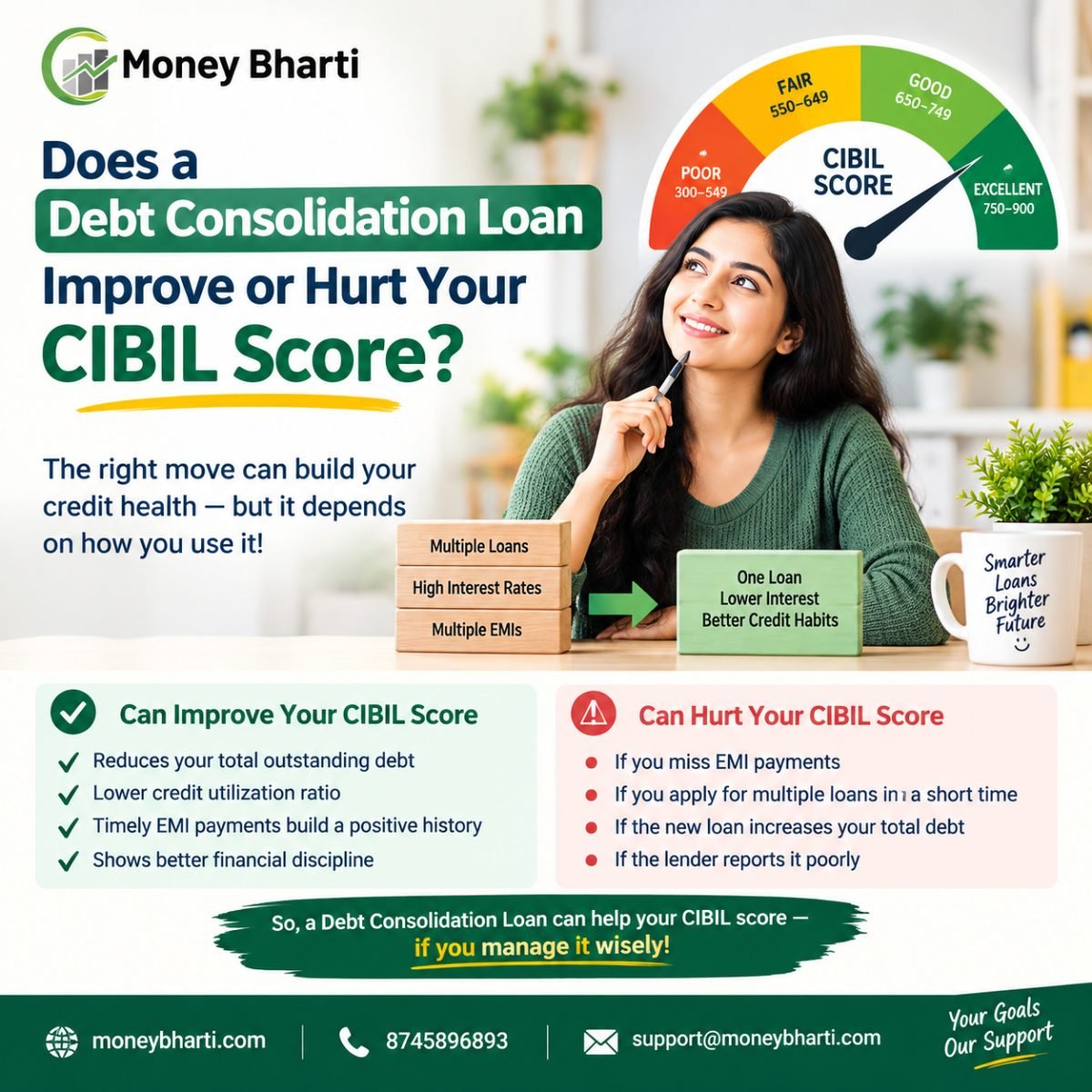 Does a Debt Consolidation Loan Improve or Hurt Your CIBIL Score?
 Best Credit Card Debt Consolidation Options in India
 Credit Card Debt Relief Programs: How They Work in India
 Credit Card Consolidation Programs: The Complete Guide
Responsible borrowing note
All rates, fees and eligibility figures on this page are indicative market ranges for illustration and are not an offer. Approval, pricing and the sanctioned amount rest entirely with the bank or NBFC. Money Bharti is a loan marketplace, not a lender. Assess your repayment capacity honestly and read the sanction letter in full before signing. This content is general information, not financial advice.