Why files come back, in five lines
- Screenshots instead of bank PDFs — the single commonest rejection.
- Five months when six were asked for, or a statement ending weeks ago.
- Name spelled differently across PAN, bank and payslip.
- Password-locked PDFs sent without the password.
- The wrong account — the one you save in, not the one salary lands in.
The short answer
PAN, Aadhaar, the last three salary slips, six months of bank statements showing salary credits, a current address proof and a cancelled cheque. Have all six ready as proper PDFs before you apply and a three-day approval usually becomes a one-day one.
The checklist, with the detail that matters
PAN card
Non-negotiable. It is how the lender pulls your credit report, so there is no route around it. The name on the PAN should match the name on your bank account and salary slips. If you married and changed your name on one but not the others, sort that out first — mismatched names are a slow, avoidable back-and-forth.
Aadhaar
Used for KYC, and increasingly for the video KYC that replaces a branch visit. Your mobile number must be the one linked to Aadhaar, because the OTP goes there. People applying from a second phone number get stuck at this step constantly.
Last three salary slips
They need to be your employer's own slips, showing gross, deductions and net separately. A plain-text email from your manager saying what you earn is not a salary slip and will be sent back.
If your company does not issue slips — smaller firms often do not — say so at the start rather than at the end. Some lenders accept Form 16 plus bank statements instead. Finding that out on day one is worth far more than discovering it on day three.
Six months of bank statements
This is the document that actually decides the loan, and the one that most often causes trouble. Requirements:
- The account your salary is credited to. Not the account you save in, not the joint account — the one the salary lands in.
- Bank-generated PDF. Downloaded from net banking or issued by the branch, with the bank's own formatting intact.
- Full six months, ending within the last few days. A statement that stops six weeks ago gets rejected for being stale.
Many lenders now fetch this directly through account aggregator consent, which removes the problem entirely and is faster. If that option is offered, take it.
Address proof
Aadhaar usually covers it. If your current address differs from the Aadhaar address — which is extremely common for people who have moved cities for work — a registered rent agreement, a recent utility bill or a passport in your current address will do. Do not simply submit the old Aadhaar and hope; the address is verified, and a mismatch stalls the file.
Cancelled cheque or bank passbook front page
Needed to set up disbursal and the auto-debit mandate. Your name must be printed on the cheque. If your chequebook does not carry the printed name, the passbook front page works instead.
The five reasons files actually get sent back
- Screenshots instead of PDFs. The single most common one. A phone screenshot of net banking is not a bank statement, however clear it looks.
- A statement that is one month short. Five months when six were asked for. Nobody notices until the file is already in underwriting.
- Name mismatch across documents. PAN says one spelling, the bank account another. Small differences count.
- Password-protected PDFs sent without the password. Bank statements often download locked. Remove the protection or send the password in the same message.
- Salary slips that do not match the bank credits. If the slip says ₹42,000 net and ₹38,000 arrives, expect a question. Usually there is an innocent explanation — a recovery, an advance — but you have to give it.
What speeds things up
Scan or download everything into one folder before you start the application, named plainly: PAN.pdf, Aadhaar.pdf, Salary-Slip-May.pdf and so on. Lenders process files, not attachments named IMG_20260803_114522.jpg. It sounds trivial. It reliably saves a day.
Once your documents are in order, check whether you clear the five eligibility checks and how much you can realistically borrow. If your salary is paid in cash, read the cash salary page first — the document list is different.
Documents are the last step, not the first. If you have not yet checked whether the product fits your situation, start at the advance salary loan guide and work forward from there — gathering papers for a loan you should not be taking is a wasted evening.
What each document is actually checked for
Every document on the list answers one specific question. Knowing which question yours is answering explains why the format matters so much.
| Document | The question it answers | What fails it |
|---|---|---|
| PAN | Who are you, and what does your credit report say? | Name spelled differently from your bank account |
| Aadhaar | Are you really this person, and where do you live? | Mobile number not linked, so the OTP never arrives |
| Salary slips | What are you paid, and by whom? | A letter or email instead of the employer's own slip |
| Bank statements | Does that salary actually arrive, month after month? | Screenshots, short periods, or the wrong account |
| Address proof | Can you be found if something goes wrong? | An old Aadhaar address you no longer live at |
| Cancelled cheque | Where do we send the money and take the EMI from? | No printed name on the cheque leaf |
The one document that decides the loan
The bank statement. Everything else confirms identity or fills a form field; the statement is what is actually being lent against. If you get one thing right, make it a clean bank-generated PDF covering the full six months and ending within the last few days. The eligibility page sets out exactly what an underwriter reads in it.
Account Aggregator — skip the PDFs entirely
Instead of downloading and uploading statements, most lenders now offer consent-based fetching through the RBI-regulated Account Aggregator framework. You approve on your own bank's page, for a stated purpose and a limited period, and you can revoke it afterwards.
Take it whenever it is offered. It is faster, it is safer than emailing files, and it removes the single most common cause of rejection at a stroke — because the data arrives in the exact format the lender's system expects, already verified.
One rule that never bends
A lender must never ask for your net banking password. Consent-based fetching exists precisely so your password stays with you. Any request for it is fraud, whatever the screen says and however official the app looks. The same goes for OTPs — a genuine lender asks you to enter one, never to read one out.
If your employer does not issue salary slips
Smaller firms often do not, and it is far more workable than people assume — provided you say so at the start rather than after three days of silence.
What lenders will usually accept instead:
- Form 16 alongside bank statements. This is the strongest substitute, because it is filed with the tax department rather than written by your employer for you.
- An employment certificate on company letterhead, with the salary stated, signed and stamped.
- An appointment letter plus bank statements showing the salary actually arriving at the stated figure.
- An offer letter, where you have recently joined and the credits have only just begun.
Expect a slightly smaller amount and a slightly higher rate. What does not work is submitting nothing and hoping the bank statement carries the file alone — the lender needs to know who the remitter is and what they claim to pay you. The cash salary page covers the harder case where the money never reaches a bank at all.
Name and address mismatches — the slow killer
Nothing on a file is rejected for this. It simply stalls, and stalls again, and a two-day approval becomes a two-week one.
Names
Your PAN, your bank account and your salary slips should carry the same name. Common causes of divergence: a marriage that updated one document but not the others, an initial expanded in one place and abbreviated in another, or a spelling the bank entered differently when the account was opened.
Fix the mismatch before applying if you can. If you cannot, flag it in the first conversation and offer a supporting document — a marriage certificate, a gazette notification, or an affidavit. Explained upfront it is a footnote; discovered in underwriting it is a query that costs days.
Addresses
Aadhaar carrying your parents' address while you live in another city is extremely common and entirely manageable. Submit a separate current address proof: a registered rent agreement, a recent utility bill, or a passport showing the current address.
What causes the delay is submitting the outdated Aadhaar alone and hoping nobody checks. The address is verified, and the mismatch surfaces at exactly the point where you thought the file was done.
A clean file, day by day
This is what the process looks like when the documents are right the first time — and where each extra day comes from when they are not.
| When | What happens | What delays it |
|---|---|---|
| Hour 1 | Application and soft eligibility check | Nothing — this part is automated |
| Hour 1–2 | KYC, usually by video call | Applying from a non-Aadhaar-linked number |
| Hour 2–4 | Bank data fetched or PDFs uploaded | Screenshots, short periods, password-locked files |
| Hour 4–24 | Underwriting and any queries | Name mismatch, slip not matching credits |
| Day 1–2 | Sanction and eSign | Employment verification call unanswered |
| Day 1–3 | Disbursal | The banking transfer window, not the lender |
Notice how many of the delays sit on your side of the process. That is the good news — almost every one of them is avoidable with an hour of preparation. The same-day page covers the timing in more detail, including the transfer cut-off that catches out evening applicants.
Your file is ready when
- Six months of bank-generated PDFs, ending this week
- Three salary slips from your employer
- PAN and bank account names match exactly
- Current address proof, not just an old Aadhaar
- Aadhaar-linked phone in your hand
Sort this out first if
- Your statements are screenshots or photos
- The PDF is password-protected
- The statement stops more than a week ago
- Your slip figure and bank credit do not match
- You are submitting a savings account, not the salary account
What still needs paper
Very little, for an unsecured salary advance. Aadhaar-based eSign is legally valid and accepted almost everywhere, and video KYC has replaced the branch visit.
Where physical steps survive, it is usually one of two things: a wet-signed mandate form at a few older banks, or original documents for a secured product — which a salary advance is not. If a lender insists on couriering paperwork for a small unsecured loan, that signals an older process rather than a stricter one, and it will cost you several days.
The hour that saves a day
Before you start the application, put everything in one folder with plain names:
- PAN.pdf
- Aadhaar.pdf
- Salary-Slip-Jun.pdf, Salary-Slip-Jul.pdf, Salary-Slip-Aug.pdf
- Bank-Statement-Feb-to-Aug.pdf — password removed
- Address-Proof.pdf
- Cancelled-Cheque.pdf
Lenders process files. They do not process IMG_20260804_114522.jpg with any enthusiasm, and a file that arrives looking organised gets read as an organised borrower. It sounds like a trivial point. It reliably saves a day, and occasionally it saves the application.
More Advance Salary Loan Guides
Where This Page Sits
This is one page in a larger guide. The pillar covers the whole subject end to end — rates, eligibility, documents and the process — and links to every page in the silo.
Comparing products rather than digging into one? These are the main guides.
From Our Blog
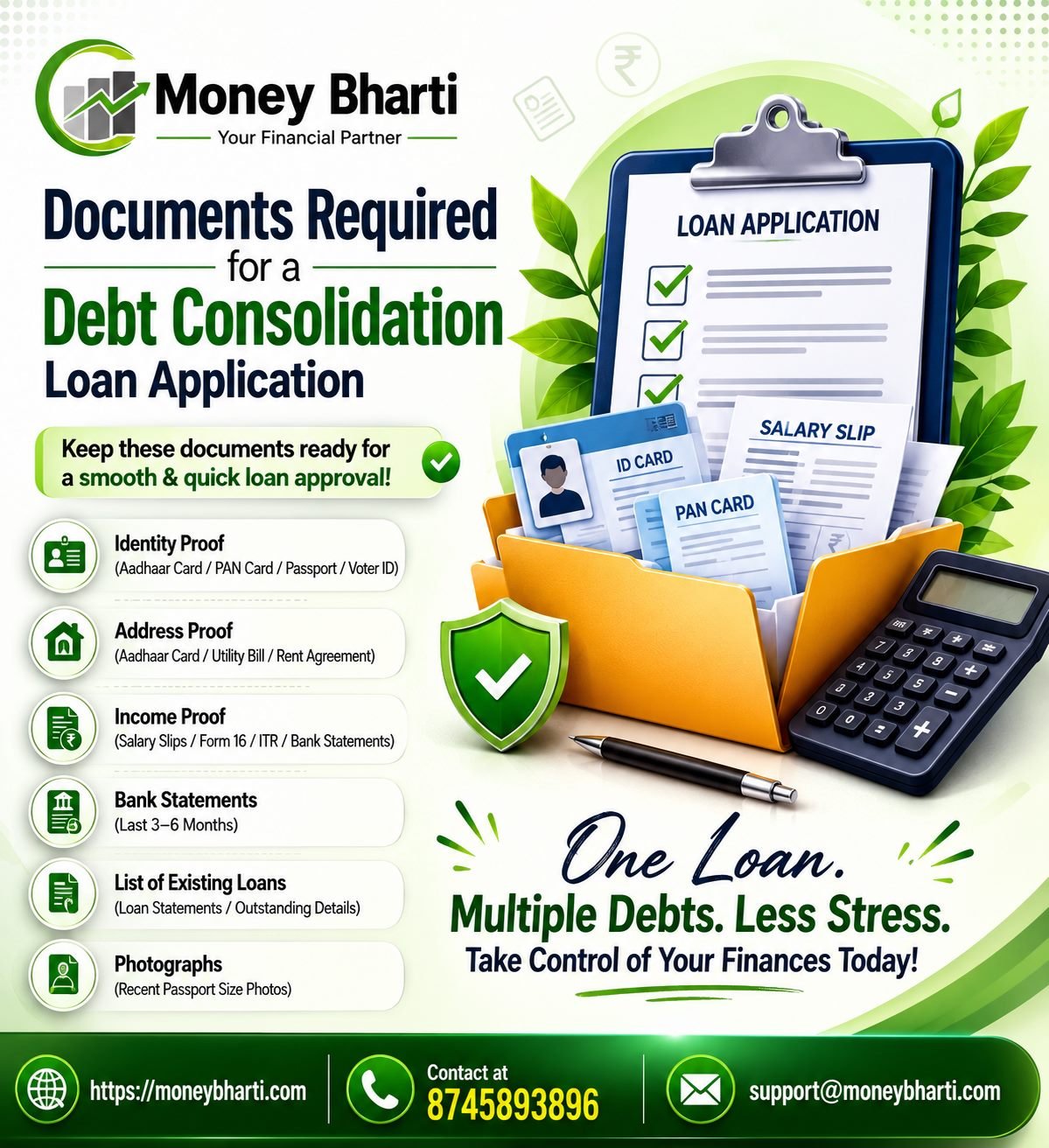 Documents Required for a Debt Consolidation Loan Application
 Debt Consolidation Loan for 700 CIBIL Score: Can You Get Approved and at What Rate? (2026 Guide)
 Best Debt Consolidation Companies in India (2026): How to Compare Lenders and Pick the Right One
 Debt Consolidation Loan in Delhi: How to Replace Credit Card, BNPL and Personal Loan Dues with One EMI
Responsible borrowing note
All rates, fees and eligibility figures on this page are indicative market ranges for illustration and are not an offer. Approval, pricing and the sanctioned amount rest entirely with the bank or NBFC. Money Bharti is a loan marketplace, not a lender. Assess your repayment capacity honestly and read the sanction letter in full before signing. This content is general information, not financial advice.