Quick Summary (30 Seconds Read)
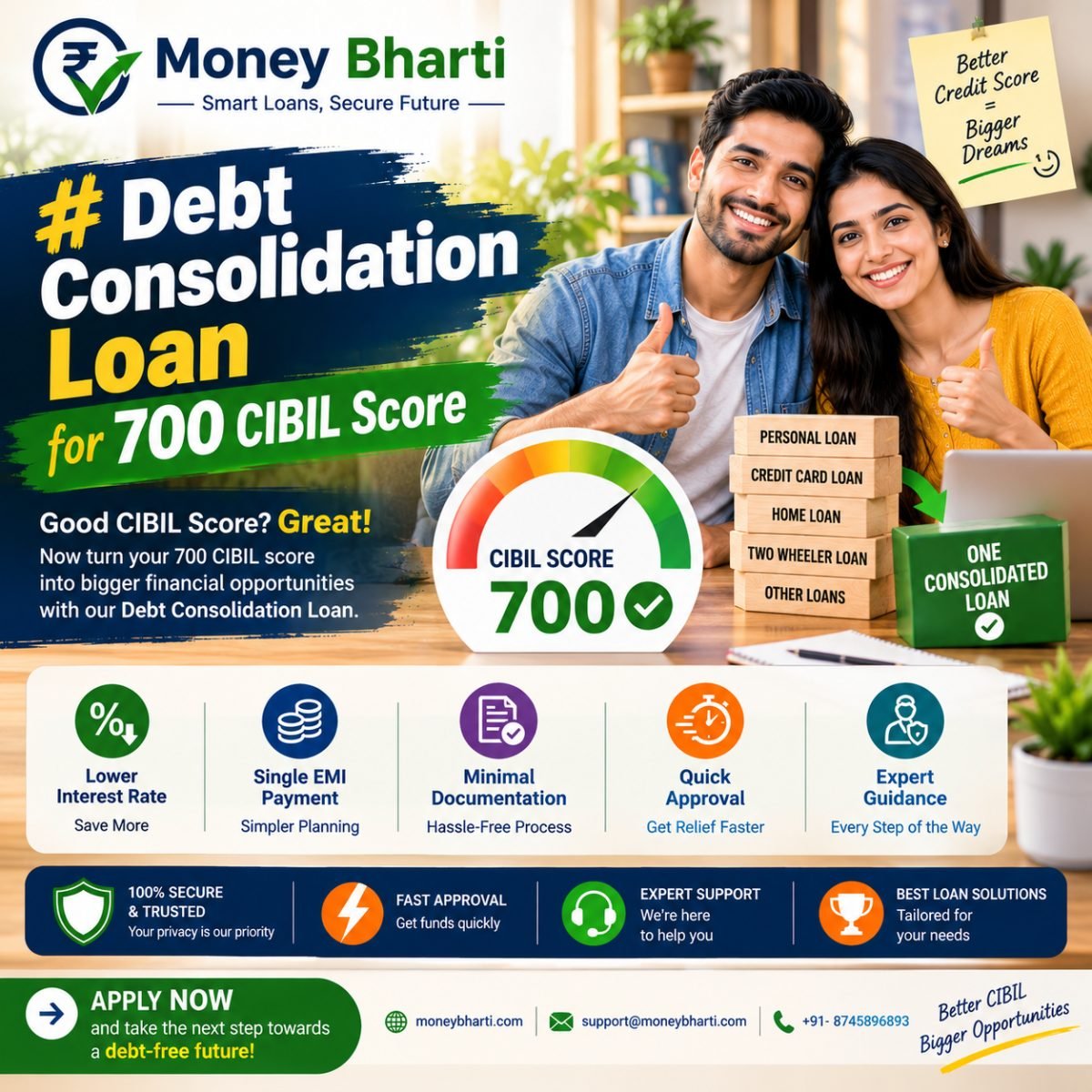
- A 700 CIBIL score is usually enough to get a debt consolidation loan, but it rarely gets you the lowest rate.
- Most lenders treat 750+ as strong and 700-749 as acceptable, so your offer is typically a few percentage points higher than a top-tier borrower's.
- In our example, ₹6.5 lakh of debt falls from ₹27,396 to ₹22,692 a month, saving about ₹1.5 lakh over three years after fees.
- On the same loan, a 700 score can cost roughly ₹40,000 more in repayment than a 780 score.
- Your income, FOIR and recent payment history matter as much as the score itself.
Problem-Based Introduction
Ananya, a QA lead in Hyderabad, has a CIBIL score of 702. She has a credit card, a personal loan and a BNPL account, and she wants to merge them. Every blog she reads says "you need 750+ for the best rates," and she is not sure whether 700 is even good enough. The honest answer is that 700 can work, but the details decide whether it works well. This guide explains what a 700 score can realistically get you, how lenders price it and how to improve your odds.
Loan Overview
A debt consolidation loan is an unsecured personal loan that clears credit card dues and other high-interest debts, so you pay one EMI instead of many. With a 700 score, you sit in the middle band that lenders treat as acceptable but not premium.
| CIBIL range | How lenders usually see it |
|---|---|
| 750 and above | Strong; best rates and fastest approvals |
| 700-749 | Acceptable; competitive but not the lowest rates |
| 650-699 | Borderline; approval possible at higher rates |
| Below 650 | Difficult; limited options |
These bands are indicative, and each lender sets its own cut-offs.
Why People Need This Loan?
- Credit card interest of 36-42% p.a. quickly outpaces repayments.
- A 700 score often comes from high utilisation or a few late payments, which consolidation can help fix.
- Several EMIs and due dates make further slips more likely.
- Paying off cards lowers utilisation, which can lift the score over time.
- Many borrowers want one EMI instead of several.
Is This Loan Right For You?
- You have two or more high-interest debts totalling ₹1 lakh or more.
- Your income comfortably covers a single EMI.
- Your score is 700 or close, with no missed payments in the last 6-12 months.
- The offered rate is clearly lower than your current average rate.
- You will not use the cleared cards for new spending.
Who Should Avoid This Loan?
- Borrowers who cannot pay their EMIs at all and need a restructuring conversation first.
- Anyone whose offered rate is higher than their current blended rate.
- Borrowers with very recent defaults or settled accounts.
- Anyone with only one cheap loan, such as a home loan.
- Anyone who is not ready to stop using the cleared cards.
Key Benefits
- One EMI with a fixed end date.
- Lower interest than cards and app loans, even at a 700 score.
- Lower credit utilisation, which can help the score improve.
- No collateral for most unsecured loans.
- Clearer budgeting and fewer missed due dates.
- Prepayment is usually possible after a few EMIs.
Risks You Should Know
- A 700 score may get a rate 2-5 points higher than a 780 score.
- Processing fees of 1-3% plus GST are charged upfront.
- Hard enquiries can dip your score temporarily, and you are close to a lender cut-off.
- Several applications in a short time can push a 700 score below a lender's threshold.
- A missed EMI on the new loan will damage the score you have worked for.
Loan Eligibility
| Criteria | Typical Requirement |
|---|---|
| CIBIL score | 700+ for most banks; 650+ at some NBFCs |
| Age | 21-60 years |
| Net income | ₹25,000+ per month (varies by city and lender) |
| Work experience | 1-2 years total, 6+ months with the current employer |
| FOIR | Total EMIs under ~50-55% of income |
| Payment history | No missed payments in the last 6-12 months |
| Credit utilisation | Under ~50%, ideally below 30% |
Check your numbers against the debt consolidation loan eligibility criteria before you apply.
Required Documents
- PAN and Aadhaar (KYC)
- Address proof: utility bill, rent agreement or passport
- Last 3 salary slips and 6 months' bank statement
- Form 16 or ITR
- Self-employed: 2-3 years' ITR, GST returns and business proof
- Statements for the cards and loans you want to clear
- Passport-size photographs
Interest Rates
With a score near 700, the offered rate depends on income, employer category and lender. Indicative bands:
- CIBIL 780+: ~10.5-13%
- CIBIL 720-779: ~12-16%
- CIBIL 700-719: ~14-19%
- CIBIL 680-699: ~16-21%
- Below 680: 20%+ or limited options
For current ranges, see our debt consolidation interest rates page.
Bank/NBFC Wise Interest Rate Comparison
Indicative ranges for borrowers with a score around 700. Individual offers vary.
| Lender type | Indicative rate (p.a.) | Processing fee | Notes |
|---|---|---|---|
| Public sector banks | ~12-16% | ~0.5-1.5% | Low cost; may be stricter on score |
| Private banks | ~13-19% | ~1-2.5% | Good fit with stable salary |
| Large NBFCs | ~14-24% | ~1-3% | More flexible at 700 and below |
| Fintech lenders | ~16-30% | ~2-5% | Quick but costlier |
For a lender-by-lender view, see our bank-wise personal loan interest rates, and the pages for the HDFC Bank debt consolidation loan and the SBI debt consolidation loan.
Processing Fees & Hidden Charges
- Processing fee: 1-3% of the loan plus 18% GST
- Foreclosure or part-prepayment: nil to about 4% of outstanding principal
- Late payment: typically around 2% per month on overdue amounts
- EMI bounce charges: a fixed fee per failed debit
- Bundled insurance or add-ons: ask whether they are optional
- Documentation and stamp charges: confirm upfront
Our processing fee and charges guide explains what to expect.
EMI Calculation with Example
Illustrative figures using the standard EMI formula.
Ananya's existing debts (₹6,50,000 total):
| Debt | Amount | Rate | Remaining tenure | EMI |
|---|---|---|---|---|
| Credit card | ₹2,50,000 | 40% | 36 months | ₹12,028 |
| Personal loan | ₹2,50,000 | 19% | 36 months | ₹9,162 |
| BNPL / app loan | ₹1,50,000 | 28% | 36 months | ₹6,206 |
| Total | ₹6,50,000 | ₹27,396 |
New consolidation loan: ₹6,50,000 at 15.5% for 36 months, EMI ≈ ₹22,692.
Formula: EMI = P × r × (1+r)^n / ((1+r)^n − 1), where r = annual rate ÷ 12 ÷ 100.
Try your own numbers in the debt consolidation EMI calculator.
EMI Comparison (Before vs After)
| Before | After | |
|---|---|---|
| Number of EMIs | 3 | 1 |
| Monthly outgo | ₹27,396 | ₹22,692 |
| Share of ₹85,000 income (FOIR) | ~32.2% | ~26.7% |
| Total repayment (36 months) | ₹9,86,256 | ₹8,16,912 |
| Total interest | ₹3,36,256 | ₹1,66,912 |
Monthly & Total Savings Example
- Monthly saving: ₹27,396 − ₹22,692 = ₹4,704
- Total repayment saving: ₹9,86,256 − ₹8,16,912 = ₹1,69,344
- Processing fee (2% + GST): about ₹15,340
- Net saving: roughly ₹1.5 lakh over three years
What the score costs you: the same ₹6.5 lakh at 12% (typical for a 780+ profile) would be about ₹21,590 a month, or ₹7,77,240 in total. At 15.5%, Ananya pays about ₹40,000 more over three years. That gap is the real price of the 50-80 points between 700 and 780.
Loan Amount & Tenure Options
On ₹6,50,000 at 15.5% p.a.
| Tenure | EMI | Total repayment |
|---|---|---|
| 24 months | ~₹31,670 | ~₹7,60,080 |
| 36 months | ~₹22,692 | ~₹8,16,912 |
| 48 months | ~₹18,252 | ~₹8,76,096 |
| 60 months | ~₹15,634 | ~₹9,38,040 |
Choose the shortest tenure whose EMI you can pay without strain. If your score improves after a year, you may be able to refinance at a lower rate, so check the foreclosure terms first.
Step-by-Step Application Process
- Check your CIBIL report and fix any errors before you apply.
- List all debts with amounts, rates, EMIs and foreclosure charges.
- Reduce card utilisation if you can, even a little, before applying.
- Calculate your FOIR to see how large an EMI you can carry.
- Use soft-enquiry eligibility checks to compare offers without hurting your score.
- Apply to your best one or two lenders, not ten.
- Complete KYC and the e-mandate on the lender's official channel.
- Read the sanction letter and the Key Fact Statement.
- Clear the old debts immediately and collect No Dues Certificates.
- Set up auto-debit and never miss an EMI on the new loan.
Processing Time & Disbursement Timeline
| Lender type | Approval | Disbursal |
|---|---|---|
| Fintech | Minutes to hours | Same day to 2 days |
| NBFC | 1-2 days | 2-3 days |
| Private bank | 1-3 days | 2-4 days |
| Public bank | 3-7 days | 5-10 days |
Customer Case Study
Illustrative case; names and figures are representative, not a specific customer.
Ananya Rao, 30, QA lead, Hyderabad. Net salary ₹85,000. Three debts totalling ₹6.5 lakh, with EMIs of ₹27,396 (about 32% of income). Her score was 702. She checked eligibility with soft enquiries, applied to one private bank and one NBFC, and chose the bank's 15.5% offer. She cleared all three debts within five days and now pays ₹22,692. Twelve months of on-time EMIs and lower card utilisation lifted her score to the mid-700s, which she plans to use to refinance at a lower rate.
Customer Persona Example
| Attribute | Profile |
|---|---|
| Name | Ananya, 30 |
| Location | Hyderabad |
| Occupation | Salaried, QA lead |
| Income | ₹85,000 per month |
| CIBIL score | ~702 |
| Pain point | Unsure whether 700 is good enough |
| Goal | One EMI and a higher score within a year |
| Fear | Rejection or a very high rate |
Loan Approval Journey (Timeline)
- Day 0: CIBIL report review and debt list
- Day 1: Soft-enquiry checks, lender comparison, application
- Day 2: Document verification
- Day 3: Sanction letter and e-sign
- Day 4-5: Disbursal and payoff of old debts
- Day 10-15: No Dues Certificates received
- Day 30-45: Credit report reflects closures
- Month 6-12: Score improves with on-time payments
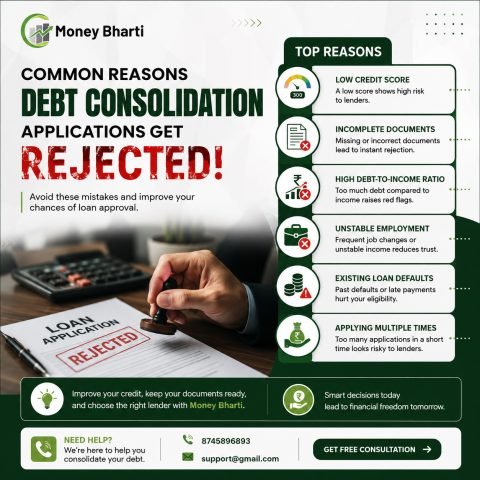
Common Loan Rejection Reasons
- Score dips below a lender's cut-off after enquiries
- FOIR too high (EMIs above ~55% of income)
- A missed payment or settled account in the last 6-12 months
- Very high credit utilisation
- Too many applications in a short period
- Unstable job or unverifiable address
- Mismatched details across documents
Tips to Increase Approval Chances
- Pay down card balances to bring utilisation under 30%.
- Avoid new credit applications for 2-3 months before applying.
- Use soft-enquiry eligibility tools to see offers without a hard hit.
- Clear any overdue amounts and get proof.
- Add a co-applicant with a strong profile if needed.
- Apply to the lender where you already have a salary account.
- Follow our guide to improve your credit score with debt consolidation.
Eligibility Score / Approval Score
Score yourself:
| Factor | Points |
|---|---|
| CIBIL 750+ | 30 |
| CIBIL 700-749 | 20 |
| CIBIL 650-699 | 10 |
| FOIR under 40% | 25 |
| FOIR 40-55% | 15 |
| Job or business stability of 2+ years | 20 |
| Salary account with the lender | 10 |
| No missed payments in 12 months | 15 |
80+: strong chance. 55-79: moderate chance, likely at a higher rate. Below 55: improve FOIR and payment history first.
A 700 score with good income, low FOIR and a clean 12-month record can score 70-80 and still get approved.
Loan Cost Breakdown
For Ananya's ₹6,50,000, 36 months, 15.5%:
| Component | Amount |
|---|---|
| Principal | ₹6,50,000 |
| Total interest | ₹1,66,912 |
| Processing fee + GST | ₹15,340 |
Total cost of borrowing |
₹1,82,252 |
Pros & Cons
| Pros | Cons |
|---|---|
| One EMI | Rate is higher than for 750+ scores |
| Lower interest than cards | Upfront fees |
| Can help the score recover | Hard enquiry on your report |
| Fixed payoff date | Risk of re-borrowing |
| No collateral | Penalties on late payment |
Myths vs Facts
| Myth | Fact |
|---|---|
| You need 750+ to get any consolidation loan | 700 often works, usually at a higher rate |
| A 700 score means automatic approval | Income, FOIR and recent payment history also matter |
| Applying to many lenders improves my odds | Many hard enquiries can lower your score |
| Consolidation always lowers my score | There is a small dip, and it usually recovers with on-time EMIs |
| I should settle my debts to fix my score | Settlement damages your record far more than consolidation |
Loan Comparison Table (vs Other Loans)
| Option | Rate (indicative) | Best for | Watch out |
|---|---|---|---|
| Consolidation personal loan | 12-24% at ~700 | Several unsecured debts | Fees, higher rate |
| Credit card balance transfer | Low introductory rate | One card, short payoff | Rate jumps later |
| Loan against property | ~9-13% | Large debts, lower rate | Property at risk |
| Gold loan | ~9-20% | Small, quick needs | Gold at risk |
| Debt settlement | N/A | Last resort | Severe score damage |
Read debt consolidation vs balance transfer and debt consolidation vs debt settlement before you decide.
Latest RBI Guidelines & Compliance
Confirm current rules at rbi.org.in. Key principles that apply:
- Key Fact Statement (KFS): you are entitled to a standard summary of the APR, fees and total cost before you sign.
- Regulated lenders only: check that the bank or NBFC is registered with the RBI.
- Digital lending rules: disbursal and repayment must flow between your bank account and the regulated lender.
- Cooling-off period: digital loans carry a short exit window if you repay the principal and proportionate interest.
- Credit reporting: lenders report to credit bureaus regularly, and you can dispute errors in your report.
- Fair recovery practices: agents must follow rules on timing and conduct.
Financial Expert Opinion
Editorial note: replace with a named, attributable expert quote before publishing.
Credit counsellors commonly advise borrowers near 700 to fix utilisation and payment history before applying, use soft-enquiry checks to compare offers and avoid a burst of applications. A few months of preparation can move you into a better rate band and save thousands of rupees.
Latest Market Trends & Statistics
Add current figures with sources before publishing.
- Lenders are tightening underwriting for unsecured loans, with more weight on recent payment behaviour.
- Soft-enquiry eligibility checks are now widely offered by digital lenders.
- Risk-based pricing means rate gaps between score bands remain meaningful.
- Regulators have flagged unsecured retail credit growth, which affects lender appetite.
Frequently Asked Questions
1. Can I get a debt consolidation loan with a 700 CIBIL score? Yes. Many banks and NBFCs approve at 700, usually at a mid-range rate.
2. Is 700 a good CIBIL score? It is generally considered acceptable to good, but below the 750+ that earns the best rates.
3. What interest rate can I expect at 700? Often around 14-19% for salaried borrowers, depending on income and lender.
4. Will my score drop if I apply? A hard enquiry can cause a small, temporary dip. Soft checks do not.
5. How many lenders should I apply to? One or two, after comparing offers with soft-enquiry tools.
6. Can I improve my score before applying? Yes. Lowering card utilisation and clearing overdue amounts can help within a few months.
7. Does a 700 score affect the loan amount? It can. Lenders may cap the amount or require a lower FOIR.
8. Can self-employed borrowers with a 700 score apply? Yes, with ITRs, GST returns and bank statements.
9. What if I was rejected before? Find the reason, fix it and wait a few months before reapplying.
10. Will a co-applicant help? Yes, a co-applicant with a stronger profile can improve your approval odds and rate.
11. Is a balance transfer better at 700? For a single card, possibly. For several debts, a consolidation loan is simpler.
12. How fast can I get the money? From a few hours at some fintechs to about a week at public sector banks.
13. What fees should I expect? A processing fee, GST, possible foreclosure charges and late-payment penalties.
14. Can I prepay or refinance later? Usually yes. Check the foreclosure terms before signing.
15. Will the loan improve my score? On-time EMIs and lower utilisation usually help over several months.
16. Is debt settlement a good option at 700? No. It is a last resort and damages your credit record.
17. What if I cannot pay the new EMI? Contact the lender early to discuss options. Ignoring it makes things worse.
18. How do I avoid fraud? Never pay an advance "approval fee," and deal only with RBI-registered lenders and official websites.
Useful Tools (EMI, Eligibility, FOIR, etc.)
- EMI calculator: use the debt consolidation EMI calculator to compare tenures.
- FOIR calculator: FOIR = (all monthly EMIs ÷ net monthly income) × 100. Aim to stay under 50%.
- Soft-enquiry eligibility checker: see offers without a hard hit on your score.
- Credit utilisation tracker: monitor each card's balance against its limit.
- Free credit report from the bureaus once a year.
Financial Terms Glossary
- APR: annual percentage rate, the true yearly cost including fees.
- CIBIL score: a 300-900 credit score from TransUnion CIBIL.
- Credit utilisation: the share of your credit limit you are using.
- EMI: equated monthly instalment.
- FOIR: fixed obligation to income ratio.
- Hard enquiry: a credit check made when you formally apply for credit.
- Soft enquiry: a check that does not affect your score.
- KFS: Key Fact Statement.
- NBFC: non-banking financial company.
- No Dues Certificate (NDC): proof that a loan or card is fully cleared.
Related Articles
- Debt Consolidation Loan
- Credit Card Debt Consolidation Loan
- Debt Consolidation Loan Eligibility
- Improve Your Credit Score with Debt Consolidation
- Debt Consolidation vs Debt Settlement
Conclusion
A 700 CIBIL score can get you a debt consolidation loan, just not always the cheapest one. Use soft-enquiry checks to compare offers, bring card utilisation down before you apply and keep every EMI on time afterwards. Done well, the loan both cuts your monthly outgo and helps you climb toward 750+.
Next step: Check your CIBIL report, list your debts and compare offers from two or three RBI-registered lenders.
Disclaimer: This article is for information only and is not financial advice. Rates, fees and policies change; confirm with the lender and consult a qualified advisor before borrowing.