Quick summary — 30 second read
If you read nothing else
- Eight core documents for every applicant, plus entity-specific extras.
- 12 months of current account statements in the bank's own format — not a spreadsheet.
- Two to three years of ITR with computation, all filed. An unfiled latest return is a serious problem.
- Four quarters of GST returns, and they must reconcile with the banking.
- The delay is never the number of documents. It is the three or four that disagree with each other.
- Udyam registration is free and unlocks CGTMSE and scheme access. Agents charging for it are selling nothing.
- Prepare in 2 – 4 days. Secured loans need three weeks more for property papers.
The core checklist — every lender asks for these
| Document | What it proves | Common problem |
|---|---|---|
| PAN of the business and the promoters | Identity, tax linkage | Proprietorships have only a personal PAN — that is normal |
| Aadhaar of promoters / directors | KYC | Name spelled differently from PAN |
| Business address proof | Where you trade | Bill in a landlord's name with no rent agreement |
| Business registration | Legal existence | Certificate expired or never renewed |
| 12 months bank statements | Real cash flow | Personal account submitted instead of current |
| ITR, 2 – 3 years with computation | Declared income | Latest year not yet filed |
| GST returns, 4 quarters | Sales, independently filed | Nil returns in an active quarter |
| Udyam registration | MSME status, scheme access | Not registered at all — it is free and takes minutes |
What changes with your entity type
| Entity | Additional documents |
|---|---|
| Proprietorship | Shop & establishment licence or Udyam certificate; the proprietor's personal ITR serves as the business ITR |
| Partnership firm | Partnership deed, firm PAN, registration certificate, KYC of every partner, authority letter to borrow |
| LLP | LLP agreement, incorporation certificate, LLPIN, designated partner KYC, audited accounts |
| Private limited | MOA and AOA, certificate of incorporation, CIN, board resolution to borrow, shareholding pattern, director KYC, audited financials |
Register on Udyam before you apply — it is free
Udyam registration takes a few minutes on the government portal, costs nothing, and needs only Aadhaar and PAN. It is what makes you eligible for CGTMSE guarantee cover, priority sector lending, and the interest concessions several banks offer MSMEs. A surprising number of eligible businesses borrow at standard rates purely because nobody told them to register. Agents charge for this — the official portal does not.
The four things that actually hold files up
1. GST and ITR that disagree. Sales of ₹90 lakh in GSTR-3B and ₹40 lakh of turnover in the ITR is the single most common query raised in underwriting. There are legitimate reasons — exempt supplies, a different financial year cut, credit notes, sales returns — but you will be asked to explain in writing, and that costs a week. Have the reconciliation ready before you submit.
2. The wrong bank account. Lenders want the current account the business actually operates through. A proprietor running collections through a personal savings account will be asked to produce a current account, and if one does not exist the file usually stops there.
3. Address mismatch. The address on GST, on the ITR, on the utility bill and on the rent agreement should be the same place. If you have moved, update GST first — it is the record the lender treats as authoritative.
4. The unfiled latest return. Applying in November with the previous year's ITR still not filed reads badly, whatever the reason. File it, then apply.
How to write the GST-to-ITR reconciliation
This is one page of A4 and it removes the most common query in business lending. Set it out as a bridge from one number to the other:
| Line | Example |
|---|---|
| Total sales as per GSTR-3B (April – March) | ₹92,00,000 |
| Less: sales returns and credit notes | (₹4,10,000) |
| Less: sales invoiced but recognised in the next year | (₹6,50,000) |
| Add: exempt or non-GST revenue | ₹1,20,000 |
| Add: sales of the previous year billed this year | ₹3,40,000 |
| Turnover as per ITR / audited accounts | ₹86,00,000 |
Attach it signed, with your CA's stamp if you have one. Underwriters read a prepared reconciliation as a sign the applicant understands their own books — which is worth more than the page itself.
Documents you may not have to submit at all
A growing share of assessment now happens without paper. Two mechanisms are worth knowing about because they change what you need to gather.
Direct GST fetch. Many lenders and the government 59-minute portal pull your returns straight from the GST system using your credentials, rather than accepting uploaded PDFs. Faster, and it removes any question of the document being altered.
Account Aggregator. With your consent, a lender can receive your bank statement data directly from your bank through the RBI-regulated Account Aggregator framework. You approve the specific data and period; nothing is shared without that consent. It is quicker than downloading statements and, because the data arrives from the source, it is trusted more.
Neither replaces your ITR or your entity documents. Both remove the most tedious part of the file, and it is worth asking a lender whether they support them before you spend a day downloading statements.
Document errors that cause avoidable queries
| Error | Why it matters | Fix |
|---|---|---|
| Name on Aadhaar differs from PAN | KYC cannot be completed | Correct one of them before applying |
| Statement downloaded as a screenshot or Excel | Not accepted as evidence | Bank-generated PDF, or use Account Aggregator |
| Statement covers 11 months, not 12 | Incomplete period | Download the full window in one go |
| Partnership deed lists a retired partner | Signing authority unclear | Supplementary deed, updated registration |
| No board resolution for a company | The company has not authorised the borrowing | Pass and certify it before submission |
| Rent agreement expired | Address proof invalid | Renew, or provide the registered lease |
| Old undischarged charge on MCA | Company looks more encumbered than it is | File satisfaction of charge |
| ITR filed but not e-verified | Treated as not filed | E-verify — takes minutes |
Extra documents your trade may be asked for
| Business | Usually also requested |
|---|---|
| Retail shop | POS or UPI settlement reports, shop licence |
| Trader / wholesaler | Stock statement, debtor ageing list |
| Manufacturer | Factory licence, pollution consent, power bills, capacity note |
| Restaurant / hotel | FSSAI licence, fire NOC, lease deed, aggregator payouts |
| Transport | RC copies, permits, fitness certificates, contracts |
| E-commerce seller | Marketplace settlement and returns reports |
| Contractor | Work orders, certified bills, BG list, retention statement |
Extra documents for secured loans
If you are offering property, add the title deed chain, the latest property tax receipt, an encumbrance certificate, the approved building plan, and a valuation from a lender-empanelled valuer. For machinery finance, add the vendor quotation or proforma invoice with GST details.
These take longer to gather than everything above put together, which is the main reason secured loans take three to six weeks rather than a week. Start on them the day you decide to apply, not after the sanction letter.
A worked case — the week a file lost
A constructed example, not a named customer
Built from the pattern of queries we see most often.
A pharma distributor applied for ₹30 lakh with what looked like a complete file: twelve months of banking, three years of ITR, GST current, Udyam done. The sanction took five weeks instead of eight days.
| What happened | Cost in days |
|---|---|
| GSTR-3B showed ₹4.6 crore; ITR showed ₹3.9 crore. No explanation attached | 8 |
| Explanation sent by email, not on letterhead — sent back | 4 |
| Address on GST was the old godown, vacated 14 months earlier | 9 |
| GST amendment filed, then had to wait for the updated certificate | 6 |
| Rent agreement for the new premises was unregistered | 5 |
Every one of those was known to the applicant before he applied. The reconciliation existed in his CA's file. The address had been wrong for over a year. Nothing about the business changed during those five weeks — only the paperwork caught up. That is the entire argument for spending two days on preparation.
When to gather what
| When | Do this |
|---|---|
| 12 months before borrowing | Open a current account if you have none; route collections through it |
| 6 months before | Register on Udyam; correct any PAN or Aadhaar name mismatch |
| 3 months before | File any pending ITR and e-verify it; update GST address if you have moved |
| 1 month before | Pull both credit reports and raise disputes |
| 1 week before | Download 12 months of statements; get the GST-to-ITR reconciliation signed |
| Day of applying | Entity documents, address proof, KYC — all current-dated |
Printable checklist
Tick every line before submitting
- ☐ PAN — business and every promoter
- ☐ Aadhaar — name matches PAN exactly
- ☐ Business registration: Udyam / GST / shop licence, current
- ☐ 12 months current account statements, bank PDF format
- ☐ ITR with computation, 2 – 3 years, all filed and e-verified
- ☐ GST returns, last 4 quarters
- ☐ GST-to-ITR reconciliation, signed
- ☐ Balance sheet and P&L, CA-certified or audited
- ☐ Business address proof matching GST records
- ☐ Rent agreement, registered and unexpired
- ☐ Entity documents — deed / LLP agreement / MOA + board resolution
- ☐ Both credit reports pulled, disputes raised
- ☐ Property papers, if offering security
- ☐ Vendor quotation, if buying equipment
Use Ctrl+P and choose "Save as PDF" to keep a copy.
Document myths worth dropping
| Belief | Reality |
|---|---|
| More documents means faster approval | Consistency matters, not volume. Extra papers that contradict the file slow it down. |
| A proprietorship needs a separate firm PAN | It cannot get one. The proprietor's PAN is the firm's PAN, and lenders know this. |
| A savings account statement will do | Not for a business. The absence of a current account weakens the whole file. |
| Udyam registration costs money | The official portal is free. Look-alike sites charge for it. |
| A CA certificate replaces the ITR | It supports the ITR. It does not substitute for a filed, e-verified return. |
| Documents can be submitted as photos | Bank statements must be bank-generated. Photographs of screens are routinely rejected. |
What we check before anything is sent
Money Bharti's own view, not a borrowed quote
Before a file leaves our desk we run three comparisons that take about twenty minutes and save about two weeks. First: the address on the GST certificate against the address on the electricity bill. Second: the total credits in the bank statements against the sales in GSTR-3B, month by month rather than annually — a yearly total can match while individual months are wildly out, and underwriters look monthly. Third: the partner or director list in the entity documents against the people whose KYC has actually been provided.
Those three checks catch most of what would otherwise come back as a query. None of them requires any judgement — just someone willing to hold two documents side by side before an underwriter does it for them.
Borrowing without GST registration
GST is not legally required to take a business loan. It is practically required by most lenders, because GST returns are the cleanest independent evidence of sales that exists — you filed them with the government, so they carry a weight no self-declared statement can.
If you are below the registration threshold, three routes remain open. Secured lending against property, where the asset carries the file. A CGTMSE-backed application, where the guarantee substitutes for the collateral. Or an NBFC that underwrites purely on twelve months of banking, which is faster but priced for the missing evidence.
What does not work is submitting an application as though GST exists and hoping the question does not come up. It always comes up, usually late, and by then you have spent a hard enquiry finding out. Say it upfront and you get routed to the right product on day one.
When your ITR is not ready, or not filed
Lenders normally want the last two filed ITRs with computation of income. If the most recent year is not filed yet, you have three options and they are not equal.
- Submit the two previous years. Most lenders accept this if the current year is genuinely within the filing window. Outside it, an unfiled return reads as a problem rather than a timing issue.
- File it before applying. Usually the better answer. An extra fortnight spent filing beats a rejection that sits on your report for two years.
- Apply where ITR is not central. Some NBFCs assess on banking and GST alone — see borrowing without ITR for what that costs.
Whether audited financials are needed depends on your constitution, not on the loan. Private limited companies and LLPs above the audit threshold must supply audited statements with the auditor's report. Proprietorships and small partnerships generally submit the ITR with computation and a balance sheet, unaudited. Sending unaudited accounts where audited ones were required is one of the more common reasons a file sits untouched for a week.
Which bank account to submit, and why it matters
Submit the current account the business actually operates through — the one receiving customer payments and paying suppliers. Not your savings account, and not the account with the healthiest-looking balance.
A savings account used for business is a red flag rather than a substitute. It suggests either that the business is not properly separated from the proprietor, or that the real trading account is being withheld. Underwriters treat both possibilities the same way.
Submit every business account, including the ones with modest activity. This is the single piece of advice most often ignored and most often regretted. An undisclosed account discovered during verification — and they usually are, because credits reference each other — changes how the entire file is read. A low balance disclosed upfront is a data point. A hidden account is a character question.
The one that damages a file most
An undisclosed business account found during verification — and they usually are found, because credits in one account reference the other — changes how every other document is read. A modest balance disclosed upfront is a data point the underwriter prices in. A hidden account is a character question, and there is no good answer to it.
What the underwriter reads in those statements is covered in more depth on the eligibility page: average credits, average balance, bounces, days below minimum balance, and whether collections are spread through the month or arrive in two lumps.
Account Aggregator — the faster way to share statements
Instead of downloading and uploading six or twelve months of PDFs, you can authorise the lender to fetch the data through the RBI-regulated Account Aggregator framework. You approve on your own bank's page, for a specific purpose and a limited period, and you can revoke it.
It is faster and safer than emailing files, and it removes the single most common cause of document rejection at a stroke — because the data arrives in the format the lender's system expects, already verified. Where it is offered, take it.
One rule holds regardless: a lender should never ask for your net banking password. Consent-based fetching exists precisely so that your password stays with you. Any request for it is fraud, whatever the screen says and whoever appears to be asking.
When the business documents are in someone else's name
A common situation in family businesses: the GST registration, the trade licence and the current account are still in a father's or a partner's name, while you run the business day to day.
Lenders underwrite the entity and the person who signs. If the registered proprietor is your father, the loan is his, his credit report is pulled, and he signs the guarantee — whatever the internal arrangement is. There is no version of this where the documents say one thing and the lending happens another way.
Two clean routes exist. Apply with the registered proprietor as the borrower and yourself as co-applicant, which keeps the vintage intact and adds your income and record. Or transfer the registrations into your name — but understand that with several lenders this resets vintage, and a fifteen-year-old business can become a new one on paper overnight. Ask before you transfer if borrowing is anywhere in the next two years' plans.
Who has to sign, and whose KYC is needed
Everyone with a stake in the entity, in practice.
- Proprietorship — the proprietor alone. You and the business are the same legal person, so your personal KYC and credit report are the file. More here.
- Partnership — KYC for every partner, and typically every partner signs as co-borrower or guarantor. One partner with a damaged record can hold up an otherwise clean file, which is worth knowing before the application rather than after. More here.
- Private limited company — KYC for all directors, plus a board resolution authorising the borrowing and naming who may sign. Directors give personal guarantees on unsecured lending regardless of limited liability. More here.
- LLP — KYC for designated partners, with the LLP agreement doing the work a partnership deed does elsewhere.
Check each signatory's credit report before applying, not after. It costs nothing and it is far better to discover a co-signer's old settled account now than to have the lender find it in week two.
Digital signatures and what still needs ink
Aadhaar-based eSign is accepted by most lenders for the loan agreement and is legally valid. Video KYC has replaced the branch visit almost everywhere for unsecured lending.
What still tends to need physical execution: mortgage documents on secured loans, because they are registered with the sub-registrar; certain guarantee deeds; and original property papers, which are deposited rather than uploaded. If you are taking a loan against property, plan for at least one in-person visit and for original documents to be physically handed over.
For everything unsecured, assume the process is fully digital and be surprised if it is not. If a lender insists on physical paperwork for a small unsecured loan in 2026, ask why — it usually signals an older process rather than a stricter one, and it will cost you a week.
Next steps
Not sure what your file is missing?
Money Bharti checks your profile against the requirements of RBI-registered banks and NBFCs before you apply, so gaps surface on day one rather than in week three. It is a soft enquiry — nothing lands on your credit reports.
Check my eligibilityRelated reading
More Business Loan Guides
Where This Page Sits
This is one page in a larger guide. The pillar covers the whole subject end to end — rates, eligibility, documents and the process — and links to every page in the silo.
Comparing products rather than digging into one? These are the main guides.
From Our Blog
 Debt Consolidation Loans for Business Owners in Mumbai
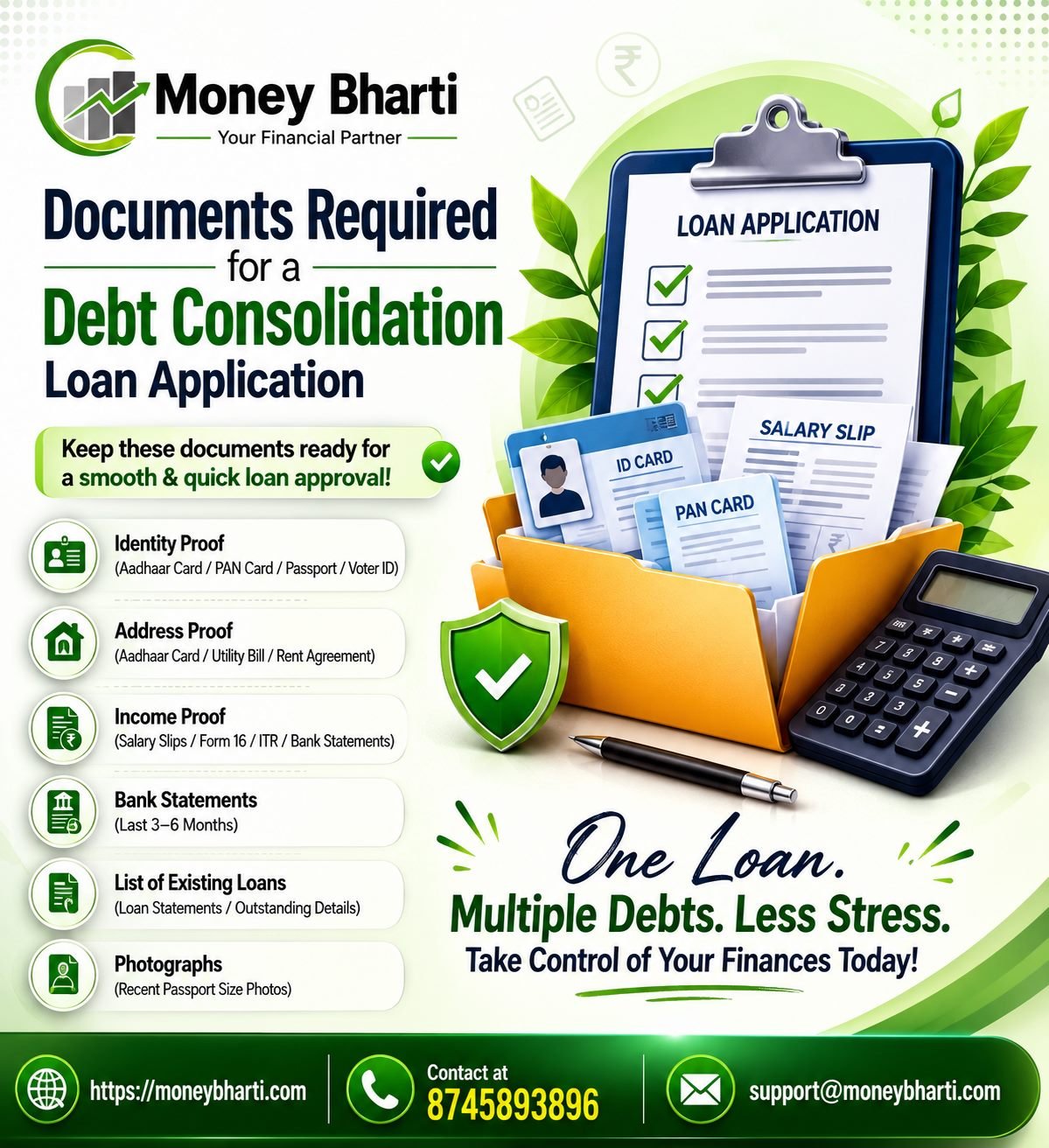 Documents Required for a Debt Consolidation Loan Application
 Best Debt Consolidation Companies in India (2026): How to Compare Lenders and Pick the Right One
 Debt Consolidation Loan in Delhi: How to Replace Credit Card, BNPL and Personal Loan Dues with One EMI
Responsible borrowing note
All rates, fees and eligibility figures on this page are indicative market ranges for illustration and are not an offer. Approval, pricing and the sanctioned amount rest entirely with the bank or NBFC. Money Bharti is a loan marketplace, not a lender. Assess your repayment capacity honestly and read the sanction letter in full before signing. This content is general information, not financial advice.