The condition everything turns on
Across effectively every women-entrepreneur scheme in India, the test is the same: the enterprise must be at least 51% owned by a woman, and managed by her. Both halves matter, and the second is the one that fails.
A family firm that transfers 51% of the shares to a wife or mother on paper while a male relative continues to run the business does not qualify, and lenders check. They look at who signs on the bank account, who appears in the GST registration and the Udyam certificate, whose name is on the trade licence, and who turns up to discuss the business. A mismatch between the shareholding and the person actually running things is a common reason these applications fail, and it is not a paperwork problem that can be patched later.
Where the woman genuinely owns and runs the enterprise, the schemes below are straightforwardly available and worth using.
What is genuinely available
Stand-Up India — the strongest of them
Between ₹10 lakh and ₹1 crore, for a greenfield enterprise in manufacturing, services, trading or allied agriculture. Every scheduled commercial bank branch is expected to facilitate at least one such loan to a woman or SC/ST entrepreneur.
Two conditions catch people out. It must be a new venture — an existing business expanding does not qualify. And where the enterprise is not a proprietorship, at least 51% of shareholding and controlling stake must be held by the woman entrepreneur.
PMEGP, at the higher subsidy slab
Women fall in the special category, which attracts a higher capital subsidy than the general category and a lower own-contribution requirement. Like Stand-Up India, PMEGP is for new units only, and the process runs through KVIC, KVIB or the District Industries Centre over several months.
Mudra
No vintage requirement, up to ₹20 lakh across the three tiers, and a very large share of Mudra lending goes to women-run micro enterprises. For a small requirement this is usually the quickest route.
Bank concessions
Several public sector and private banks run women-entrepreneur products with a modest interest concession, reduced or waived processing fees, or relaxed collateral norms — often bundled with CGTMSE cover. These vary by bank and change from year to year, so the practical advice is to ask each lender directly what they currently offer to women-owned MSMEs rather than to rely on any published list.
Register on Udyam in the woman owner's name
The Udyam certificate is what most lenders and scheme administrators use to establish both MSME status and women-owned status. If the registration was done years ago in a male relative's name while the business is genuinely owned and run by a woman, the concessions will be refused on the paperwork. Correcting the registration is free and takes minutes, and it should be done before any application rather than during one.
Everything else is the same
The concessions sit on top of ordinary credit assessment; they do not replace it. Vintage, turnover, declared income in the ITR, current account conduct and both credit reports are all read exactly as they would be for any other applicant, and a scheme does not overturn a decision made on those grounds.
This is worth saying because the disappointment is common: an applicant expects the scheme to carry a weak file, and it does not. What the schemes change is collateral, subsidy and pricing — not whether the business can service the loan. The main eligibility page covers what is being assessed underneath.
Questions this page gets asked
What counts as a woman-owned business?
At least 51% ownership by a woman, together with actual management and control of the enterprise. Nominal shareholding with someone else running the business does not qualify, and lenders verify through the bank mandate, GST and Udyam records and the signing authority.
Is Stand-Up India only for new businesses?
Yes. It funds greenfield enterprises — a first venture in that line of activity. An existing business seeking expansion capital should look at CGTMSE-backed lending or ordinary MSME facilities instead.
Do women get lower interest rates on business loans?
Several banks offer a modest concession on women-entrepreneur products, and scheme-backed lending is usually cheaper because of the guarantee. The reduction is real but not dramatic — the bigger benefit is generally the relaxed collateral requirement.
Can a woman get a business loan without collateral?
Yes, through CGTMSE-backed facilities, Mudra up to ₹20 lakh, or Stand-Up India, all of which are designed to work without conventional security. Ordinary unsecured lending is also available on the usual criteria.
Is there a special credit score requirement?
No. The same thresholds apply — 700 and above on the promoter's personal CIBIL for most lenders, with CMR read as well once exposure crosses roughly ₹10 lakh. Schemes affect security and pricing, not the credit assessment.
Find the schemes your business actually qualifies for
Money Bharti checks your ownership structure, Udyam status and financial profile against both scheme criteria and lender policies across RBI-registered banks and NBFCs. Soft enquiry only — your credit score is not affected.
Check my eligibilityRelated reading
More Business Loan Guides
Where This Page Sits
This is one page in a larger guide. The pillar covers the whole subject end to end — rates, eligibility, documents and the process — and links to every page in the silo.
Comparing products rather than digging into one? These are the main guides.
From Our Blog
 Debt Consolidation Loans for Business Owners in Mumbai
 Personal Loan in Delhi: Eligibility, Rates and How to Apply
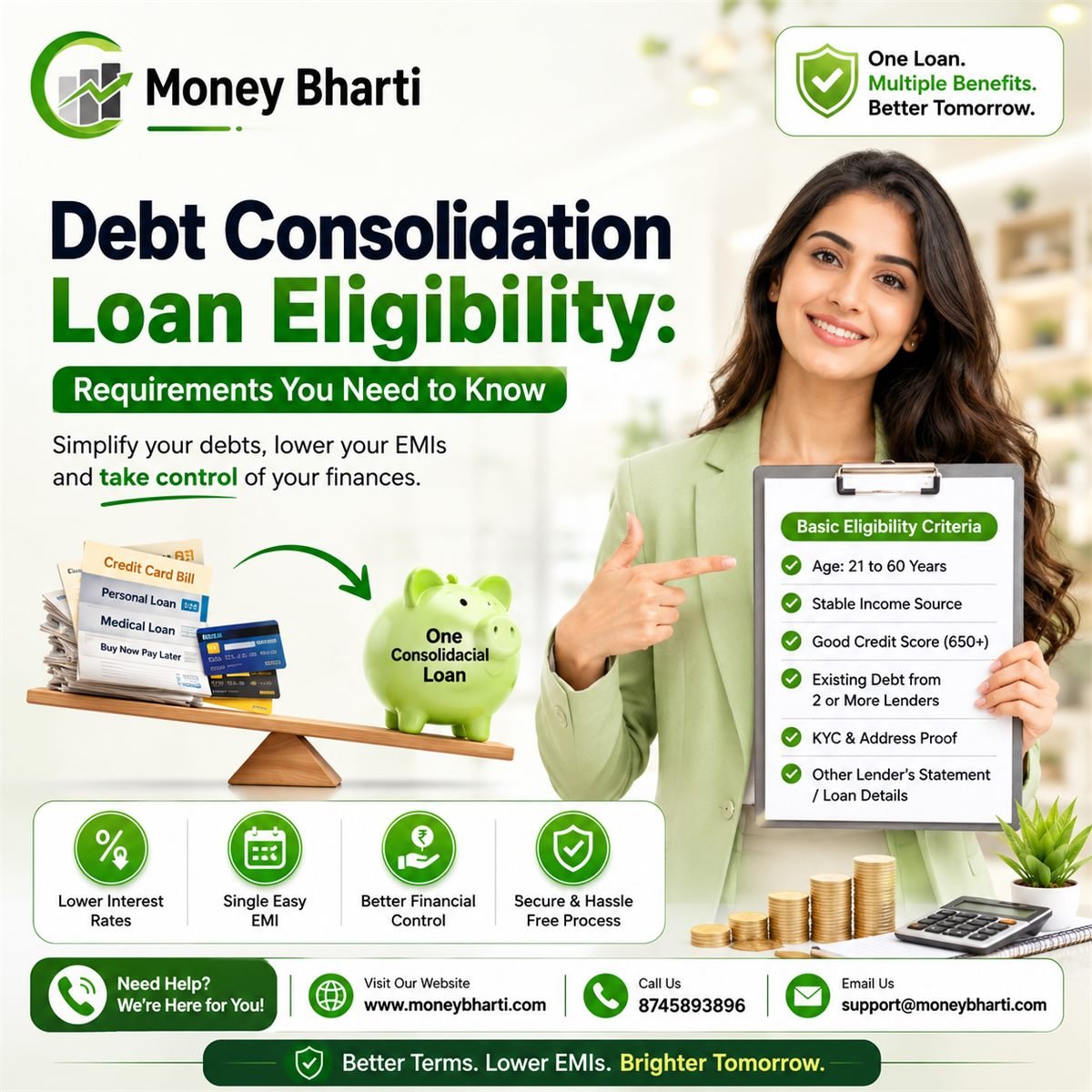 Debt Consolidation Loan Eligibility Requirements
 What Is a Debt Consolidation Loan? Benefits and Eligibility
Responsible borrowing note
All rates, fees and eligibility figures on this page are indicative market ranges for illustration and are not an offer. Approval, pricing and the sanctioned amount rest entirely with the bank or NBFC. Money Bharti is a loan marketplace, not a lender. Assess your repayment capacity honestly and read the sanction letter in full before signing. This content is general information, not financial advice.