Quick approval, minimal paperwork, and funds credited in as little as 24 hours — compare offers from 15+ RBI-regulated banks and NBFCs before you decide.
Introduction
Delhi is not a cheap city to live in, and most people who've spent a few years here know it firsthand. Rent alone can take up a third of a decent salary, and between commuting costs, school fees, the occasional medical bill, and the wedding season that never seems to end, there's almost always something that needs money faster than your savings can provide it.
That's usually the point where a personal loan enters the picture — not as a last resort, but as a practical way to handle a real expense without draining an emergency fund or maxing out a credit card at 40% interest. Whether it's consolidating a few bills, funding a home renovation in Rohini, covering a wedding in Dwarka, or just bridging a gap before your next bonus lands, a personal loan in Delhi today is faster and less complicated to get than it was even three or four years ago.
This page walks through everything worth knowing before you apply — interest rates, eligibility, documents, and the kind of details that actually affect whether your application gets approved or quietly rejected.
Why Choose Money Bharti
We're not a bank, and we don't pretend to be one. Money Bharti works as a loan marketplace — we take your application once and match it against multiple RBI-regulated banks and NBFCs, so you're not stuck with whatever rate your salary account bank happens to offer you.
The advantage of doing it this way is fairly simple: banks compete for your application instead of you going door to door comparing rates yourself. For someone already juggling work and a busy Delhi schedule, that difference in time and effort matters more than it sounds.
Features & Benefits
- Loan amounts up to ₹40 lakhs, depending on your income and credit profile
- Interest rates starting at 10.49% per annum, among the more competitive ranges currently available to salaried applicants in Delhi
- No collateral required — this is an unsecured loan, so there's no need to pledge property, gold, or any other asset
- Fast digital processing — most of the application, document upload, and e-KYC can be completed from a phone, similar to how our online instant personal loan process works end to end
- Flexible tenure ranging from 12 to 60 months, so your EMI can be shaped around what actually fits your monthly budget
- Minimal documentation for salaried applicants with a stable employment history
- Prepayment options available with most partner lenders, in case you want to close the loan earlier than planned
Personal Loan Interest Rates in Delhi
Interest rates for personal loans in Delhi currently range from around 10.49% to 24% per annum, and where you land within that range depends heavily on three things: your credit score, your income stability, and the lender you're matched with.
Credit Score | Typical Interest Rate Range |
750 and above | 10.49% – 14% |
700 – 749 | 14% – 18% |
650 – 699 | 18% – 22% |
Below 650 | 22% – 24% (limited lenders) |
It's worth pointing out that even a 2-3% difference in rate can add up to a meaningful amount over a three or four-year tenure, which is exactly why comparing offers from more than one lender — rather than accepting the first number you're quoted — tends to be worth the extra few minutes. If your priority is purely getting the lowest possible rate, it's worth specifically checking our lowest interest personal loan options before finalising anything.
Loan Amount & Tenure
- Minimum loan amount: ₹50,000
- Maximum loan amount: ₹40,00,000 (subject to income and lender policy)
- Minimum tenure: 12 months
- Maximum tenure: 60 months
A general rule of thumb worth keeping in mind: a shorter tenure means a higher EMI but less total interest paid, while a longer tenure lowers your monthly outgo at the cost of paying more interest overall. Neither is universally "better" — it depends on what your monthly budget can comfortably absorb. If you'd rather borrow only as needed instead of taking a fixed lump sum, a personal loan overdraft is worth comparing as an alternative structure.
Eligibility Criteria
- Age: 21 to 60 years at the time of application
- Employment type: Salaried (private company, PSU, MNC, or government) or self-employed with stable income
- Minimum income: ₹20,000 per month net take-home for salaried applicants (may vary by lender)
- Work experience: At least 1 year of total work experience, with a minimum of 6 months in the current job
- Credit score: 650 or above is generally preferred, though a few NBFCs consider lower scores at higher rates
- Residence: Applicant should currently reside in Delhi NCR or a serviceable location for the chosen lender
- Bank account: An active account where salary or business income is credited regularly
Documents Required
Identity & Address Proof
- PAN Card
- Aadhaar Card
- Passport / Voter ID (optional, as additional proof)
Income Proof (Salaried)
- Last 3 months' salary slips
- Last 6 months' bank statements showing salary credit
- Form 16 or latest ITR (if requested by the lender)
Income Proof (Self-Employed)
- Last 2 years' ITR
- Business bank statements (last 6-12 months)
- Business registration proof / GST certificate, where applicable
Additional
- Passport-size photograph
- Existing loan statements, if consolidating debt as part of the loan purpose
Step-by-Step Application Process
- Fill the online application — Share basic details: name, employment type, monthly income, and the loan amount you need.
- Get matched with lenders — Your profile is checked against partner banks and NBFCs, and you're shown the offers you qualify for, typically within a few hours.
- Upload documents — Submit ID proof, income documents, and bank statements digitally; no branch visit required.
- Verification — The chosen lender verifies your documents and may call to confirm employment or income details.
- Loan agreement & e-sign — Once approved, you review the loan agreement, sanction letter, and e-sign digitally.
- Disbursal — Funds are credited directly to your bank account, often within 24 to 48 hours of final approval.
Personal Loan EMI Calculator
Use this to estimate your monthly instalment before applying.
Example calculation:
- Loan Amount: ₹5,00,000
- Interest Rate: 12% per annum
- Tenure: 36 months
- Estimated EMI: ₹16,607 per month
- Total Interest Payable: ₹97,852
- Total Repayment: ₹5,97,852
Adjusting the tenure or loan amount changes this significantly, so it's worth running a few different combinations before deciding what you're comfortable committing to every month. Use our personal loan EMI calculator directly to test your own numbers instead of relying on the example above.
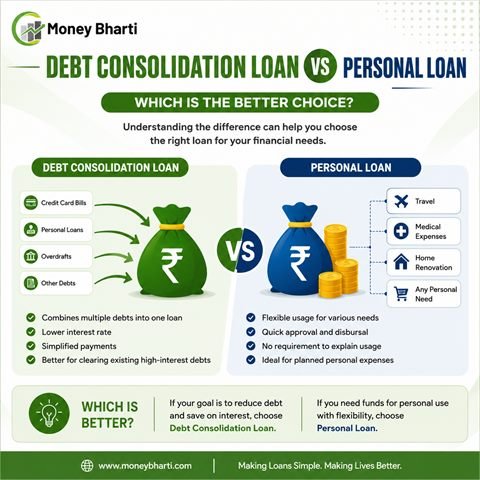
If you're specifically looking to combine multiple existing debts into this one loan, it's worth reading through our dedicated debt consolidation loan page, since eligibility and structuring can differ slightly from a standard personal loan. And if it's really just one expensive existing loan you want moved to a better rate, a balance transfer loan might be the simpler, more targeted option.
Top Banks & NBFC Partners
Money Bharti works with a network of RBI-regulated lenders, including major public and private sector banks along with established NBFCs serving the Delhi NCR region. Depending on your profile, you may be matched with:
- Leading public sector banks offering lower interest rates for applicants with strong credit scores
- Private sector banks known for faster digital processing
- NBFCs that work with slightly lower credit scores or shorter employment histories, typically at a higher interest rate
The exact lender you're matched with depends on your income, credit profile, and the loan amount requested — which is part of why comparing multiple offers through a single application tends to save time.
Tips to Improve Loan Approval
- Check your credit score before applying — a score of 750+ significantly improves both approval odds and the interest rate you're offered
- Avoid applying to multiple lenders individually — each hard inquiry can temporarily lower your score; a single marketplace application avoids this
- Keep your debt-to-income ratio low — lenders generally prefer that your existing EMIs don't exceed 40-50% of your monthly income
- Maintain a stable bank balance — frequent overdrafts or bounced payments in recent statements can raise red flags
- Apply for a realistic amount — requesting significantly more than your income can support often leads to rejection rather than a reduced offer
- Keep documents updated — an expired ID or a salary slip that doesn't match your bank credit can delay or derail approval
- For smaller, short-term gaps, it's worth considering whether an advance salary loan fits your situation better than a full personal loan, especially if you only need to bridge a few weeks before payday
Common Reasons for Rejection
- Low credit score (typically below 650), especially with a history of missed payments
- High existing debt burden relative to income, leaving little room for a new EMI
- Unstable employment history, such as frequently switching jobs or a very short tenure at the current one
- Income mismatch — salary slips or ITR not aligning with actual bank credits
- Incomplete or inconsistent documentation
- Multiple loan applications submitted around the same time, which can appear as credit-hungry behaviour to lenders
- Overdrafts or bounced EMIs/cheques visible in recent bank statements
Why Thousands of Delhi Borrowers Trust Money Bharti
Beyond the marketplace model itself, what tends to bring people back — or refer a colleague — comes down to a few consistent things: transparent communication about rates and charges before commitment, no hidden processing fees sprung on borrowers after approval, and a dedicated advisor who actually answers questions instead of routing every query through a chatbot. Over time, that combination has built a base of repeat and referred customers across Delhi NCR who didn't just take one loan and disappear — they came back the next time they needed one, or sent a friend.
Customer FAQs
1. What is the minimum salary required for a personal loan in Delhi? Most lenders require a minimum net monthly income of ₹20,000, though this can vary depending on the specific bank or NBFC.
2. Can I get a personal loan with a credit score of 650? Yes, though your options may be limited to certain NBFCs, and the interest rate is likely to be on the higher end of the range.
3. How much loan amount can I get based on my salary? Most lenders offer between 10 to 20 times your monthly net salary, subject to your existing obligations and the lender's specific policy.
4. How long does it take to get a personal loan approved? For salaried applicants with complete documentation, approval can happen within a few hours to one business day.
5. Is collateral required for a personal loan? No, personal loans are unsecured, meaning no property, gold, or asset needs to be pledged.
6. Can self-employed individuals apply for a personal loan in Delhi? Yes, self-employed applicants can apply, though the required documents differ slightly and typically include ITRs and business bank statements.
7. What is the maximum tenure available for a personal loan? Most lenders offer tenures up to 60 months (5 years), though this can vary by lender and loan amount.
8. Does checking my eligibility affect my credit score? No, checking eligibility is typically a soft inquiry and does not impact your credit score.
9. Can I prepay or foreclose my personal loan early? Yes, most lenders allow prepayment or foreclosure, though some may charge a nominal prepayment fee depending on the loan agreement.
10. What documents are needed for a salaried applicant? PAN, Aadhaar, last 3 months' salary slips, and last 6 months' bank statements are the core requirements.
11. Can NRIs apply for a personal loan in Delhi? Some lenders do offer personal loans to NRIs with an Indian income source or co-applicant, though eligibility criteria are stricter.
12. What happens if I miss an EMI payment? A missed EMI typically attracts a late payment charge and can negatively affect your credit score if not resolved promptly.
13. Is it possible to get a personal loan without a salary slip? Some lenders accept alternate income proof like bank statements or Form 16, but a salary slip is generally preferred for faster processing.
14. How is the EMI calculated? EMI is calculated based on the loan amount, interest rate, and tenure using a standard reducing-balance formula; our EMI calculator can give you an instant estimate.
15. Can I get a lower interest rate if I already bank with a lender? Sometimes, yes — existing customers with a good relationship and repayment history may be offered preferential rates by their own bank.
16. What is the processing fee for a personal loan? Processing fees typically range from 1% to 3% of the loan amount, depending on the lender.
17. Can I apply for a top-up loan later? Yes, most lenders offer a top-up facility after a certain repayment period, provided your repayment track record is clean.
18. Do I need a guarantor for a personal loan? Most personal loans do not require a guarantor, though borderline applications may occasionally need one depending on the lender's assessment.
19. How many times can I apply if my loan gets rejected? There's no fixed limit, but it's advisable to address the reason for rejection (such as improving your credit score) before reapplying, rather than applying repeatedly within a short span.
20. Can I use a personal loan to consolidate existing debt? Yes, this is one of the most common uses of a personal loan — using it to pay off multiple credit cards or smaller loans and combining them into a single EMI.
21. Will applying through Money Bharti cost me anything? No, checking your eligibility and comparing offers through Money Bharti is completely free; charges only apply once you accept a specific lender's loan offer.
22. What is the difference between a personal loan and a loan against salary? A personal loan is typically a longer-tenure, larger-amount loan based on overall income and credit profile, while a salary advance loan is a smaller, short-tenure loan meant to bridge a temporary cash gap.
23. Can I change my EMI date after the loan is disbursed? Some lenders allow this on request, though it usually requires reaching out to customer support and may take a billing cycle to reflect.
24. Is a personal loan taxable as income? No, a personal loan is not considered income and is not taxable, since it is a liability that needs to be repaid.
25. How do I check my loan application status? You can check your application status through the lender's portal, the Money Bharti dashboard, or by contacting your assigned loan advisor directly.
Explore More
Still not sure this is the right loan type for you? Related options — debt consolidation loan, balance transfer loan, advance salary loan, and personal loan overdraft — are all covered in detail on their respective pages.