If your debt consolidation loan application got rejected, you're not alone — and it's rarely because a lender is being unfair. Most rejections come down to a handful of predictable, fixable reasons. This guide walks through exactly what lenders check, why applications fail, and what you can realistically do next. For general resources on managing your finances, visit MoneyBharti.com.
We're not going to tell you "just improve your credit score" and leave it there. We'll break down the real mechanics — CIBIL score bands, FOIR calculations, documentation issues — so you know precisely where your application stood, and what to change before you try again.
Disclaimer: Interest rates, credit score cut-offs, and lender policies change frequently and vary by institution. The ranges mentioned here reflect commonly used industry benchmarks in India. Always confirm current criteria directly with your lender, or check your official credit report through CIBIL, Experian, Equifax, or CRIF High Mark before applying.
What Is a Debt Consolidation Loan (Quick Recap)
Quick Answer: A debt consolidation loan is a single new loan — usually an unsecured personal loan for debt consolidation — that you use to pay off multiple existing debts, such as credit card dues or other personal loans. Instead of tracking several EMIs and interest rates, you move from a multiple-EMI to single-EMI loan structure. It doesn't erase your debt; it restructures it, ideally at a lower blended interest rate.
Most Indian lenders don't have a separate product literally called "debt consolidation loan." Instead, you apply for a personal loan and use the disbursed amount to close your existing dues. That's an important detail, because it means your application is underwritten using the exact same standards as any other personal loan — not a special, more lenient process.
How Lenders Actually Evaluate a Debt Consolidation Application
Quick Answer: Lenders evaluate debt consolidation applications in two stages. First, an automated eligibility filter checks your credit score, income, age, and employment type against minimum thresholds. Second, if you clear that filter, a manual or algorithmic underwriting step looks more closely at your total debt burden, repayment history, and documentation before making a final call.
The Two-Step Filter — Eligibility, Then Underwriting
Think of it like two doors, not one.
Door 1 — Eligibility screening. This is largely automated. The system checks basic boxes: Are you within the lender's age range? Is your income above their minimum? Is your credit score above their cut-off? If any of these fail, the application often gets an instant, algorithmic rejection — sometimes within minutes.
Door 2 — Underwriting review. If you clear Door 1, a human underwriter or a more detailed algorithm digs into your full credit report, existing EMIs, employer category, and the purpose of the loan. This is where FOIR, recent credit behaviour, and document consistency come into play. Many applicants who "look fine on paper" get rejected here because their overall debt load or repayment history raises concerns that a simple income check wouldn't catch.
Understanding this two-step process matters because it tells you where your application likely failed — and that changes what you should fix first.
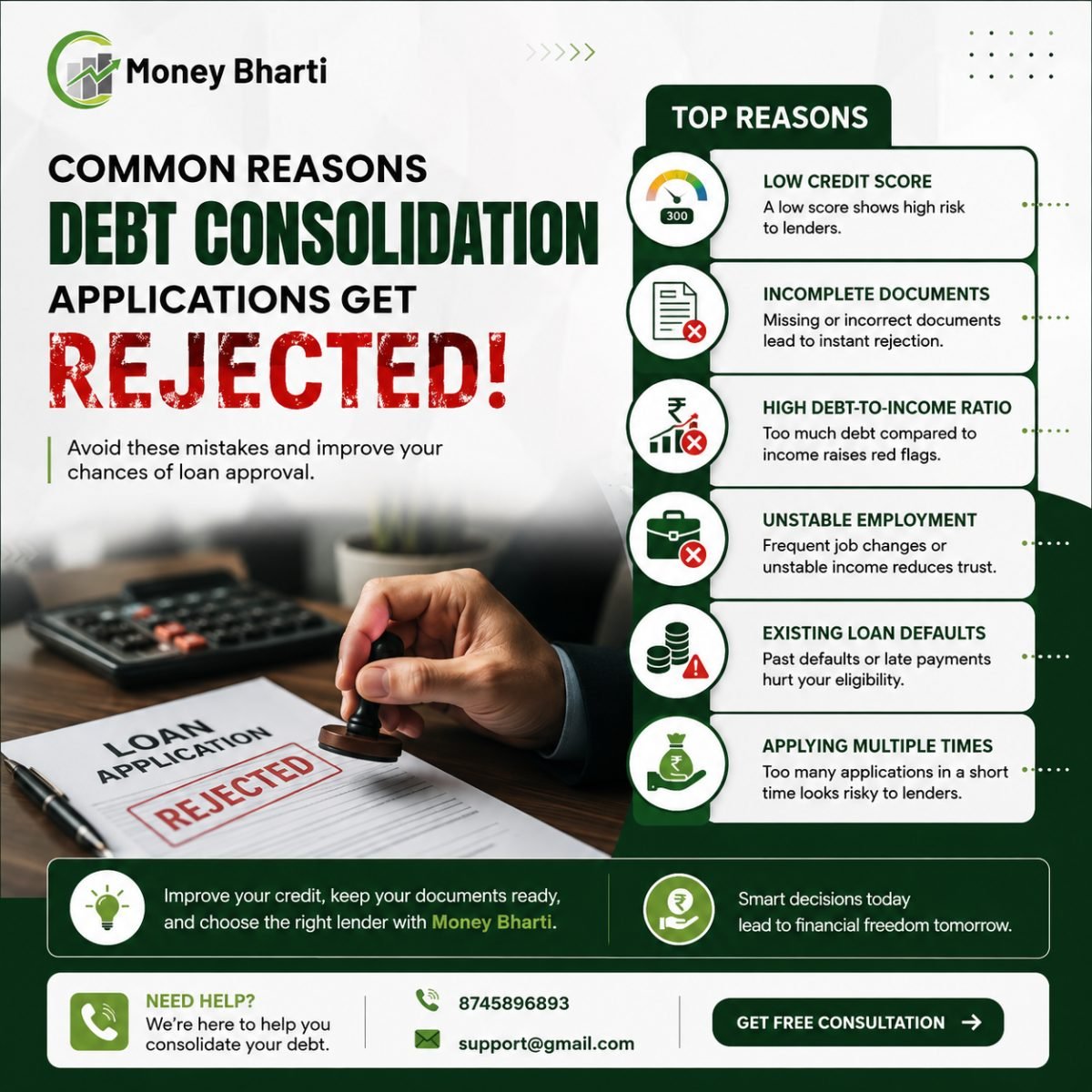
12 Common Reasons Debt Consolidation Applications Get Rejected
1. Low or Damaged CIBIL/Credit Score
This is the single biggest reason for rejection. In India, credit scores (commonly called CIBIL scores, though Experian, Equifax, and CRIF High Mark also issue them) range from 300 to 900.
| Score Range | General Standing | Typical Lender Response |
|---|---|---|
| 750–900 | Excellent | Fast approval, often at best rates |
| 700–749 | Good | Approval likely with most banks and NBFCs |
| 650–699 | Fair | NBFCs and digital lenders more flexible; banks stricter |
| Below 650 | Weak | High chance of rejection, or approval only via select NBFCs at higher rates |
Most banks look for a score of 700–750 or higher for unsecured personal loans, which is what a debt consolidation loan usually is. If your score dropped because of a missed EMI, a maxed-out credit card, or a settled loan, that history stays visible on your credit report for years and directly hurts your approval chances — even if your current income is strong.
The fix: Pull your own credit report (not just the score) and check every entry line by line. Errors do happen — a loan you closed years ago might still show as "active" due to a reporting delay. Dispute genuine errors with the bureau. For a genuinely low score, focus on on-time payments and lower credit card usage for a few months before reapplying — there's no instant fix here.
2. High FOIR (Fixed Obligation to Income Ratio)
Quick Answer: FOIR measures how much of your monthly income already goes toward EMIs and fixed debt payments. Most lenders want your FOIR — including the new loan's EMI — to stay between 40% and 55%. If adding a new EMI would push you above that, the application gets rejected, regardless of your credit score.
Here's the formula:
FOIR = (Total Monthly Fixed Obligations ÷ Net Monthly Income) × 100
Worked example: Suppose your take-home salary is ₹70,000 a month. You currently pay ₹15,000 toward a car loan EMI and ₹10,000 toward two credit cards' minimum-plus dues — a total of ₹25,000. Your existing FOIR is (25,000 ÷ 70,000) × 100 = 35.7%. That looks healthy. But if you now apply for a debt consolidation loan with an EMI of ₹20,000, your obligations rise to ₹45,000, pushing FOIR to (45,000 ÷ 70,000) × 100 = 64.3% — likely too high for most lenders, even though it's meant to replace, not add to, your existing debts.
This is genuinely confusing for a lot of applicants: the entire point of consolidation is to simplify debt, yet the new EMI is calculated as an addition until the old loans are formally closed. Some lenders account for this if you provide proof that old accounts will be closed immediately with the disbursed amount; others don't factor it in until closure is confirmed.
The fix: Ask upfront whether the lender considers post-consolidation FOIR (i.e., calculates your ratio after assuming old loans are closed) or pre-consolidation FOIR. If a lender only looks at pre-consolidation numbers, choosing a longer tenure to lower the new EMI, or a slightly smaller loan amount, can bring your ratio back within range.
3. Too Much Existing Unsecured Debt
Even with an acceptable FOIR on paper, lenders get cautious when a large share of your income is already tied to unsecured debt — credit card dues, personal loans, buy-now-pay-later balances. Unsecured debt is viewed as higher risk than secured debt (like a home or car loan), because there's no asset backing it.
If you're carrying dues across four or five credit cards plus two personal loans, a lender may conclude you're already over-leveraged, and adding another unsecured loan — even one meant to simplify things — increases their risk exposure.
The fix: Before applying, try to close at least one or two smaller accounts using savings, if possible, to reduce the number of open unsecured lines. Fewer, larger obligations often look better to underwriters than many small scattered ones.
4. Recent Loan Defaults or Settled Accounts
A "settled" status on your credit report (where you paid less than the full amount owed, and the lender marked the account as settled rather than closed) is a red flag that stays visible for years. It signals to future lenders that you were unable to repay in full once already.
Even if you never formally defaulted but delayed payments by 30, 60, or 90+ days at some point, this shows as "days past due" (DPD) markers on your report, and recent DPD entries weigh heavily against you.
The fix: There's no shortcut here — recency matters most. A default from five years ago with a clean record since then is far less damaging than one from the last six months. If you have a settled account, some lenders allow you to "upgrade" it to "closed" by paying the remaining waived amount; ask your original lender if this is possible, since it can meaningfully improve how the entry reads on your report.
5. Multiple Loan Applications in a Short Period
Every time you formally apply for credit, the lender runs a "hard inquiry" on your credit report. Unlike checking your own score (a "soft inquiry," which doesn't affect anything), hard inquiries are visible to other lenders and can lower your score slightly — and multiple inquiries within a short window signal "credit hungry" behaviour to underwriters.
This creates a frustrating cycle: you get rejected, apply somewhere else immediately, get rejected again, apply a third time — and each attempt makes your profile look riskier, even if nothing else about your finances has changed.
The fix: Space out applications. If you've applied twice in the last month, pause for at least a few weeks before trying again, and use that time to address the actual reason for rejection rather than simply trying more lenders.
6. Unstable or Insufficient Income
Lenders want to see income that comfortably supports the new EMI on top of your remaining expenses, not just technically clears the FOIR threshold. Minimum income requirements vary widely — a metro-based bank branch might require ₹25,000–₹35,000 net monthly income for salaried applicants, while NBFCs and digital lenders sometimes go lower, often at higher interest rates to offset risk.
For self-employed applicants and freelancers, income consistency matters as much as the amount. Large fluctuations month to month, or income that arrives through informal channels without a clear paper trail, make it harder for a lender to confidently project your repayment ability.
The fix: Salaried applicants should ensure salary slips and bank statements clearly match. Self-employed applicants should keep at least 6–12 months of consistent bank statements and updated ITRs ready, since lenders lean heavily on documented, provable income rather than verbal claims.
7. Job/Business Instability or Short Tenure
A borrower who recently switched jobs, or has been with their current employer for only a few months, looks riskier to a lender than someone with two or more years of stable tenure — even at the same salary. Similarly, a business owner whose company was incorporated recently, or one operating in a sector the lender considers volatile, may face tighter scrutiny.
Some lenders also categorise employers into tiers ("Category A" large, well-known companies vs smaller or less-established ones), and this categorisation can influence both approval odds and the interest rate offered.
The fix: If you've recently changed jobs, it sometimes helps to wait until you've completed at least 6 months to a year at the new employer before applying, if your situation allows it. If you can't wait, a co-applicant with stable income can sometimes offset this concern.
8. Mismatched or Incomplete KYC Documents
This sounds minor, but it causes more rejections than people expect. Common issues include: your name spelled differently across PAN, Aadhaar, and bank documents; an outdated address on one document but not another; salary slips that don't match the bank statement credit amounts; or simply missing pages in a submitted document.
Online debt consolidation services and digital lending platforms in particular rely on automated document verification, and even small mismatches can trigger an automatic decline rather than a request for clarification.
The fix: Before applying, line up PAN, Aadhaar, latest salary slips (or ITRs for self-employed), and the last 3–6 months of bank statements, and check that names, addresses, and figures are consistent across all of them. Update any outdated KYC details with the relevant authority first.
9. Requesting a Consolidation Amount That's Too High
Sometimes the issue isn't your profile — it's the number you asked for. If you request an amount well beyond what your income and FOIR can support, the system may reject the application outright rather than counter-offering a lower amount (though some lenders do make lower offers instead of rejecting).
The fix: Use an EMI or eligibility calculator honestly before applying — many bank and NBFC websites offer these — and request an amount your own numbers support, not just the total of everything you owe. If the true amount needed to close all your debts is too high for one loan, a phased approach (consolidating your highest-interest debts first) may work better than one large ambitious application.
10. Being Under-Age, Over-Age, or Outside the Lender's Policy
Most Indian lenders require applicants to be at least 21–23 years old at the time of application and no older than 58–65 at the time the loan matures (the exact cut-offs vary by lender and by whether you're salaried or self-employed). If your loan tenure would push your age at maturity beyond the lender's limit, the application can be rejected purely on this technical ground, regardless of your finances.
The fix: Check the specific age and tenure policy of the lender before applying, and consider a shorter tenure if you're near the upper age limit.
11. Existing Loans With the Same Lender in Irregular Standing
If you already have a loan or credit card with the same bank or NBFC you're applying to, and that existing account has had late payments, an over-limit status, or bounced EMI instructions (ECS/NACH returns), this internal history often weighs more heavily than your external credit report — because the lender has direct, first-hand experience with your repayment behaviour.
The fix: If your relationship with a particular lender has been rocky, it may genuinely be easier to apply with a different bank or NBFC where you're starting with a clean slate, rather than trying to convince the same lender that things have changed.
12. Applying With the Wrong Lender for Your Profile
Not every lender serves every profile. A large private bank may have strict, conservative criteria built for high-income, long-tenure salaried employees, while an NBFC or digital lender might specifically cater to self-employed individuals, gig workers, or those with moderate credit scores — at a correspondingly higher interest rate.
Applying to a lender whose typical customer profile looks nothing like yours is one of the most common — and most avoidable — reasons for rejection.
The fix: Research a lender's typical eligibility criteria (minimum income, minimum score, employment types accepted) before applying, rather than applying broadly and hoping one says yes.
Bank vs NBFC vs Digital Lender — Who Rejects More, and Why
Quick Answer: Banks generally have the strictest, most conservative criteria and reject more borderline applications, but offer the lowest interest rates to those who qualify. NBFCs sit in the middle — more flexible on credit score and income, usually at moderately higher rates. Digital lenders often offer an instant debt consolidation loan process that's flexible on paper but relies heavily on automated document checks, so mismatched paperwork causes quick, automatic rejections.
| Factor | Banks | NBFCs | Digital Lenders |
|---|---|---|---|
| Typical CIBIL score expectation | 700–750+ | 650–700+ | 600–650+ (varies widely) |
| Income documentation | Strict, thorough | Moderate | Often automated/algorithmic |
| Interest rates | Generally lowest | Moderate | Often higher |
| Approval speed | Slower, more manual review | Faster than banks | Fastest, often instant/automated |
| Flexibility for self-employed | Lower | Higher | Highest |
| Common rejection trigger | Low score, high FOIR | High existing debt load | Document mismatch, algorithm-driven decline |
This isn't a strict rule for every institution, but it's a useful general pattern when deciding where to reapply after a rejection.
Does a Rejected Application Hurt Your Credit Score?
Quick Answer: The rejection itself doesn't directly lower your score, but the hard inquiry generated when you applied does register on your credit report and can cause a small, temporary dip. Multiple rejections close together compound this effect, since each one adds another hard inquiry.
A single hard inquiry usually has a modest impact. The bigger risk is a pattern — several applications within a few weeks — which can make your profile look "credit hungry" to the next lender reviewing your report, independent of the actual rejection outcomes.
Self-Diagnostic Checklist: Which Reason Applies to You?
Go through this list honestly. Ticking two or more boxes usually points to the real reason behind your rejection.
- My CIBIL/credit score is below 700
- My existing EMIs and card dues already take up more than 40% of my income
- I have a "settled" account or a missed payment in the last 12 months
- I've applied for a loan or credit card more than twice in the last 2–3 months
- My income has been inconsistent or I've recently changed jobs
- I'm self-employed with limited documented income proof
- My PAN, Aadhaar, and bank details don't perfectly match
- I asked for a loan amount larger than my calculated eligibility
- I'm near the lender's minimum or maximum age limit for the tenure I chose
- I already have an existing account with this lender that had late payments
What to Do After a Debt Consolidation Loan Rejection
Immediate Steps (First 7 Days)
- Get the rejection reason if possible. Some lenders share a general reason on request; others don't. It's worth asking.
- Pull your full credit report, not just the score, from CIBIL, Experian, Equifax, or CRIF High Mark.
- Check for errors — wrong account status, duplicate entries, or accounts that aren't actually yours.
- Pause new applications. Avoid applying elsewhere immediately; give yourself time to diagnose the actual issue first.
Medium-Term Fixes (30–90 Days)
- Bring down your FOIR by paying off at least one smaller debt if you can, even partially.
- Make every payment on time for the next few billing cycles — recent behaviour carries real weight.
- Correct KYC mismatches across PAN, Aadhaar, and bank records.
- Reassess the loan amount you'll request, based on an honest eligibility calculation.
- Shortlist lenders whose typical borrower profile is closer to yours before reapplying.
How to Improve Your Approval Odds Before You Reapply
- Keep credit card usage below roughly 30% of your total limit in the months before applying.
- Avoid taking on any new credit (even a new card) while your consolidation application is being planned.
- If your income alone doesn't comfortably support the FOIR requirement, consider a co-applicant with steady income.
- Choose a tenure that brings your new EMI to a comfortable, sustainable level rather than the shortest possible tenure.
- Be transparent about the purpose of the loan (debt consolidation) — some lenders view a clearly stated, sensible purpose more favourably than a vague one.
Alternatives If You Keep Getting Rejected
If consolidation applications keep failing, it doesn't mean you're out of options. It can help to compare a few debt consolidation companies or structured debt consolidation programs before deciding your next step.
Pros and cons of the main alternatives:
| Option | Pros | Cons |
|---|---|---|
| Secured loan (against gold, FD, or property) | Easier approval, lower interest rates | Requires an asset to pledge; risk of losing it on default |
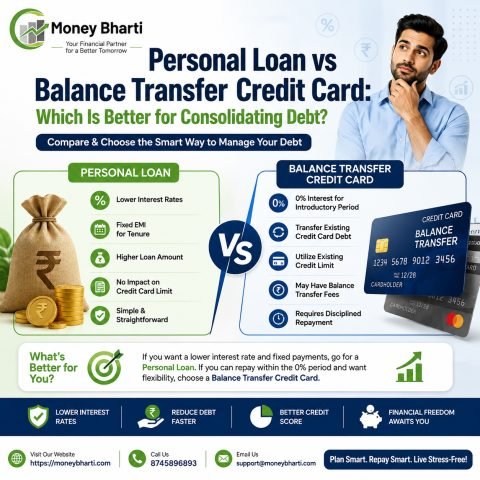
| Balance transfer on existing credit cards/loans | Can lower interest temporarily | Often has processing fees; doesn't reduce total debt |
| Negotiating directly with existing lenders or debt relief companies | No new hard inquiry; may get revised terms | Not all lenders agree; can affect credit report notation |
| Working with a co-applicant | Improves eligibility, shared responsibility | Puts financial responsibility on another person too |
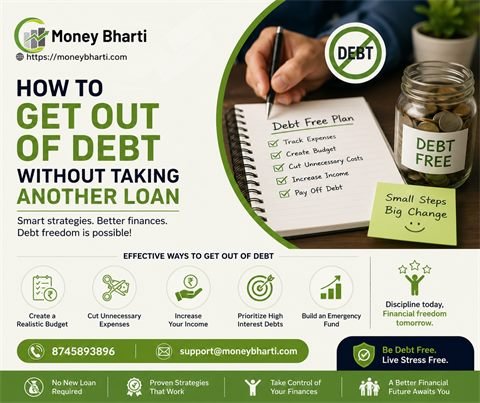
| Structured debt repayment plan without a new loan | No new debt taken on | Slower; requires discipline and budgeting |
A secured loan — for example, against a fixed deposit or gold — is often easier to get approved because it carries lower risk for the lender, even if your unsecured loan application was declined. It's worth exploring this route if you have an eligible asset and are comfortable with the trade-off.
Frequently Asked Questions
1. What is a debt consolidation loan? It's typically an unsecured personal loan you take out specifically to pay off multiple existing debts — like credit cards or other loans — so you're left managing one EMI instead of several.
2. What CIBIL score is required for a debt consolidation loan in India? Most banks prefer a score of 700–750 or higher for the best terms. NBFCs and digital lenders sometimes accept scores from around 650, occasionally lower, though usually at a higher interest rate. Exact cut-offs vary by lender.
3. Why do debt consolidation loans get rejected even with a good salary? A good salary alone doesn't guarantee approval. If your FOIR is too high because of existing EMIs, or your credit history shows recent missed payments, the application can still be rejected despite a healthy income.
4. Does a loan rejection show up on my CIBIL report? The rejection decision itself isn't listed as "rejected" on your report, but the hard inquiry from your application is recorded and visible to future lenders.
5. How many days should I wait before reapplying after a rejection? There's no fixed rule, but waiting at least a few weeks to a couple of months — while you fix the underlying issue — is generally more effective than reapplying immediately.
6. Can I get a debt consolidation loan with a 600 CIBIL score? It's difficult with most banks, but some NBFCs and digital lenders may consider scores in this range, typically at a higher interest rate and with stricter income checks.
7. What is FOIR and why does it matter for loan approval? FOIR (Fixed Obligation to Income Ratio) measures what percentage of your income already goes toward EMIs and fixed obligations. Most lenders want this to stay around 40–55%, including the new loan's EMI.
8. Is it better to apply through a bank or an NBFC after a rejection? It depends on why you were rejected. If your score and documentation are strong but your income is on the lower side, an NBFC may be more flexible. If your credit history has recent issues, changing lender type alone may not solve the underlying problem.
9. Will consolidating my credit card debt lower my credit score temporarily? It can cause a small, short-term dip due to the new hard inquiry and the temporary increase in total obligations, but consistent on-time repayment of the new consolidated loan generally helps your score recover and improve over time.
10. What documents are commonly required for a debt consolidation loan? Typically PAN, Aadhaar, recent salary slips or ITRs, bank statements for the last 3–6 months, and proof of existing loans or card dues you intend to close.
11. Can self-employed individuals get debt consolidation loans easily? It's generally harder than for salaried applicants, mainly because income can be less predictable. Lenders usually ask for more thorough documentation, like ITRs and longer bank statement histories, to assess repayment capacity.
12. Does applying to multiple lenders at once hurt my chances? Yes, it can. Each application triggers a hard inquiry, and several inquiries close together can make you look "credit hungry" to underwriters, even if your finances haven't changed.
13. What is considered a "settled" account, and does it hurt approval? A settled account is one where you paid less than the full amount owed and the lender agreed to close it as "settled" rather than "closed." It signals a past repayment shortfall and can significantly hurt future loan approval chances.
14. Can I add a co-applicant to improve my approval chances? Yes, in many cases a co-applicant with stable income and a good credit history can improve your combined eligibility and FOIR, making approval more likely.
15. Is debt consolidation the same as debt settlement? No. Consolidation means taking a new loan to pay off existing debts in full, ideally at better terms. Settlement means negotiating to pay less than what's owed, which is recorded on your credit report and generally seen as more damaging long-term.
16. What happens to my old loans once a consolidation loan is approved? You use the disbursed amount to pay off and close your existing debts. It's important to actually close those accounts promptly and confirm their "closed" status appears correctly on your credit report afterward.
17. Can a rejected application be reconsidered by the same lender? Occasionally, if you can address the specific reason for rejection (like providing missing documents), some lenders will reconsider. It's worth asking directly, though there's no guarantee.
18. Do digital lending apps reject fewer applications than banks? Not necessarily fewer — they often have more flexible income and score criteria, but rely heavily on automated document verification, so mismatched or incomplete paperwork can trigger quick automatic declines.
19. How much loan amount can I realistically expect for debt consolidation? This depends on your income, existing obligations, and the lender's FOIR policy. Using an online eligibility calculator with your actual numbers gives a more realistic estimate than assuming you'll get the full amount you owe.
20. What are the alternatives if I keep getting rejected for consolidation loans? Consider a secured loan against an asset like gold or a fixed deposit, a balance transfer on existing debt, direct negotiation with current lenders, adding a co-applicant, or a structured repayment plan without taking on new debt.