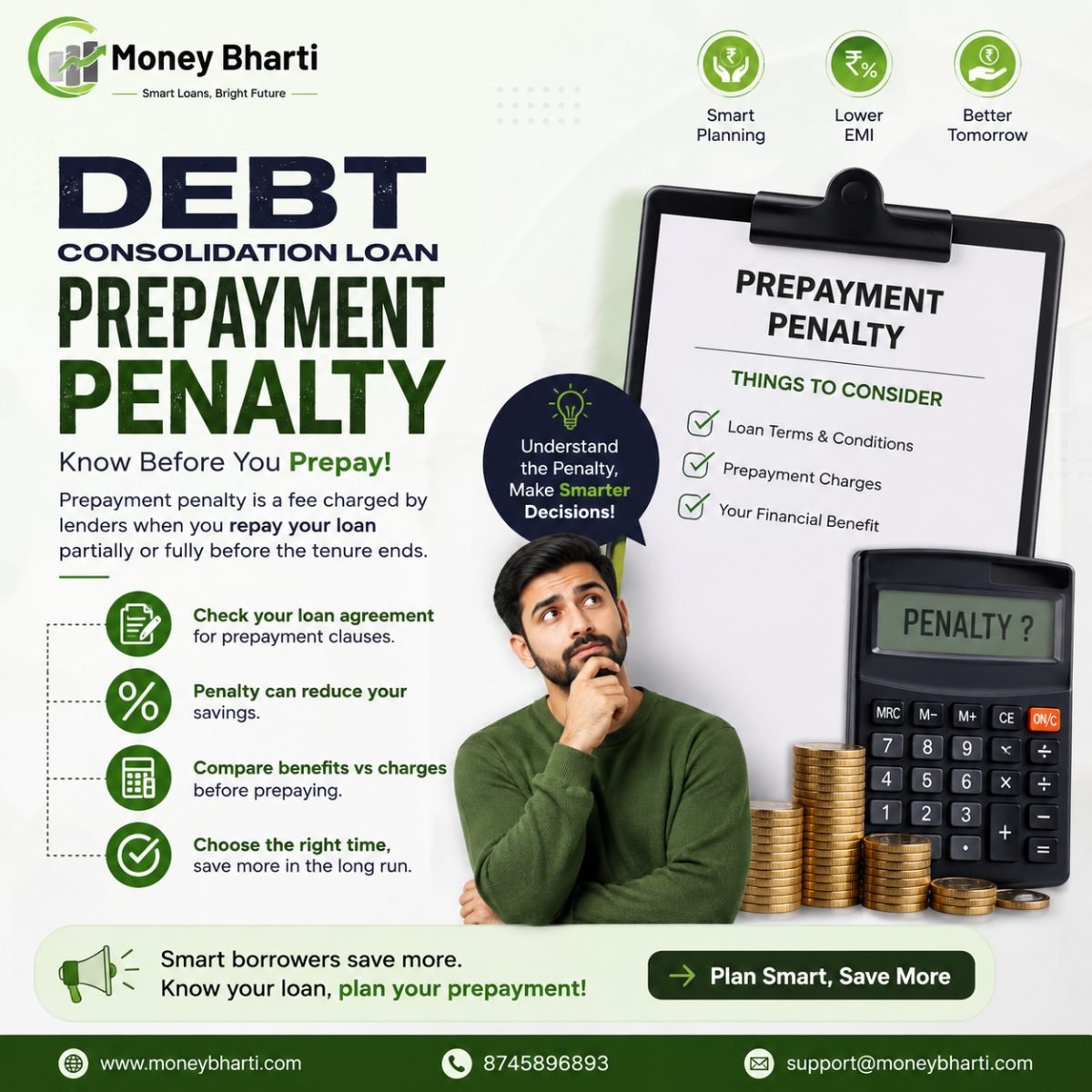
You got a bonus. Or a raise. Or you sold something you didn't need anymore. And now there's extra cash sitting in your account, and one obvious thought: why not just close the loan and be done with it?
Good instinct. But before you transfer that lump sum, there's one question worth thirty seconds of your time — will your lender charge you extra for the privilege of paying them back early? It sounds backwards, and honestly, it kind of is. But prepayment penalties have been a normal part of Indian lending for years, and while the rules changed recently, they didn't change for everyone.
This piece breaks down exactly where you stand — whether your debt consolidation loan is one of the ones RBI now protects, or one that still plays by the old rules.
A quick note before we start: foreclosure charges, lock-in periods, and eligibility under RBI's new rule depend on your loan's sanction date, interest type, and lender. The numbers below reflect commonly seen ranges in the market. Your Sanction Letter and Key Facts Statement will have the actual figures that apply to you — that document beats anything you read here.
Prepayment, Foreclosure, Part-Payment — Getting the Terms Straight
Quick take: these three terms get used almost interchangeably, and that's part of why people get confused. Prepayment is the umbrella term — paying any amount before it's due. Foreclosure specifically means closing the entire loan early. Part-payment means paying a chunk extra without closing the account completely.
Here's the distinction in plain terms. If you owe ₹3 lakh and pay the whole thing off in one shot, that's foreclosure — the loan is gone, done, finished. If you instead pay an extra ₹50,000 on top of your regular EMI just to knock down the principal faster, that's a part-payment, and your loan continues with a smaller balance and (usually) a shorter remaining tenure or a lower EMI going forward.
Why does the distinction matter? Because some lenders charge differently for each. A few waive charges on part-payments but still charge for full foreclosure, or vice versa. It genuinely varies, so don't assume the rule that applies to one automatically applies to the other.
Does RBI Really Ban Prepayment Charges? Here's the Actual Rule
Quick take: Not exactly a blanket ban — it's more specific than that. The Reserve Bank of India's (Pre-payment Charges on Loans) Directions, 2025, which took effect from January 1, 2026, stop lenders from charging prepayment or foreclosure fees on floating-rate loans taken by individuals for non-business purposes. That covers most personal loans used for debt consolidation. But there are real exceptions, and a lot of people are misreading how broad this rule actually is.
Let's be precise about it, because the internet has a habit of oversimplifying regulatory news into "RBI bans all loan fees!" headlines, and that's not quite what happened.
Who the New Rule Protects
If your loan is floating-rate, taken for a personal (non-business) reason, and was sanctioned or renewed on or after January 1, 2026, your lender legally cannot charge you a prepayment or foreclosure fee — full stop, regardless of loan amount or whether you have a co-applicant. This applies whether you're borrowing from a bank or an NBFC. It's a genuinely borrower-friendly change, and it exists specifically because RBI noticed lenders using inconsistent, sometimes punitive practices that discouraged people from ever refinancing or closing loans early.
Who It Doesn't Cover
Here's where things get less generous. Fixed-rate loans aren't automatically covered — lenders are still free to charge a prepayment fee on those, based on whatever's written in your loan agreement. And if your loan was sanctioned before January 1, 2026, and hasn't been renewed since, the new protection may not apply retroactively — the old terms in your original agreement could still hold. Certain loan categories, like foreign currency borrowings, sit outside this framework entirely, though that's less relevant for a typical rupee-denominated consolidation loan.
So the honest answer to "does RBI ban prepayment charges" is: yes, for a specific and fairly common category of loan — but not universally, and not retroactively for every loan already on the books.
Floating Rate vs Fixed Rate — Why This One Detail Changes Everything
Quick take: this single detail — is your interest rate floating or fixed — determines almost everything about whether you'll pay a penalty. Floating-rate loans move with the market (linked to a benchmark like the repo rate), while fixed-rate loans stay the same for the entire tenure. Only floating-rate loans get the RBI protection.
It's worth actually checking this rather than assuming. A lot of borrowers don't remember which type they signed up for, especially if the loan was arranged quickly through a digital lender. Your loan agreement or interest rate statement will say explicitly — look for the words "floating," "linked to repo rate," or "MCLR-linked" versus a flat, unchanging annual rate.
If you've got a fixed-rate consolidation loan and you're weighing whether to switch to something with better terms, it might be worth comparing what a lower-interest debt consolidation option looks like elsewhere — sometimes the savings from a better rate outweigh a one-time foreclosure charge anyway.
How Much Do Prepayment Charges Actually Cost?
Quick take: where they still apply, prepayment or foreclosure charges commonly fall somewhere in the range of 2% to 6% of your outstanding principal, though this varies a lot by lender, loan type, and how much of the tenure remains. There's no single number that applies across the board — you genuinely have to check your own agreement.
To put that in real terms: on an outstanding balance of ₹4 lakh, a 3% foreclosure charge works out to ₹12,000. That's not pocket change, but it also might be far less than the interest you'd otherwise pay over the remaining months of the loan. Which brings us to the actual question that matters — not "is there a fee," but "is the fee worth it."
Lock-In Periods — The Charge Nobody Warns You About
Quick take: even when a lender doesn't technically charge a "penalty," many still enforce a lock-in period — commonly somewhere around 6 to 12 months — during which you simply aren't allowed to foreclose the loan at all, fee or no fee.
This one catches people off guard more than the fee itself. You call up ready to close the loan, cash in hand, and you're told: not yet, you're still inside the lock-in window. It's not framed as a penalty, but functionally, it delays your ability to save on interest — which amounts to the same thing.
If you're planning ahead — say, you expect a bonus in six months and you're already thinking about closing the loan then — it's worth asking your lender about the lock-in period at the time you take the loan, not after.
Is Paying the Penalty Still Worth It? A Simple Way to Decide
Quick take: compare the one-time penalty cost against the total interest you'd save by closing early. If the interest saved is meaningfully higher than the penalty, prepaying almost always makes sense — even with a fee attached.
Let's walk through a rough example, because the numbers make this a lot clearer than the concept alone.
Say you've got ₹3 lakh outstanding on a consolidation loan at 14% annual interest, with 18 months left on the tenure. If you let it run its full course, you'd pay roughly ₹32,000–₹35,000 more in interest over those 18 months (the exact figure depends on your amortisation schedule). Now suppose foreclosing today comes with a 3% charge on the outstanding amount — that's ₹9,000.
Even after paying that ₹9,000 fee, you're still coming out ahead by roughly ₹23,000–₹26,000, plus you're debt-free 18 months sooner. In most cases like this, the penalty is a rounding error next to the interest you avoid. You can run your own numbers through an EMI calculator rather than relying on rough estimates — the real savings depend on your exact rate, balance, and remaining tenure.
The only time prepaying genuinely doesn't make sense is when you're very close to the end of the tenure anyway — say, two or three EMIs left — where the interest you'd save is already small, and a foreclosure charge could actually outweigh it.
Bank vs NBFC vs Digital Lender on Prepayment
Quick take: banks tend to follow RBI's rules fairly strictly and are generally predictable once you know your loan's rate type. NBFCs can be a mixed bag — some waive charges generously to attract borrowers, others hold firm on fixed-rate contracts. Digital lenders, especially for smaller instant debt consolidation loans, sometimes bake in a flat early-closure fee regardless of rate type, so it pays to read the fine print carefully with these.
| Lender Type | Typical Approach to Prepayment | What to Watch For |
|---|---|---|
| Banks | Follow RBI directions closely on floating-rate loans; fixed-rate terms per agreement | Confirm your rate type in writing |
| NBFCs | Varies — some are more flexible to attract customers | Compare a few NBFCs before assuming the terms are standard |
| Digital lenders / online services | Often flat fees, sometimes independent of RBI categorisation nuances | Read the fine print — app-based loans move fast, and it's easy to skim past this clause |
None of this is a hard rule for every single institution — it's a general pattern, and the only way to know for sure is to check your own agreement.
Questions to Ask Before You Sign (Not After)
Most people only think about prepayment terms after they've decided to pay early — by which point it's too late to negotiate. Ask these questions upfront instead, ideally before you sign anything:
- Is this loan floating-rate or fixed-rate?
- If floating-rate, when was it sanctioned — does it fall after the January 2026 cutoff?
- Is there a lock-in period, and how long is it?
- Does the prepayment charge apply to full foreclosure only, or also to part-payments?
- Is the charge a flat percentage, or does it reduce as the tenure progresses?
- Is this clearly stated in the Key Facts Statement, or only buried in the loan agreement's fine print?
If you're comparing more than one lender before choosing where to consolidate, it genuinely helps to ask this exact list to each of them — the answers can differ more than you'd expect between two debt consolidation companies offering seemingly similar rates.
How to Prepay Without Getting an Unpleasant Surprise
A few practical habits go a long way here.
First, don't wait until the day you want to prepay to find out the terms — check your Sanction Letter or Key Facts Statement now, even if you're not planning to close the loan anytime soon. Second, call your lender and ask for the exact foreclosure amount in writing before you transfer anything; verbal estimates over the phone aren't always accurate. Third, if you're within a lock-in period, ask whether a partial prepayment is allowed even if full foreclosure isn't — sometimes it is. And finally, once the loan is closed, get a formal No Dues Certificate or closure letter, and confirm the closure is reflected correctly on your credit report a few weeks later. Loans that are foreclosed but not properly updated on your report can occasionally cause confusion down the line.
For salaried employees planning around annual bonuses or increments, it often makes sense to time the prepayment request right after your lock-in period ends, rather than waiting indefinitely — every extra month you carry the loan is more interest paid for no real benefit.
Frequently Asked Questions
1. What is a prepayment penalty on a debt consolidation loan? It's a fee some lenders charge when you repay your loan — partially or in full — before the end of the agreed tenure, meant to offset the interest income they lose from early closure.
2. Is there a difference between prepayment and foreclosure charges? Prepayment is the broader term for paying early in any amount; foreclosure specifically refers to closing the entire loan at once. Some lenders apply different charges — or none at all — depending on which one you're doing.
3. Does RBI ban prepayment charges on all personal loans? No, not on all of them. RBI's rule specifically bans prepayment charges on floating-rate loans taken by individuals for non-business purposes, sanctioned or renewed on or after January 1, 2026.
4. Which loans are covered by RBI's 2025 Pre-payment Charges Directions? Floating-rate loans given to individuals for personal (non-business) use — including most personal loans used for debt consolidation — sanctioned or renewed on or after January 1, 2026.
5. Are fixed-rate consolidation loans exempt from prepayment charges? No, it's the opposite — fixed-rate loans are not covered by the new exemption, so lenders can still legally charge a prepayment or foreclosure fee on them based on the loan agreement.
6. How much do lenders typically charge for foreclosure? Where charges still apply, they commonly range from around 2% to 6% of the outstanding principal, though this varies by lender and should be confirmed in your specific loan documents.
7. What is a lock-in period on a personal loan? It's a set period — often 6 to 12 months — during which a lender doesn't allow foreclosure at all, regardless of whether a fee would otherwise apply.
8. Can I part-prepay my loan instead of foreclosing it fully? In most cases, yes. Many lenders allow partial prepayments that reduce your outstanding balance without closing the loan entirely, though terms and any applicable charges can differ from full foreclosure.
9. Does part-prepayment also attract a penalty? It depends on the lender. Some waive charges on part-payments while still charging for full foreclosure, or the reverse — always check both scenarios separately in your agreement.
10. Is it worth paying a foreclosure charge to close my loan early? Usually, yes, if the interest you save by closing early is meaningfully more than the one-time charge. It's worth calculating both numbers before deciding rather than assuming either way.
11. Do NBFCs follow the same prepayment rules as banks? NBFCs are covered by the same RBI directions for eligible floating-rate loans, but in practice their individual policies can vary more than banks', so it's worth checking each lender's terms directly.
12. Where can I check my loan's exact prepayment terms? Your Sanction Letter, loan agreement, and Key Facts Statement (KFS) will all state the applicable charges and conditions — these documents take precedence over general information you read online.
13. Does prepaying a loan improve my credit score? Closing a loan responsibly and on good standing generally has a positive long-term effect on your credit profile, though a healthy mix of credit types and consistent repayment history matters more than any single closure.
14. Can a lender change prepayment charges after I've taken the loan? Generally, the terms disclosed at the time of sanctioning apply for that loan's tenure. Lenders are required to clearly disclose these charges upfront, and undisclosed charges introduced later typically cannot be enforced.
15. What is a Key Facts Statement and why does it matter here? It's a standardised, simplified summary of your loan's key terms — including charges like prepayment fees — that lenders are required to provide. It's meant to be easier to read than the full loan agreement and is a reliable place to check this specific detail.
16. Does my existing loan (taken before 2026) qualify for the new RBI rule? Only if it's floating-rate and has been renewed on or after January 1, 2026. A loan sanctioned earlier and not since renewed may still follow its original agreement's terms.
17. Can I negotiate a lower or waived prepayment charge? It's possible, particularly if your loan doesn't fall under the mandatory exemption. It doesn't hurt to ask your lender directly, especially if you have a strong repayment history with them.
18. Is there a minimum amount I need to prepay for it to matter? Not officially, though very small part-payments may not meaningfully reduce your interest burden once you factor in any applicable charges. Larger part-payments generally make the exercise more worthwhile.
19. What happens to my EMI schedule after a part-prepayment? Most lenders let you choose between reducing your EMI amount (keeping the same tenure) or reducing the tenure (keeping the same EMI). It's worth asking which option benefits you more based on your goals.
20. Should I prepay my loan or invest the extra money instead? This depends on your loan's interest rate versus the expected return on the investment, and your comfort with debt. If your loan's interest rate is higher than what you'd realistically earn elsewhere, prepaying is often the more straightforward, lower-risk choice — though this is a personal financial decision worth thinking through carefully.