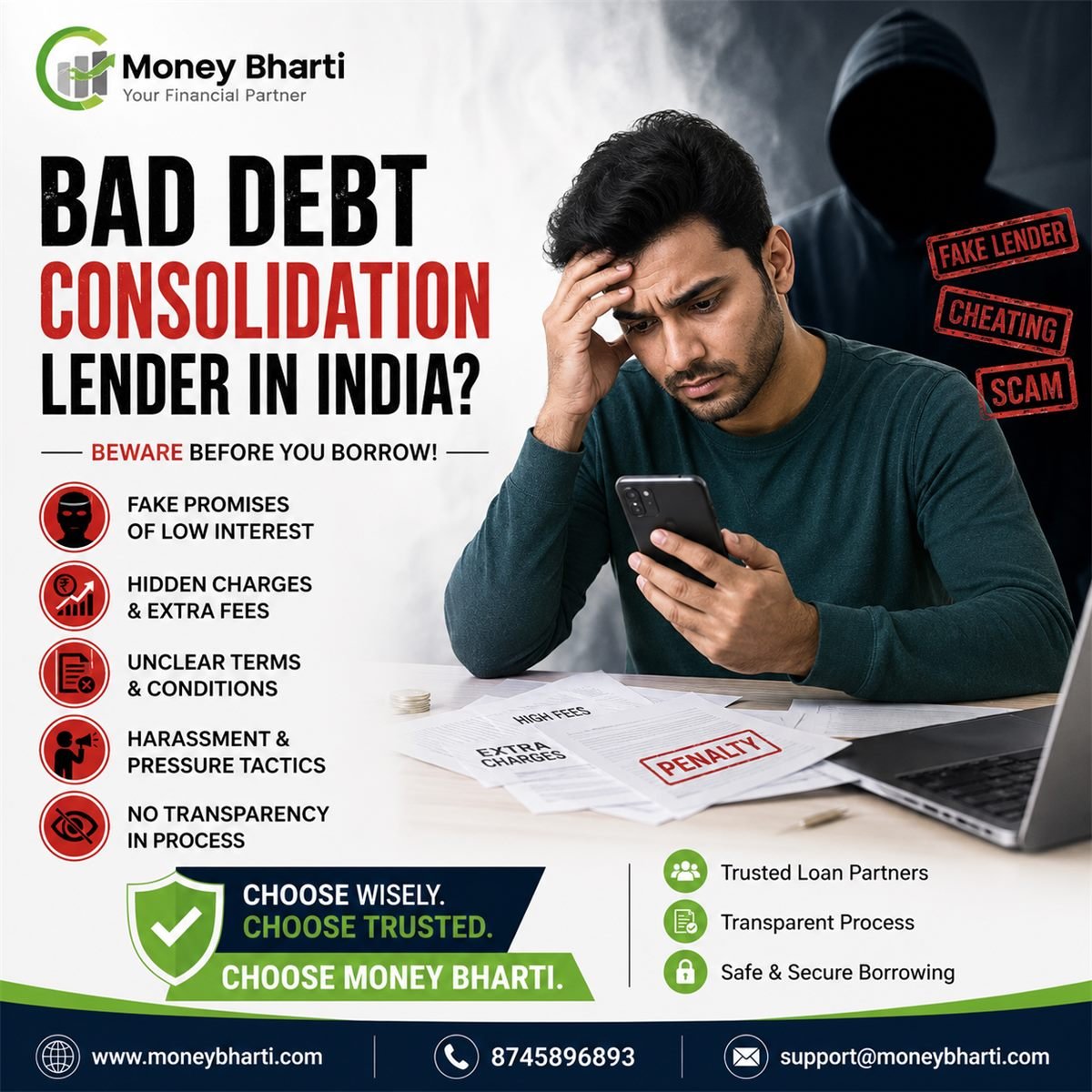
Quick Summary Box
- A genuine debt consolidation lender never asks for money before disbursing your loan.
- RBI-registered NBFCs and banks are always verifiable on the RBI website.
- Guaranteed approval, no-document loans, and pressure tactics are the biggest warning signs.
- Excessive app permissions and threats during recovery point to illegal lending apps.
- Always check the lender's registration, physical address, and grievance redressal system before signing.
What Is a Debt Consolidation Loan? (Definition)
A debt consolidation loan is a single new loan that you use to pay off multiple existing debts, such as credit card bills, personal loans, or other high-interest dues. Instead of managing several EMIs with different due dates and interest rates, you repay one lender through one EMI. It sounds simple, but the safety of this process depends completely on who you borrow from — which is why identifying a bad lender matters more than chasing the lowest advertised rate.
Quick Answer: A debt consolidation loan combines multiple debts into a single loan with one EMI, usually at a lower or fixed interest rate. It only works in your favour if the lender is genuine, transparent, and properly regulated.
Why the Lender Matters More Than the Interest Rate
Borrowers usually compare interest rates first and lender credibility last. This is backwards. A slightly higher rate from a regulated bank is far safer than a "lowest rate guaranteed" offer from an unverified app or agent. Bad lenders make money not through fair interest, but through hidden fees, aggressive recovery, and terms designed to trap you in a longer debt cycle. Before you compare numbers, you need to compare trustworthiness.
Quick Answer: Interest rate is only one factor. A lender's regulatory status, transparency, and recovery practices decide whether consolidation actually reduces your debt stress or increases it — whether you choose a debt consolidation loan or a balance transfer loan.
Red Flag 1: The Lender Is Not RBI-Registered
Every legal lender in India — a bank, an NBFC, or a digital lending app — must be either a scheduled bank or an NBFC registered with the Reserve Bank of India (RBI). Many fraudulent apps and "instant loan" companies operate without any RBI registration, often using offshore servers or shell companies to escape accountability.
How to check: Search the lender's name on the RBI's list of registered NBFCs, or check if the app is listed under RBI's approved digital lending apps guidance. If you cannot find the lender's registration number anywhere, treat it as a serious red flag.
Quick Answer: If a lender cannot show RBI registration or NBFC status, it has no legal accountability in India. Never borrow from an unregistered entity, regardless of how attractive the offer looks.
Red Flag 2: Guaranteed Approval With No Credit Check
Genuine lenders always assess your CIBIL score, income proof, and repayment capacity as part of your loan eligibility check before approving a loan — this is a legal requirement, not a formality. If a lender promises "100% guaranteed approval" or "loan without any document," they are either planning to charge you hidden fees regardless of approval, or they are not a real lending business at all.
Quick Answer: No legitimate lender can guarantee approval without checking your credit history and income. This promise is one of the clearest signs of a scam or predatory lender.
Red Flag 3: Upfront "Processing Fee" Before Disbursal
This is the most common trick used by fraudulent lenders. You are asked to pay a "processing fee," "GST charge," "insurance," or "verification fee" via UPI or bank transfer before the loan amount is disbursed. Once you pay, the lender either disappears or asks for more fees under a new name.
Legitimate practice: Real lenders deduct processing fees directly from the loan amount at disbursal, or add them to the EMI structure. They do not ask you to pay money first to "release" your own loan.
Quick Answer: Never pay any fee before your loan amount reaches your account. Genuine lenders deduct charges from the loan itself — they never ask for a separate advance payment.
Red Flag 4: Pressure Tactics and Artificial Urgency
Phrases like "offer valid only for the next 2 hours," "only 3 slots left today," or repeated calls pushing you to decide immediately are classic pressure tactics. Genuine financial decisions, especially ones that affect years of repayment, should never be rushed. Predatory lenders use urgency so you skip reading the terms carefully.
Quick Answer: Any lender pressuring you to decide within minutes or hours is trying to stop you from reading the fine print. A genuine offer will still be valid tomorrow.
Red Flag 5: Hidden Charges Buried in the Agreement
Bad lenders often disclose a low headline interest rate but bury additional charges — processing fees, foreclosure penalties, legal charges, "service fees," or insurance add-ons — deep inside the loan agreement in small print. By the time you notice, you have already signed.
Quick Answer: Always ask for the complete fee breakdown in writing before signing. If a lender refuses to share this, or the agreement has vague terms like "applicable charges," walk away.
Red Flag 6: No Verifiable Physical Address or Registered Office
A real NBFC or bank has a registered office address that you can independently verify — through the RBI database, MCA (Ministry of Corporate Affairs) portal, or Google Maps. Many loan-app scams operate only through a mobile app and a customer support number, with no traceable office.
Quick Answer: If you cannot find or verify a physical registered address for the lender, treat this as a strong warning sign. Legitimate NBFCs are always registered entities with a traceable office.
Red Flag 7: Vague or Constantly Changing Loan Terms
If the interest rate, tenure, or EMI amount keeps changing between your first conversation and the final agreement — or if the lender avoids giving you a clear, written loan schedule — this signals a lack of transparency. Genuine lenders provide a fixed, written repayment schedule before you agree to anything.
Quick Answer: Ask for a written amortisation schedule showing every EMI, the interest portion, and the principal portion. A lender who avoids giving you this document is hiding something.
Red Flag 8: Loan Amount Routed Through a Personal UPI or Bank Account
Loan disbursal must always happen from the lender's official current account — never through a personal UPI ID, personal savings account, or a third-party wallet. If your "lender" asks you to send money to, or receive money from, an individual's personal account, this is a strong sign of fraud, not formal lending.
Quick Answer: Loan disbursal and repayment should only ever go through the lender's verified official bank account, never a personal UPI ID or an individual's account.
Red Flag 9: No Formal, Signed Loan Agreement
A genuine consolidation loan always comes with a formal loan agreement — either physical or digitally signed (e-sign/e-stamp) — that both parties retain a copy of. If a lender disburses money based only on a WhatsApp chat or verbal confirmation, with no signed contract, you have no legal proof of the loan terms if a dispute arises later.
Quick Answer: Insist on a signed loan agreement with clear terms before accepting any disbursal. Without this document, you have no legal protection if the lender later changes the terms.
Red Flag 10: Excessive App Permissions (Contacts, Gallery, Camera)
Many fraudulent instant-loan apps ask for permissions completely unrelated to lending — access to your phone contacts, photo gallery, call logs, or camera. These permissions are often misused for harassment: contacting your family and friends, or threatening to misuse personal photos, if you delay a payment. RBI guidelines on digital lending explicitly restrict apps from accessing such unrelated data.
Quick Answer: A lending app should only need basic KYC and financial information. If it demands access to your contacts or gallery, uninstall it and avoid borrowing from that platform.
Red Flag 11: Threats, Abuse, or Harassment-Style Recovery Advertised
Some lenders — particularly unregistered digital lending apps — use recovery agents who threaten borrowers, call family members repeatedly, or use abusive language. RBI's Fair Practices Code prohibits such behaviour for regulated lenders. If a lender's recovery reputation (visible in reviews or news reports) already includes harassment complaints, do not borrow from them, regardless of the interest rate offered.
Quick Answer: Legitimate lenders follow RBI's Fair Practices Code during recovery. Any lender known for threats, abuse, or contacting your family without consent should be avoided entirely.
Red Flag 12: Interest Rate "Too Good to Be True"
If a lender is offering a low-interest debt consolidation rate significantly below what banks and established NBFCs currently offer, be cautious. Extremely low advertised rates are often bait — the real cost gets added back through processing fees, "insurance," or penalty clauses. Since interest rates change over time, always verify current rates directly on RBI or the lender's official website rather than relying on marketing claims.
Quick Answer: An interest rate far below the market average is usually a marketing trap, not a genuine offer. Always verify current debt consolidation interest rates on the lender's official website before trusting an advertised figure.
Red Flag 13: No Grievance Redressal Mechanism
Every RBI-regulated lender must have a Grievance Redressal Officer and a clear complaint escalation process, eventually reaching the RBI Ombudsman if unresolved. Bad lenders either have no complaint process at all, or make it deliberately difficult to reach anyone once you have a problem.
Quick Answer: Ask for the lender's grievance redressal officer's name and contact details before borrowing. If they cannot provide this, they are likely not following RBI's mandatory compliance framework.
Red Flag 14: App Not on Official Stores, or Filled With Fake Reviews
RBI has directed digital lending apps to be listed only on official platforms like Google Play Store and Apple App Store, not distributed through APK links or third-party sites. Additionally, watch for apps with hundreds of generic five-star reviews posted within a short time span — a common sign of fake review manipulation to hide real complaints.
Quick Answer: Only download loan apps from official app stores. Be suspicious of apps shared via APK links, or those with suspiciously uniform, recently posted five-star reviews.
Red Flag 15: Repeated Complaints About the Same Specific Issue
One or two negative reviews can happen to any business. But if you see a consistent pattern — many borrowers reporting the exact same issue, such as "charged hidden fee after approval" or "harassed family members" — this is not a coincidence. It reflects the lender's actual business practice.
Quick Answer: Look for patterns, not isolated complaints. When multiple independent reviewers describe the same specific problem, it reflects a systemic issue with that lender, not bad luck.
Genuine vs Fraudulent Lender: Comparison Table
Here's how genuine debt consolidation companies differ from fraudulent ones on the factors that matter most:
| Factor | Genuine Lender | Fraudulent / Bad Lender |
|---|---|---|
| Registration | RBI-registered bank or NBFC | No registration, or unverifiable |
| Fees | Deducted from loan amount | Demanded upfront via UPI/transfer |
| Approval | Based on CIBIL and income check | "Guaranteed," no document needed |
| Agreement | Signed, written, detailed | Verbal or WhatsApp-only |
| App permissions | Only KYC-related | Contacts, gallery, camera access |
| Recovery practice | Follows RBI Fair Practices Code | Threats, harassment, family contact |
| Grievance redressal | Dedicated officer, RBI Ombudsman | No formal process |
| Interest rate | Matches market range, transparent | Unrealistically low, hidden charges |
How to Verify a Debt Consolidation Lender: Step-by-Step
- Search the lender on the RBI website to confirm NBFC or bank registration status.
- Check the MCA portal for company registration and registered office address.
- Download the app only from Google Play or Apple App Store, never via APK link.
- Ask for the grievance redressal officer's name and direct contact number.
- Request a written loan agreement with full fee breakdown before accepting any amount.
- Search the lender's name with the word "complaint" or "fraud" to check recent borrower experiences.
- Confirm the disbursal account is the lender's official current account, not a personal UPI ID.
Quick Answer: Verification takes less than 15 minutes but can save you from years of debt trouble. Check RBI registration, the registered office, app store presence, and recent borrower complaints before signing anything.
What to Do If You Already Borrowed From a Bad Lender
If you suspect you are already dealing with a fraudulent or predatory lender:
- Stop sharing any further personal documents or app permissions immediately.
- Keep written records of every call, message, and payment made.
- File a complaint with the RBI's Sachet portal (for unregistered lending entities) or your local cyber crime cell if you are facing harassment.
- Consult your bank, a certified financial counsellor, or verified debt relief companies before making further payments under pressure.
- Do not respond to threats — report them instead, as harassment-based recovery is illegal for both regulated and unregulated lenders.
Quick Answer: If you're already stuck with a bad lender, stop sharing data, document everything, and report the lender through the RBI Sachet portal or your nearest cyber crime cell rather than continuing to negotiate under pressure.
Checklist Before Signing Any Debt Consolidation Loan
- [ ] Lender is RBI-registered (bank or NBFC)
- [ ] Registered office address is verifiable
- [ ] No upfront fee requested before disbursal
- [ ] Written loan agreement provided
- [ ] Complete fee breakdown shared in writing
- [ ] App downloaded only from official app store
- [ ] App does not request contacts/gallery access
- [ ] Grievance redressal officer details available
- [ ] Recent reviews checked for repeated complaint patterns
- [ ] Disbursal account matches lender's official business account
Expert Tip
Before signing, use a debt consolidation EMI calculator to check your total repayment amount (EMI × tenure), not just the monthly EMI. Some bad lenders design EMIs to look affordable while stretching tenure unnecessarily, increasing your total interest outgo significantly. Always ask for this total figure in writing.
Frequently Asked Questions
1. How do I know if a debt consolidation lender is registered with RBI? Search the lender's exact name on the RBI's official website under its list of registered NBFCs and banks. If the name doesn't appear, or the registration number given doesn't match RBI records, the lender is not authorised to operate legally in India.
2. Is it normal for a lender to ask for a processing fee? Yes, processing fees are normal, but they should be deducted from your loan amount at disbursal or added to your EMI — not collected separately as an advance payment before you receive any money.
3. Can a genuine bank guarantee loan approval? No. Every regulated lender, including banks, must assess your credit score and repayment capacity before approving a loan. Any guarantee of approval without checks is not a standard banking practice.
4. What should I do if a loan app asks for my contact list? Do not grant this permission. It is not required for legitimate lending and is a known tactic used by fraudulent apps for harassment-based recovery. Consider uninstalling the app.
5. Are all digital lending apps unsafe? No, many digital lending apps are run by RBI-registered NBFCs and are completely safe. The key is verifying registration and checking that the app follows RBI's digital lending guidelines, not avoiding digital lenders entirely.
6. How can I check a lender's registered office address? You can check the Ministry of Corporate Affairs (MCA) portal using the company's name or CIN, or cross-verify the address listed on the RBI's NBFC registry.
7. What is the RBI Sachet portal? It is an official RBI-supported portal where consumers can file complaints against unregistered or illegal lending entities operating in India.
8. Can a lender legally contact my family members for recovery? Regulated lenders may contact listed references only in specific, limited circumstances defined under fair practice guidelines, not for routine harassment. Repeated or abusive contact with family members is not acceptable practice.
9. Why do some lenders offer unusually low interest rates? Extremely low rates are sometimes used as bait to attract borrowers, with the actual cost recovered later through processing fees, penalty clauses, or add-on charges. Always ask for the full cost breakdown, not just the headline rate.
10. Is a verbal loan agreement valid in India? A verbal agreement offers very limited legal protection. Always insist on a signed, written loan agreement — physical or digitally e-signed — that clearly states the loan amount, interest rate, tenure, and all applicable charges.
11. What documents should a genuine lender ask for? Typically PAN, Aadhaar, income proof, bank statements, and existing loan details. If a lender asks for excessive or unrelated documents, or none at all, treat this with caution.
12. How do I file a complaint against a harassing lender? You can approach the lender's grievance redressal officer first. If unresolved, escalate to the RBI Ombudsman (for regulated entities) or the Sachet portal and your local cyber crime cell (for unregistered apps or harassment).
13. Does a low CIBIL score mean I'll only find bad lenders? Not necessarily. Some regulated NBFCs specialise in lending to lower credit-score borrowers at higher, but transparent, interest rates. The concern is not a lower score being accepted — it's when no score check happens at all.
14. Can I negotiate loan terms with a lender before signing? Yes, genuine lenders generally allow reasonable negotiation on tenure or processing fees. A lender who refuses to discuss terms or rushes you to sign without explanation should raise concern.
15. What is the difference between an NBFC and an unregistered lending app? An NBFC is a company registered with and regulated by the RBI, required to follow lending norms, fair practice codes, and grievance redressal rules. An unregistered app operates outside this framework, with no accountability if something goes wrong.
16. Should I pay a "GST charge" separately before loan disbursal? No. Any applicable GST on processing fees is typically included within the fee structure deducted from the loan amount, not collected as a separate advance payment before disbursal.
17. How can I verify if online reviews about a lender are genuine? Look for reviews with specific, varied details rather than generic praise, and check the timing — a sudden spike of identical five-star reviews within a short period is often a sign of manipulation.
18. What happens if I stop paying a fraudulent lender? Consult a financial counsellor or legal advisor about your specific situation. Do not make decisions solely under pressure from threats, and report any harassment to the appropriate authorities immediately.
19. Can debt consolidation hurt my CIBIL score? A new loan application does involve a hard credit inquiry, which may cause a small, temporary dip. However, consolidating and repaying debt responsibly through a genuine lender generally supports long-term credit health.
20. Is it safe to consolidate debt through a loan aggregator website? It can be, if the aggregator only connects you to RBI-registered lenders and does not itself disburse funds or collect upfront fees. Always verify the actual lending partner's registration independently before proceeding.
Final Word
Debt consolidation can genuinely simplify your finances — but only when the lender you choose is transparent, regulated, and accountable. The red flags above are not rare exceptions; they are patterns that repeat across thousands of borrower complaints in India every year. Take the extra fifteen minutes to verify a lender before you sign anything. It is a small effort compared to the years it can take to recover from a bad lending decision.
This article is for general informational purposes and does not constitute financial advice. Interest rates, RBI regulations, and lender policies change over time — always verify current details on the RBI's official website or directly with the lender before making a borrowing decision.