Quick Summary
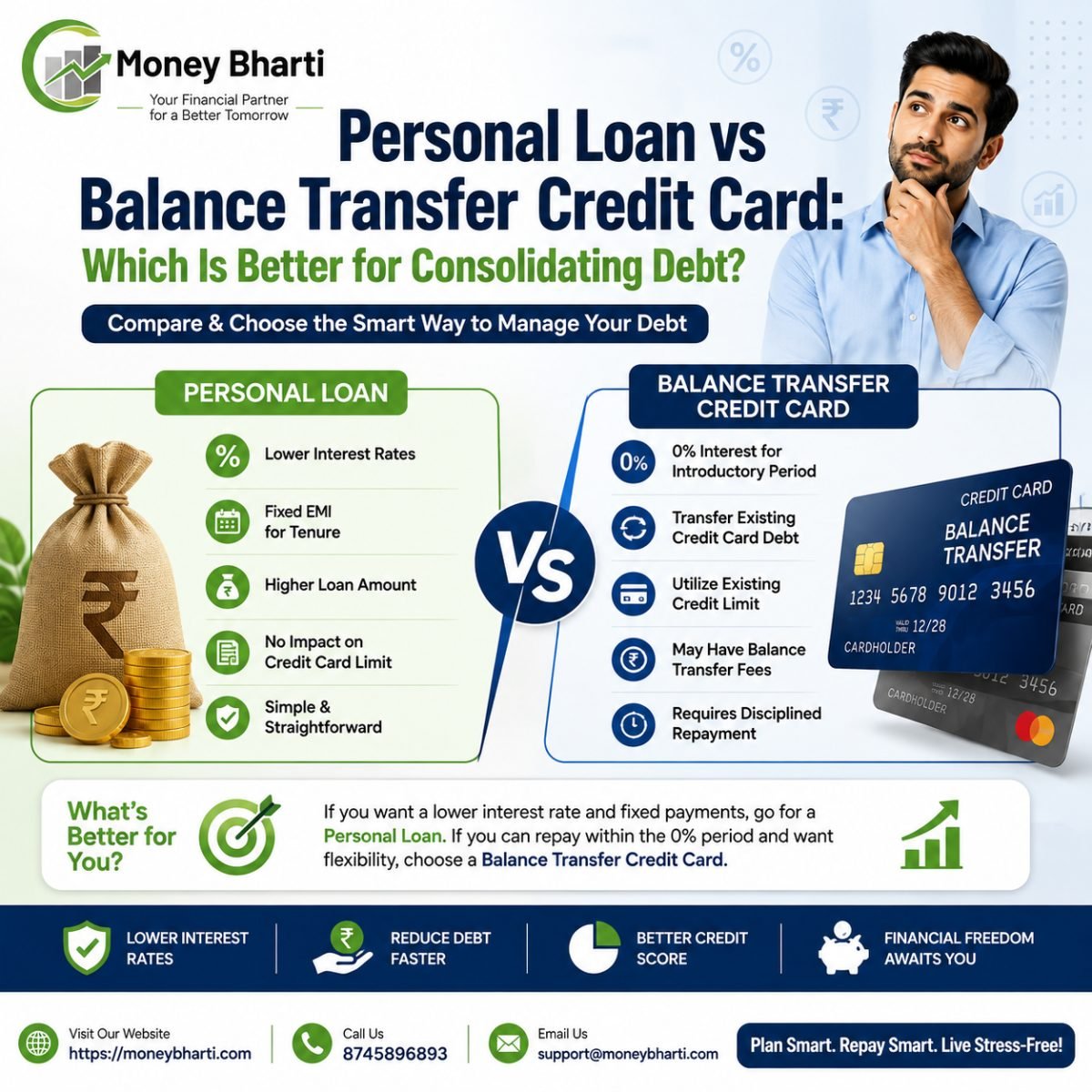
If you're juggling multiple credit card bills or high-cost EMIs, you basically have two consolidation tools: a personal loan (fixed EMI, fixed tenure, rate usually 9.99%–24% p.a.) or a balance transfer (BT) credit card (0% or low-interest promo period, usually 3–12 months, then it reverts to a high standard rate of 30%+ p.a.).
- Choose a personal loan if your debt is large, you need more than 6–12 months to repay, or you want payment certainty.
- Choose a BT credit card if your outstanding is small, you're confident you can clear it within the promo window, and you want to avoid a new formal loan on your credit report.
- Avoid both if you can't realistically commit to a fixed monthly repayment — consolidation without a spending fix just delays the problem.
Use Debt Consolidation Calculator to compare both options with your actual numbers before deciding.
Problem-Based Introduction
It usually starts small. One credit card for daily spends, another for a big-ticket purchase, maybe a third that offered a joining bonus you couldn't resist. A few missed due dates later, you're paying 3–3.5% per month in interest — that's 40%+ annually — on revolving balances across three or four cards, and you've lost track of which bill is due when.
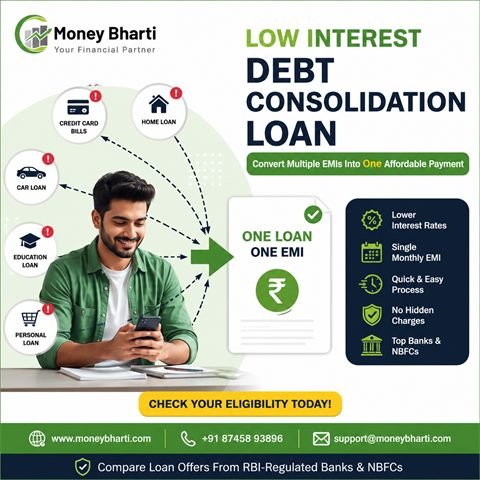
This is the exact situation debt consolidation is built for. Instead of managing multiple due dates and multiple interest rates, you combine everything into a single repayment. The two most common ways to do this in India are a personal loan for debt consolidation and a balance transfer credit card. Both can work — but they work very differently, suit different debt profiles, and carry different risks if used carelessly. This guide breaks down both options in detail so you can pick the one that actually saves you money.
Loan Overview
Personal Loan for Debt Consolidation: An unsecured loan from a bank or NBFC, disbursed as a lump sum, used to pay off your existing credit card dues or other loans in one go. You then repay the personal loan through fixed monthly EMIs over a chosen tenure (typically 12–60 months) at a fixed interest rate.
Balance Transfer Credit Card: A credit card (usually a new one, sometimes an existing one) that lets you shift an outstanding balance from another card onto it, usually at a promotional interest rate — often 0%–1.5% per month — for a limited period (3, 6, 12, or sometimes 18 months). Once the promo period ends, any remaining balance reverts to the card's standard interest rate, which is typically among the highest forms of consumer credit.
Both aim to reduce your effective interest cost, but a personal loan is a structured, amortizing product, while a BT credit card is a revolving product with a time-bound discount.
Why People Need This Loan?
People turn to debt consolidation — through either route — for a few common reasons:
- Multiple cards, multiple interest rates: Tracking 3–4 due dates a month is error-prone, and one missed payment triggers late fees plus a rate reset.
- High revolving interest: Credit card interest compounds monthly; unpaid balances snowball fast.
- Simplification: One EMI or one card payment is easier to budget for than five scattered bills.
- Credit score protection: High credit utilization (balance-to-limit ratio) drags your CIBIL score down; consolidating and closing the utilization gap can help it recover.
- Lower overall interest cost: Moving 30–42% p.a. credit card debt to a 10–18% p.a. personal loan, or a 0% promo BT card, cuts the interest bill significantly if managed well.
Is This Loan Right For You?
A consolidation loan (or BT card) is a good fit if:
- You have a clear, sizeable outstanding balance across cards or short-term loans.
- Your income is stable enough to support one fixed EMI comfortably.
- You've stopped adding new debt — consolidation without behaviour change just delays the crisis.
- You have a reasonable credit score (650+) — this determines whether you get a rate that actually saves you money.
- You can commit to a defined repayment timeline rather than making minimum payments indefinitely.
Who Should Avoid This Loan?
- Anyone whose credit score is too low to qualify for a rate meaningfully better than their existing card rate — consolidating at a similar or higher rate defeats the purpose.
- Anyone who is likely to keep swiping the "cleared" credit cards — this is the single biggest reason consolidation fails; the old cards get used again and the borrower ends up with both the new loan and fresh card debt.
- Anyone with irregular or uncertain income, since a fixed EMI becomes a liability during a lean month, unlike minimum credit card payments which flex (at a cost).
- Anyone whose total debt is very small (say, under ₹20,000–30,000) — the processing fee and paperwork of a personal loan may not be worth it; simply paying off the card directly may be faster.
Key Benefits
- Lower blended interest rate — moving from ~36–42% p.a. card debt to a ~10–18% p.a. personal loan (or a genuine 0% BT window) is the single biggest driver of savings.
- Fixed EMI and fixed tenure (personal loan) — predictable budgeting, and a guaranteed end date to the debt, unlike revolving credit.
- Improved credit utilization ratio — paying off card balances with a loan frees up your card limits, which can boost your CIBIL score within a couple of billing cycles.
- Single monthly payment — fewer due dates to track, fewer chances of a missed-payment penalty.
- No collateral required — both options are unsecured; you don't risk an asset.
Risks You Should Know
- BT card rate reversal: Once the promo period on a balance transfer card ends, the leftover balance jumps to the card's standard rate — often 30%+ p.a. — which can be worse than what you started with if you haven't cleared it in time.
- Balance transfer fee: Most BT offers charge 1–5% of the transferred amount upfront, which eats into your savings.
- New debt on old cards: The most common consolidation trap — old cards get "freed up" and used again, leaving you with both the new loan/BT balance and fresh card dues.
- Processing fees on personal loans: Typically 1–3% of the loan amount plus GST; factor this into your real cost, not just the headline interest rate.
- Credit score dip, short term: A new personal loan is a hard inquiry and adds a new credit line, which can cause a small, temporary score dip even though utilization improves.
- Prepayment/foreclosure terms: Always confirm these upfront — check our prepayment calculator before signing.
Loan Eligibility
Typical personal loan eligibility criteria in India (varies by lender):
| Criteria | Salaried | Self-Employed |
| Age | 21–60 years | 25–65 years |
| Minimum income | ₹15,000–25,000/month | ₹2–5 lakh annual profit (varies) |
| Credit score | 650+ (750+ for best rates) | 650+ (750+ for best rates) |
| Employment/business stability | 1–2 years with current employer | 2–3 years in business |
| Existing EMI/income ratio (FOIR) | Usually capped at 50–60% | Usually capped at 50–60% |
For a BT credit card, eligibility is essentially standard credit card eligibility — income proof, a functioning credit score, and often an existing relationship with the bank issuing the BT offer. Check your exact eligibility with Free Eligibility Checker before applying, since a hard inquiry that gets rejected can dent your score.
Required Documents
For a personal loan (salaried applicants):
- PAN card and Aadhaar card
- Last 3 months' salary slips
- Last 6 months' bank statement (salary account)
- Employee ID / employment proof
- Passport-size photograph
For a personal loan (self-employed applicants):
- PAN card and Aadhaar card
- Last 2 years' ITR
- Last 6 months' business bank statement
- GST registration (if applicable)
- Business proof / registration certificate
For a balance transfer credit card:
- PAN and Aadhaar
- Latest salary slip or income proof
- Statement of the card(s) you're transferring the balance from
Interest Rates
As of 2026, personal loan interest rates in India start around 9.99% p.a. from top private banks (for borrowers with strong credit profiles) and go up to 24–36% p.a. with NBFCs and digital lenders for weaker profiles. Public sector banks like SBI typically start around 10–11.5% p.a. on their personal loan products.
Credit card balance transfer offers usually work in two phases:
- Promo period: 0%–1.5% per month (roughly 0%–18% annualized), lasting 3 to 12 months depending on the issuer and offer.
- Post-promo rate: Reverts to the card's standard interest rate, typically 2.5%–3.75% per month, which works out to 30%–45% p.a. — among the most expensive forms of consumer credit.
The gap between these two phases is exactly why timing matters so much with BT cards — see our live Personal Loan Interest Rate Comparison page for current bank-wise figures, since rates change frequently.
Bank/NBFC-Wise Interest Rate Comparison
(Indicative starting rates for well-qualified borrowers — always confirm current rates directly with the lender, as they change frequently and depend heavily on your credit profile.)
| Lender | Type | Indicative Starting Rate (p.a.) |
| HDFC Bank | Bank | ~9.99% |
| ICICI Bank | Bank | ~9.99%–10.45% |
| Axis Bank | Bank | ~10.99% |
| IndusInd Bank | Bank | ~9.99%–10.99% |
| State Bank of India | Bank (PSU) | ~10.00%–11.45% |
| Kotak Mahindra Bank | Bank | ~10.50% |
| IDFC FIRST Bank | Bank | ~10.49% |
| Bajaj Finance | NBFC | ~11%–13% |
| Tata Capital | NBFC | ~10.99% |
| Poonawalla Fincorp | NBFC | ~9.99% (select profiles) |
| Digital lenders (KreditBee, InCred, etc.) | NBFC/Fintech | ~14%–48% |
Government employees, salary-account holders, and applicants with a CIBIL score above 750 typically get the lowest end of these ranges, sometimes with an additional 0.25%–0.75% discount. For the latest numbers before you apply, cross-check with our bank-by-bank comparison.
Processing Fees & Hidden Charges
| Charge | Personal Loan | BT Credit Card |
| Processing fee | 1%–3% of loan amount + GST | Often ₹0, but some cards charge a flat fee |
| Balance transfer fee | Not applicable | 1%–5% of transferred amount |
| Foreclosure/prepayment charge | Nil on floating-rate retail loans sanctioned after Jan 1, 2026 (per RBI); may still apply on older/fixed-rate loans — confirm with lender | Not applicable (revolving credit) |
| Late payment fee | Fixed fee + possible rate reset | High flat fee + rate reset to standard APR |
| GST | 18% on processing fee and other charges | 18% on applicable fees |
Always ask for the Key Fact Statement (KFS) — RBI has made this mandatory from January 1, 2026 for retail loans, and it lays out the true Annual Percentage Rate (APR) including all fees, not just the headline interest rate. This is the single best tool for spotting hidden costs.
EMI Calculation with Real Example
Example: ₹5,00,000 consolidated onto a personal loan at 12% p.a. reducing balance, for a 3-year (36-month) tenure.
Using the standard EMI formula:
EMI = P × r × (1+r)^n / [(1+r)^n − 1]
Where P = ₹5,00,000, r = 1% (monthly), n = 36 months
This works out to an EMI of approximately ₹16,607/month, with total interest paid over the tenure of roughly ₹97,850, and total repayment of about ₹5.98 lakh.
Compare this to keeping the same ₹5,00,000 as revolving credit card debt at 3.5% per month (42% p.a.): making only minimum payments (typically 5% of outstanding) would stretch repayment over years and could cost well over ₹4–5 lakh in interest alone.
Try your own numbers on EMI Calculator — it's free and takes under a minute.
EMI Comparison (Before vs After)
| Before Consolidation (4 cards, avg. 40% p.a.) | After Consolidation (Personal Loan @ 12% p.a., 36 months) | |
| Outstanding balance | ₹5,00,000 | ₹5,00,000 |
| Effective annual rate | ~40% | 12% |
| Monthly payment | Minimum due ~₹25,000 (variable, rises with penalties) | Fixed EMI ~₹16,607 |
| Repayment clarity | Unclear — revolves indefinitely if only minimum is paid | Fixed 36-month payoff |
| Total interest (est.) | ₹4,00,000+ if only minimums paid over years | ~₹97,850 |
Monthly & Total Savings Example
Using the figures above:
- Monthly cash flow improvement: ~₹8,000–9,000 lower payment than aggressive card minimums, once penalty/late fees are factored in.
- Total interest saved over the tenure: Potentially ₹2.5–3 lakh+, depending on how long the credit card debt would otherwise have taken to clear.
- Credit score impact: Utilization typically drops from "maxed out" to near-zero across the paid-off cards, which is one of the fastest legitimate ways to improve a CIBIL score.
These are illustrative numbers — your actual savings depend on your card rates, balances, and the personal loan rate you qualify for. Run the numbers with Debt Consolidation Calculator.
Loan Amount & Tenure Options
- Personal loan amount: Typically ₹50,000 to ₹40–50 lakh, depending on income and lender; most consolidation loans fall in the ₹1–10 lakh range.
- Tenure: 12 to 60 months (some lenders go up to 84 months). Shorter tenure = lower total interest but higher EMI; longer tenure = lower EMI but higher total interest paid.
- BT credit card limit: Depends on your card's credit limit and the issuer's BT offer terms — usually capped at a percentage of your total limit.
Step-by-Step Application Process
Personal Loan:
- Check your credit score and estimate eligibility.
- Compare lenders on interest rate, processing fee, and tenure — compare here.
- Choose a loan amount that covers your total outstanding dues, not more.
- Submit KYC, income, and bank statement documents (often paperless via net banking/Aadhaar e-KYC).
- Receive sanction letter and Key Fact Statement — read it fully.
- On disbursal, immediately pay off the credit card balances you intended to consolidate.
- Set up auto-debit for the EMI to avoid missed payments.
Balance Transfer Credit Card:
- Check if your existing card issuer or a new card offers a BT promotion.
- Confirm the promo rate, duration, and transfer fee upfront.
- Apply for the transfer via net banking/app or by contacting the bank.
- Balance moves within a few working days; continue paying the old card's minimum until confirmation.
- Set a personal deadline — ideally the promo end date minus one billing cycle — to have the balance cleared.
Processing Time & Disbursement Timeline
| Step | Personal Loan | BT Credit Card |
| Application to approval | Few hours (digital lenders) to 3–5 working days (banks) | 2–5 working days |
| Approval to disbursal | Same day to 2 working days | 3–7 working days for balance to reflect |
| Total time to relief | 1–7 working days | 5–10 working days |
Real Customer Case Study
Profile: Salaried professional, 32, Bengaluru, ₹65,000/month take-home.
Situation: Outstanding across three credit cards totalled ₹4.2 lakh, with a blended effective rate of about 38% p.a. Minimum payments alone were consuming nearly 30% of take-home pay each month, with the balance barely shrinking.
Action: Took a ₹4.5 lakh personal loan at 11.5% p.a. for 36 months (the extra amount covered processing fees and a small buffer), used it to clear all three cards in one transaction, and kept the cards open but unused to preserve credit history length.
Result: Monthly outflow dropped to a fixed EMI of roughly ₹14,850 — about ₹5,000 less than the card minimums were demanding — with a clear 36-month payoff date and an estimated interest saving of over ₹2 lakh compared to the trajectory the card debt was on.
Customer Persona Example
"The Multi-Card Juggler" — Priya, 29, Marketing Executive
- Holds 3 credit cards, uses all of them regularly
- Pays minimum due most months, occasionally misses a date
- Credit utilization consistently above 80%
- Best fit: Personal loan, because her total outstanding is large (₹3 lakh+) and she needs more than a 6-month runway to clear it comfortably.
"The Single-Card Overspender" — Rohit, 26, Software Engineer
- One card, ₹80,000 outstanding after a one-off large purchase
- Stable, high income; confident of clearing it in 6 months
- Best fit: BT credit card, since the amount is manageable within a short promo window and he wants to avoid opening a new loan account.
Loan Approval Journey (Timeline)
- Day 0: Application submitted with documents
- Day 0–2: Credit bureau check, income verification
- Day 1–3: Internal risk assessment (FOIR, employer category, credit score)
- Day 2–4: Sanction letter and Key Fact Statement issued
- Day 3–5: E-signing of loan agreement
- Day 3–7: Disbursal directly to your bank account
Common Loan Rejection Reasons
- Credit score below the lender's cutoff (usually <650)
- High existing EMI burden relative to income (FOIR exceeding lender limits)
- Frequent recent credit inquiries ("loan shopping" flags risk models)
- Inconsistent or undocumented income (common issue for self-employed applicants)
- Employer not on the lender's approved list (for certain NBFCs/banks)
- Errors or mismatches between application details and bureau/KYC records
- Existing loan default or history of missed payments
Tips to Increase Approval Chances
- Check and improve your credit score before applying — even a 30-point improvement can shift you into a better rate band.
- Apply to 1–2 lenders at a time, not many at once, to avoid multiple hard inquiries.
- Keep your FOIR (fixed obligations to income ratio) under 50% wherever possible.
- Maintain 3–6 months of clean bank statement history before applying.
- Correct any errors on your credit report first — use your free annual credit report from each bureau, then see what your score does to the rate you are offered.
- If self-employed, keep ITR filings current and consistent year-on-year.
Eligibility Score / Approval Score
Most lenders use an internal score combining:
- Credit score (35–40% weight): 750+ is considered strong.
- Income stability (25–30% weight): Tenure with employer/business, income consistency.
- FOIR (20–25% weight): Lower existing obligations relative to income = better score.
- Banking behaviour (10–15% weight): Average balance, bounced payments, salary credit regularity.
You can get an indicative eligibility score using Eligibility Calculator before formally applying.
Loan Cost Breakdown
For the ₹5,00,000 / 12% p.a. / 36-month example used earlier:
| Component | Approx. Amount |
| Principal | ₹5,00,000 |
| Total interest | ₹97,850 |
| Processing fee (2% + GST) | ~₹11,800 |
| Total cost of loan | ~₹6,09,650 |
| Effective APR (incl. fees) | ~13.2%–13.5% |
This is why comparing only the headline interest rate is misleading — always compare the APR, disclosed in the mandatory Key Fact Statement.
Pros & Cons
Personal Loan
Pros: Fixed EMI and end date; typically lower long-term rate than card debt; simplifies multiple payments into one; can improve credit utilization quickly.
Cons: Processing fees; new hard inquiry; requires income documentation; fixed EMI is less flexible than a card's minimum-due option during a genuinely tough month.
Balance Transfer Credit Card
Pros: Can be genuinely 0% for the promo period; often less paperwork if it's with an existing issuer; no new loan account needed.
Cons: Transfer fee eats into savings; rate reverts sharply if not cleared in time; requires strong repayment discipline within a short window; easy to underestimate how fast the promo period passes.
Myths vs Facts
| Myth | Fact |
| "A balance transfer card is always cheaper than a loan." | Only during the promo period — after that, BT card rates are usually higher than a personal loan. |
| "Taking a personal loan will hurt my credit score long-term." | It causes a small, temporary dip from the hard inquiry, but improved utilization typically helps your score recover and often improve within a few months. |
| "Closing my credit cards after consolidating is good for my score." | Not necessarily — closing cards reduces your total available credit and can shorten your credit history, which may lower your score. Keeping them open but unused is often better. |
| "Lower EMI is always the better choice." | A lower EMI over a longer tenure often means paying significantly more total interest — compare total cost, not just the monthly number. |
| "Prepayment always has a penalty." | Under RBI's 2026 rules, floating-rate retail loans sanctioned or renewed after January 1, 2026 cannot carry foreclosure or prepayment charges — but check the terms of your specific loan. |
Loan Comparison Table (vs Other Loans)
| Option | Typical Rate (p.a.) | Best For | Key Risk |
| Personal loan | 9.99%–24% | Larger balances, need for structure | Processing fee, fixed EMI |
| Balance transfer credit card | 0%–18% (promo), 30%+ after | Small balances, short payoff window | Rate reversal after promo |
| Loan against property | 8.5%–12% | Very large debt, own property | Risk to the property if you default |
| Gold loan | 9%–18% | Quick, smaller amounts | Risk of losing pledged gold |
| Top-up on existing home loan | 8.75%–9.5% | Existing home loan customers | Increases secured debt tied to your home |
Compare all options side by side using our debt consolidation savings calculator.
Latest RBI Guidelines & Compliance
Key regulatory changes relevant to debt consolidation as of 2026:
- Mandatory Key Fact Statement (KFS): Every retail loan, including personal loans, must come with a standardised one-page disclosure of the APR, all charges, and the grievance officer's contact details, effective January 1, 2026.
- No prepayment/foreclosure charges on floating-rate retail loans: Sanctioned or renewed after January 1, 2026 — a major benefit if you plan to clear a consolidation loan early.
- Real-time credit bureau reporting: Lenders are moving toward faster (in some cases weekly) reporting of repayment behaviour, meaning both good and bad payment behaviour reflects in your score sooner than before.
- Digital Lending Directions: Direct fund transfers to borrower accounts (no pass-through via intermediaries), a public directory of registered digital lending apps, and restrictions on manipulative "dark pattern" practices in loan apps.
Always verify the current guidelines directly on the RBI website before applying, as rules are refined periodically.
Financial Expert Opinion
Financial advisors generally frame the personal-loan-vs-BT-card decision around one question: can you realistically clear the balance within a short, defined window? If yes, and the promo terms are genuinely favourable after fees, a BT card can be the cheaper route. If the debt is larger, the timeline uncertain, or you know your own spending discipline is shaky, a fixed-EMI personal loan removes the guesswork and the risk of a rate cliff. Most advisors also stress that consolidation is a tool to buy breathing room and structure — not a substitute for fixing the spending pattern that created the debt in the first place.
Latest Market Trends & Statistics
- Personal loan interest rates for well-qualified borrowers in India are currently starting around 9.99% p.a. at several leading private banks, as of mid-2026.
- A growing share of personal loan applications — reportedly around 30% at some digital lending platforms — are now specifically for paying off credit card outstanding, reflecting rising card debt stress among salaried borrowers.
- Digital lending is projected to account for a majority of new personal loan originations by 2026, driven by faster, paperless approval processes.
- RBI's continued push toward standardised disclosure (via the KFS) is making it significantly easier to compare the true cost of a personal loan versus a balance transfer card, beyond the headline rate.
Frequently Asked Questions
1. Is a personal loan better than a balance transfer credit card for debt consolidation? It depends on your balance size and repayment timeline. Larger balances or longer payoff needs generally favour a personal loan; smaller balances you can clear within a promo window may favour a BT card.
2. Will a balance transfer hurt my credit score? A new card or loan application causes a small, temporary dip from the hard inquiry, but reduced utilization typically helps your score recover within a few months.
3. How long do balance transfer promo rates usually last? Typically 3 to 12 months, occasionally longer, depending on the issuer and specific offer.
4. What happens if I don't clear the BT balance before the promo ends? The remaining balance reverts to the card's standard interest rate, often 30%+ p.a., which can erase your earlier savings.
5. Can I get a personal loan with a low credit score? Yes, but at a much higher interest rate (often 18%–36%+) through NBFCs or digital lenders, since lower scores signal higher risk to the lender.
6. Is there a prepayment penalty on a debt consolidation personal loan? Under RBI's 2026 rules, floating-rate retail loans sanctioned or renewed after January 1, 2026 cannot carry prepayment or foreclosure charges. Always confirm the specific terms of your loan.
7. How much can I save by consolidating credit card debt into a personal loan? It varies widely, but moving from a ~36–42% p.a. card rate to a ~10–15% p.a. personal loan can save tens of thousands to a few lakh rupees in interest, depending on the balance and tenure.
8. Should I close my credit cards after paying them off with a loan? Not necessarily — keeping them open (but unused) preserves your available credit and credit history length, both of which support your score.
9. What documents do I need for a debt consolidation personal loan? PAN, Aadhaar, income proof (salary slips or ITR), and bank statements — see the Required Documents section above.
10. How fast can I get a personal loan disbursed? Anywhere from a few hours with digital lenders to about a week with traditional banks, depending on documentation and verification speed.
11. What is FOIR and why does it matter? FOIR (Fixed Obligations to Income Ratio) measures your existing EMI/debt obligations against your income. Lenders typically cap it at 50–60% when assessing new loan eligibility.
12. Can self-employed individuals get a debt consolidation personal loan? Yes, with ITR filings, business bank statements, and (where applicable) GST registration as supporting documents.
13. What is a Key Fact Statement (KFS)? A mandatory, standardised one-page disclosure — required for retail loans since January 1, 2026 — showing the true APR, all fees, and grievance contact details, making it easy to compare lenders on a like-for-like basis.
14. Is it better to take a smaller EMI over a longer tenure or a larger EMI over a shorter tenure? A shorter tenure means a higher EMI but lower total interest paid. A longer tenure lowers the EMI but increases total interest. Choose based on what your monthly cash flow can comfortably absorb, while keeping the tenure as short as realistically possible.
15. Can I do a balance transfer between two cards from the same bank? Usually no — balance transfer offers are typically designed to move debt from a competitor's card, not between two cards of the same issuer.
16. Does a balance transfer fee apply on the full balance or the promo period only? It typically applies once, upfront, on the entire amount transferred — regardless of the promo period length.
17. What's the difference between flat interest rate and reducing balance rate? A flat rate is calculated on the original principal throughout the tenure, making the effective cost roughly double the quoted rate. A reducing balance rate — the standard for most personal loans — is calculated only on the outstanding principal, which is significantly cheaper.
18. Can I consolidate loans from multiple lenders (not just credit cards) with one personal loan? Yes — personal loans for debt consolidation can be used to pay off multiple credit cards, other personal loans, or short-term borrowings, as long as the total fits within your approved loan amount.
Useful Tools
- Personal Loan EMI Calculator
- Debt Consolidation Calculator
- Loan Eligibility Checker
- How Your Credit Score Affects Your Rate
- FOIR Calculator
Downloadable Resources
- Debt Consolidation Decision Checklist (PDF)
- Personal Loan vs BT Card Comparison Worksheet (PDF)
- Sample Key Fact Statement (KFS) Explainer (PDF)
(Link these to your actual downloadable assets on MoneyBharti once created.)
Infographic / Visual Explanation
(Suggested visual: a side-by-side flowchart — "Credit Card Debt" branching into "Personal Loan Route" vs "Balance Transfer Route," each showing rate, timeline, and total cost at a glance. Recommend designing this separately and embedding it here.)
Financial Terms Glossary
- APR (Annual Percentage Rate): The true annual cost of credit, including interest and fees — not just the headline interest rate.
- CIBIL Score: A three-digit credit score (300–900) reflecting your credit repayment history and risk profile.
- Credit Utilization Ratio: The percentage of your total available credit that you're currently using; lower is better for your score.
- EMI (Equated Monthly Instalment): The fixed monthly payment that covers both principal and interest on a loan.
- FOIR (Fixed Obligations to Income Ratio): The proportion of your income already committed to existing debt repayments.
- Foreclosure/Prepayment: Paying off a loan before its scheduled tenure ends.
- KFS (Key Fact Statement): A mandatory standardised disclosure of a loan's true cost and terms.
- NBFC (Non-Banking Financial Company): A financial institution that offers loans and credit but does not hold a full banking licence.
- Reducing Balance Rate: Interest calculated only on the outstanding principal, not the original loan amount.
Related Articles
- How Debt Consolidation Affects Your Credit Score
- Debt Consolidation Loan vs Personal Loan
- Debt Consolidation vs Balance Transfer
- Credit Card Debt Consolidation Loan
Conclusion + Call-to-Action
Both a personal loan and a balance transfer credit card can genuinely reduce your interest burden — the right choice comes down to the size of your debt, how quickly you can realistically repay it, and how much structure you need to stay disciplined. Larger, longer-term debt is usually better served by a fixed-EMI personal loan; smaller balances you're confident of clearing fast can work well with a BT card's promo window. Whichever route you choose, the goal is the same: stop the interest from compounding and give yourself a clear, affordable path back to zero.
Ready to compare your actual numbers? Use Debt Consolidation Calculator to see your personal loan EMI, compare it against your current card costs, and check your eligibility — free, in under two minutes.