Neeche Chennai ka article hai, same instructions ke saath: English, unique title aur content, 40 sections, aur city keywords par internal links. Is baar angle OMR/Guindy ke IT professionals, T. Nagar aur Ambattur ke traders, Northeast monsoon ke emergency kharche aur Deepavali–Pongal season ka hai. Example bhi naya hai: ₹4 lakh ka debt, 30 mahine ka tenure. Chennai ka self-link nahi lagaya, baaki 10 city links body mein ek-ek baar hain.
Quick Summary (30-Second Read)
- A debt consolidation loan in Chennai lets you clear several expensive debts (cards, app loans, older personal loans) with one new loan and a single EMI.
- It helps only if the new rate is clearly lower than your current blended rate, even after fees.
- In this guide's example, ₹4 lakh of debt across three lenders falls from ₹18,432 to ₹15,641 a month, and the net saving is about ₹77,800 over 30 months.
- Check foreclosure charges on the old loans and read the Key Fact Statement (KFS) before you sign.
- Consolidation fixes the price of your debt, not the habit behind it. Without a spending cap, the problem returns.
Problem-Based Introduction
In Chennai, big expenses tend to arrive in clusters. The Northeast monsoon floods a ground-floor flat and suddenly there are repairs and a new fridge to pay for. June brings school fees and new uniforms. Then Deepavali and Pongal follow, with gold, clothes and travel to hometowns.
Many families and small business owners cover these with whatever is closest: a credit card, a "zero-cost" EMI offer, a quick app loan. Each looks harmless on its own. By January, though, you may be tracking four due dates, and the card rollover is quietly charging three percent a month.
A debt consolidation loan is built for exactly this stage. One lender takes over all the scattered dues, and you repay a single instalment, on a single date, with a clear end.
Loan Overview
| Feature | Details |
|---|---|
| What it does | Uses one new loan to pay off several existing debts |
| Common form | Unsecured personal loan; secured routes also exist |
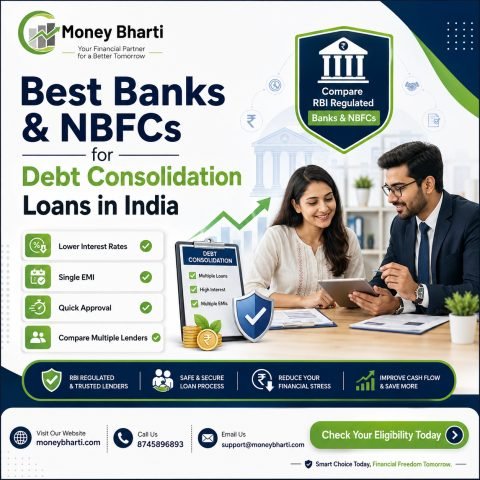
| Where to get it in Chennai | Public sector banks, private banks, NBFCs and digital lenders |
| Typical tenure | 12 to 60 months |
| Rate type | Fixed or floating, depending on lender |
| Repayment | Monthly EMI by auto-debit (NACH/e-mandate) |
| How to apply | Online, or at branches in Anna Salai, T. Nagar, Guindy, Adyar and OMR |
Why People Need This Loan
- Emergency repairs and replacements after heavy rain or flooding
- Annual school and college fees paid on cards
- Festival and wedding spending on credit
- Business owners bridging stock or payroll gaps with personal cards
- Several small instalment plans that now add up to a heavy monthly outflow
Is This Loan Right for You?
It fits you if:
- Your current debts cost far more than a typical bank personal loan
- Your salary or business income is steady and documentable
- Your credit record is reasonably clean
- You can freeze new unsecured borrowing until the loan is repaid
Who Should Avoid This Loan?
- People whose old loans are already cheap, such as home or education loans
- Borrowers with only a few EMIs left on most debts
- Anyone who plans to reuse the cleared cards
- Households with highly irregular income who cannot sustain a fixed EMI
- Anyone approached by unregistered "loan consultants" asking for an advance fee
Key Benefits
- Lower interest cost: trading 30%+ card interest for a personal loan rate reduces what you pay.
- One date to remember: fewer missed payments and fewer late fees.
- A clear finish line: a fixed tenure shows the day the debt ends.
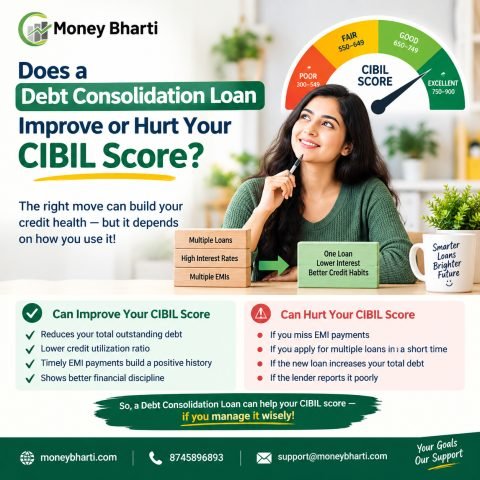
- Healthier credit profile: on-time EMIs and lower card utilisation help your score.
- More predictable budgeting: useful in a year with big seasonal expenses.
Risks You Should Know
- A longer tenure can shrink the EMI but raise total interest.
- Processing fee and GST reduce your saving from day one.
- If old accounts are not closed, you may still receive dues or reminders.
- Spending on cleared cards can leave you with more debt than before.
- Secured loans put gold or property at risk if you default.
Loan Eligibility
| Criterion | Typical expectation |
|---|---|
| Age | Around 21 to 60 years |
| Income source | Salaried, professional or self-employed with proof |
| Job/business vintage | Commonly 6 to 12 months in the current job, or 2+ years in business |
| Credit score | 700+ for better odds and pricing |
| Existing EMIs | Generally kept within 40% to 50% of monthly income |
| Residence | Stable address in or near Chennai with valid proof |
Required Documents
- PAN and Aadhaar for identity and e-KYC
- Address proof such as a utility bill or rent agreement if your Aadhaar address is old
- Last 3 months' salary slips and 6 months' bank statements
- For the self-employed: ITR, GST returns where applicable, and business bank statements
- Outstanding statements for every debt you want to close
- A recent photograph and an Aadhaar-linked mobile number
Interest Rates
Personal loan interest rates in India range from about 8.75% to 24% a year, depending on your credit score, income and employment profile. Consolidation loans are priced in that same band. Your score, your employer's standing and any existing relationship with the lender usually decide where you land. A salaried borrower with a salary account at the same bank often gets a better quote than a walk-in customer.
Bank/NBFC-Wise Interest Rate Comparison
Published rates from a BankBazaar table updated on 4 August 2026. Your own offer will differ.
| Lender | Published rate (p.a.) | Processing fee |
|---|---|---|
| Axis Bank | 8.75% to 21.55% | Up to 2% |
| IDFC First Bank | 9.99% onwards | 0% to 3.5% |
| Kotak Mahindra Bank | 10.99% onwards | Up to 5% |
| Yes Bank | 10.85% to 21% | Up to 2.5% |
| IndusInd Bank | 12% onwards | Up to 3.5% |
| Punjab National Bank | Floating from 10.25%, fixed from 11.25% | 0.35% of loan amount |
Since Indian Bank and Indian Overseas Bank are both headquartered in Chennai, it is worth asking them for quotes too. I have not listed their rates because I could not verify current figures. Compare total cost, not just the headline rate.
Processing Fees & Hidden Charges
| Charge | Watch-out |
|---|---|
| Processing fee + 18% GST | Deducted upfront, so you receive slightly less than the sanctioned amount |
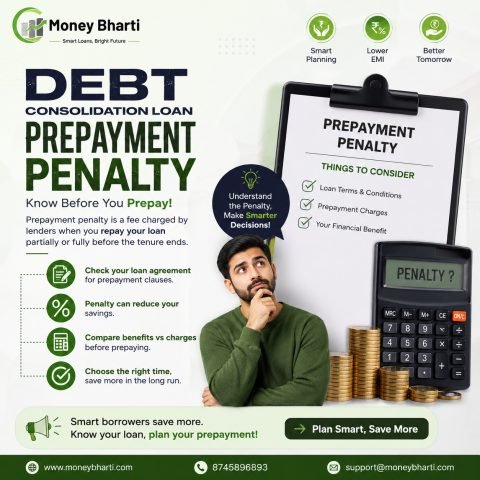
| Foreclosure on old loans | Fixed-rate loans may still levy it |
| Penal interest | Charged on overdue EMIs |
| Mandate bounce fee | Applied when the auto-debit fails |
| Bundled insurance | Sometimes pre-selected; decline if unwanted |
| Part-prepayment rules | Check the minimum amount and any lock-in |
EMI Calculation with a Example
Formula: EMI = P × r × (1+r)ⁿ ÷ [(1+r)ⁿ − 1]
Vignesh's debts (a hypothetical 34-year-old IT professional on OMR, each debt with 30 months left):
| Debt | Balance | Rate | EMI |
|---|---|---|---|
| Credit card (flood repairs + festive shopping) | ₹1,60,000 | 35% | ₹8,075 |
| Personal loan | ₹1,50,000 | 18% | ₹6,246 |
| Instant-loan app | ₹90,000 | 26% | ₹4,111 |
| Total | ₹4,00,000 | ₹18,432 |
New consolidation loan: ₹4,00,000 at 12.75% for 30 months gives an EMI of about ₹15,641.
EMI Comparison (Before vs After)
| Before | After | |
|---|---|---|
| Number of EMIs | 3 | 1 |
| Monthly outgo | ₹18,432 | ₹15,641 |
| Tenure | 30 months | 30 months |
| Total repayment | ≈ ₹5,52,960 | ≈ ₹4,69,230 |
| Total interest | ≈ ₹1,52,960 | ≈ ₹69,230 |
The tenure is unchanged, so the entire saving comes from the lower rate.
Monthly & Total Savings Example
- Monthly relief: ₹18,432 − ₹15,641 = ₹2,791
- Gross saving over 30 months: ≈ ₹83,730
- Processing fee (1.25% + GST): ₹5,000 + ₹900 = ₹5,900
- Net saving: ≈ ₹77,830
If any old loan charges a foreclosure fee, subtract it from this figure.
Loan Amount & Tenure Options
The same ₹4 lakh at 12.75%:
| Tenure | EMI | Total interest |
|---|---|---|
| 18 months | ≈ ₹24,532 | ≈ ₹41,576 |
| 24 months | ≈ ₹18,970 | ≈ ₹55,280 |
| 30 months | ≈ ₹15,641 | ≈ ₹69,230 |
| 48 months | ≈ ₹10,682 | ≈ ₹1,12,736 |
Shorter tenures cost less overall but demand a bigger monthly commitment. Choose the shortest one that still leaves room for rent, groceries and an emergency reserve.
Step-by-Step Application Process
- List every debt: lender, balance, rate, EMI and foreclosure terms.
- Pull your credit report and correct any errors.
- Work out your blended rate, the number the new loan has to beat.
- Request quotes and KFS documents from 3 to 4 lenders.
- Compare total cost, including fees.
- Apply online or at a branch and complete e-KYC.
- Read the sanction letter for rate type, fees and prepayment terms.
- When funds arrive, clear all old debts the same day.
- Collect written closure proof for each account.
- Keep a small buffer in your account for the first few EMI dates.
Processing Time & Disbursement Timeline
| Route | Usual timeframe |
|---|---|
| Pre-approved offer from your own bank | Same day to 1 day |
| Digital lender or NBFC | 1 to 3 days |
| Branch application at a public sector bank | About 3 to 7 days |
| Self-employed or complex profile | Up to roughly 10 days |
Customer Case Study
(A composite example, not a real individual.)
Manoj, 47, supplies small components to units around Ambattur. When a large buyer delayed payments by three months, he covered raw material through two personal cards and a short-term app loan. His monthly outflow rose to more than half of his declared income. He took a consolidation loan backed by his ITR and bank statements, cleared the cards and the app loan on the day of disbursal, and began routing customer payments into one current account. A year of clean repayments lifted his score, which helped him negotiate a lower rate on his next working-capital limit.
Customer Persona Example
| Name | Harini, 30 |
| Role | Senior analyst at a Guindy firm |
| Debts | Two cards, a laptop EMI and a small personal loan |
| Pain points | School fees for a younger sibling, festive spending, little emergency cash |
| Best approach | Ask her salary bank for a pre-approved offer, choose 24 to 30 months, and set a monthly card limit |
Loan Approval Journey (Timeline)
| Stage | What happens |
|---|---|
| Enquiry | You share income and debt details |
| Verification | Lender checks KYC, credit report and income |
| Offer | Amount, rate and tenure are proposed |
| Sanction | You review the KFS and sign digitally |
| Disbursal | Funds reach you, or your old lenders directly |
| Closure | You collect no-dues proof for each old debt |
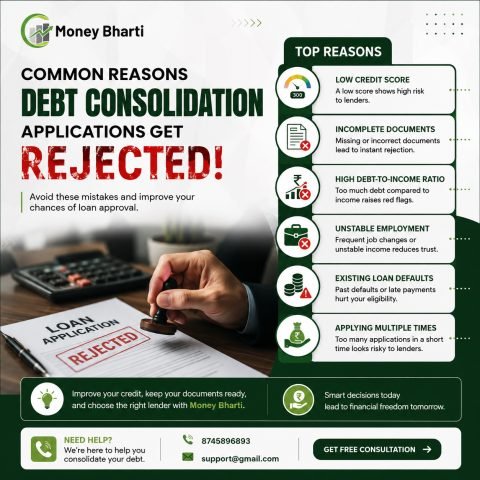
Common Loan Rejection Reasons
- Credit score below the lender's cut-off
- Recent missed EMIs or card dues
- Many loan or card applications in a short period
- Existing EMIs already taking most of your income
- Mismatched details across Aadhaar, PAN and bank records
- Very new job or short business history
- Income that cannot be verified with documents
Tips to Increase Approval Chances
- Approach your salary bank first, since it already knows your cash flow
- Pay every due on time for at least three cycles before applying
- Pay down card balances to lower your utilisation
- Keep name, address and PAN details consistent across documents
- Space out applications instead of applying everywhere at once
- Add a co-applicant with steady income if yours varies
- Fix errors on your credit report before applying
Eligibility Score / Approval Score
A quick readiness meter (not an official lender score). Score each answer: A = 3, B = 2, C = 1.
| Question | A | B | C |
|---|---|---|---|
| Credit score | 750+ | 700–749 | Below 700 |
| EMIs as a share of income | Under 40% | 40–50% | Over 50% |
| Job or business vintage | 2+ years | 1–2 years | Under 1 year |
| Missed payments in 12 months | None | One | Two or more |
11–12: strong profile, negotiate firmly. 8–10: good chance, tidy up weaker areas first. 4–7: spend a few months improving before you apply.
Loan Cost Breakdown
For Vignesh's ₹4 lakh at 12.75% over 30 months:
| Component | Amount |
|---|---|
| Principal | ₹4,00,000 |
| Interest | ≈ ₹69,230 |
| Processing fee incl. GST | ₹5,900 |
| Total cost | ≈ ₹4,75,130 |
Pros & Cons
| Pros | Cons |
|---|---|
| One EMI, one date | Upfront fees reduce savings |
| Can cut interest sharply | Longer tenures raise total interest |
| Easier budgeting around seasonal costs | Risk of using cleared cards again |
| Helps credit recovery | Small temporary dip after enquiry |
| Many lender options in Chennai | Some offers include unwanted add-ons |
Myths vs Facts
| Myth | Fact |
|---|---|
| "A consolidation loan wipes out my debt." | It moves the debt into one loan; you still repay it in full. |
| "Old accounts close automatically." | You must confirm each one is paid and closed. |
| "Paying an advance fee guarantees approval." | Be cautious; genuine lenders deduct fees from the loan amount. |
| "Rates are lower in big cities." | Rates depend on your profile and the lender, not the city. |
| "A bigger loan is a better deal." | Borrow only what you need to clear your debts. |
Loan Comparison Table (vs Other Loans)
| Option | Best for | Caution |
|---|---|---|
| Consolidation personal loan | Several high-rate unsecured debts | Fees and tenure |
| Card balance transfer | Small card balances you can clear fast | Promo rate expires |
| Gold loan | Quick, smaller amounts | Gold is held as collateral |
| Loan against property | Large sums, long tenures | Property at risk on default |
| Debt settlement | Severe hardship only | Serious, lasting credit damage |
Latest RBI Guidelines & Compliance
Prepayment. RBI has barred regulated lenders from levying pre-payment charges on floating rate loans taken by individuals for non-business purposes, and the rule applies to loans sanctioned or renewed on or after 1 January 2026. For fixed-rate personal loans, lenders can still charge foreclosure fees, typically 2% to 6% of the outstanding principal. Read every old agreement before closing those loans.
Key Fact Statement. The KFS is a mandatory one-page document that lays out the APR, all fees, total repayment, tenure and cooling-off terms, and lenders must share it before you sign. Lenders cannot charge fees that are not disclosed in the KFS.
Credit reporting. Lenders are moving to weekly credit reporting cycles, with full implementation from 1 July 2026, so your repayment record should reflect in your score sooner.
If a complaint with your lender goes unresolved, you can escalate it through RBI's complaint portal (cms.rbi.org.in). Rules change, so verify the latest circulars on rbi.org.in before publishing.
Financial Expert Opinion
Planners typically recommend this order: stop new borrowing first, compare the total remaining cost of your old debts with the new loan's total cost, and only then decide. Keep the tenure as short as your budget allows, and treat the monthly saving as seed money for an emergency fund, which matters in a city where a single monsoon can create sudden bills. If you want a named expert quote in this article, obtain it directly, with the person's consent.
Latest Market Trends & Statistics
- Pre-approved digital offers are shortening approval times for salaried borrowers.
- Lenders compete on fee waivers and fast disbursal to attract consolidation customers.
- Faster credit reporting rewards timely repayment sooner than before.
- Rates differ widely between lenders, which makes comparison shopping worthwhile.
I have not included Chennai-specific statistics, such as household debt levels, because I could not verify them. Add figures from RBI or a credit bureau report and cite the source.
Frequently Asked Questions
1. Where can I get a debt consolidation loan in Chennai?
From banks, NBFCs and digital lenders serving Tamil Nadu, online or at local branches.
2. Do I need a Chennai address to apply?
You need valid address proof, and the lender must serve your location.
3. I work in Chennai but my family home is in another district. Can I apply?
Yes, as long as your current address and income documents can be verified.
4. What credit score do I need?
Most lenders prefer 700 or above, and higher scores usually get better rates.
5. Can traders and small business owners apply?
Yes, with ITR, bank statements and business proof.
6. Is a longer tenure better?
It lowers the EMI but raises total interest. Choose the shortest you can comfortably afford.
7. Will the lender pay my old creditors directly?
Many do, which is the safest route. Confirm before you accept.
8. Should I close my cards after consolidating?
Not necessarily, but avoid using them while the loan is running.
9. Is there any fee to close my old loans?
Possibly on fixed-rate loans, so check each agreement.
10. How fast can I get the money?
From the same day to about a week, depending on the lender and your profile.
11. Can I use a consolidation loan for flood-repair costs?
You can use a personal loan for that, but if you only need a small amount, compare it with other options first. Consolidation is meant for clearing existing debts.
12. What if I move to Bengaluru or Hyderabad for work?
Your loan stays with you. For local lender tips, see debt consolidation loan in Bangalore or Hyderabad.
13. What if I relocate to a western metro or Delhi NCR?
You can read the guides for Mumbai, Pune, Delhi, Gurgaon or Noida.
14. Do rates differ by city?
Mostly not. Rates are set by your profile and the lender's policy. Readers in Kolkata, Jaipur or Ahmedabad can check their local pages for lender availability.
15. Can I prepay the new loan?
Yes. Floating-rate loans sanctioned from 1 January 2026 carry no prepayment charge; for fixed-rate loans, check the KFS.
16. What if my application is rejected?
Ask for the reason, fix the issue over a few months, and reapply.
17. Is a co-applicant useful?
Yes, especially if your income varies or your score is borderline.
18. Is consolidation better than settlement?
For borrowers with steady income, usually yes, because settlement damages your credit record.
Useful Tools
- EMI calculator to test amounts and tenures
- FOIR calculator: (total monthly EMIs ÷ monthly income) × 100
- Blended-rate calculator to find the rate you need to beat
- Free credit report check
- Eligibility estimator based on income and existing EMIs
- Debt payoff planner (highest-rate-first vs smallest-balance-first)
Downloadable Resources
Chennai Borrower's Checklist:
- [ ] Listed every debt with rate and balance
- [ ] Checked credit report for errors
- [ ] Prepared address proof matching current residence
- [ ] Collected 3+ quotes with KFS (include Indian Bank and IOB)
- [ ] Checked foreclosure fees on old loans
- [ ] Compared total cost, not just EMI
- [ ] Cleared old debts on disbursal day
- [ ] Collected written closure proof
- [ ] Set a monthly spending cap after consolidation
- [ ] Started a small emergency fund
Debt Inventory Sheet: lender, balance, rate, EMI, months left, foreclosure fee.
Infographic / Visual Explanation
  THE SEASONAL PILE-UP                 THE RESET
  ┌──────────────────────┐        ┌───────────────────────┐
  │ Monsoon repairs      │        │ One loan ₹4,00,000    │
  │ School fees          │  ───►  │ @ 12.75%, 30 months   │
  │ Deepavali / Pongal   │        │ EMI ₹15,641           │
  └──────────────────────┘        └───────────────────────┘
   3 EMIs = ₹18,432                Net saving ≈ ₹77,800
Financial Terms Glossary
- Auto-debit (NACH): automatic EMI deduction from your bank account
- Blended rate: weighted average interest across all your debts
- Co-applicant: a second person sharing responsibility for the loan
- Credit utilisation: the share of your card limit that you use
- Foreclosure: repaying a loan fully before its scheduled end
- KFS: Key Fact Statement, the standard fact sheet lenders must provide
- No-dues certificate: proof that a loan has been fully repaid
- Penal interest: extra interest on overdue payments
- Rollover: unpaid card balance carried into the next month with interest
- Tenure: the loan's repayment duration in months
Related Articles
- Debt Consolidation Loan in Bangalore
- Debt Consolidation Loan in Hyderabad
- Debt Consolidation Loan in Mumbai
- Debt Consolidation Loan in Pune
- Debt Consolidation Loan in Delhi
- Debt Consolidation Loan in Kolkata
Conclusion + Clear Call-to-Action
Chennai's calendar of monsoon emergencies, school fees and festivals makes it easy for small dues to stack up. Vignesh's example shows what a well-timed consolidation can do: one EMI in place of three, ₹2,791 back in the monthly budget, and about ₹77,800 saved. That only worked because he compared offers, checked the fees and left the cards alone.
Your next step: list every debt you owe, work out your blended rate, and ask three lenders for quotes and their KFS this week. If the total cost beats what you pay now, go ahead. If it does not, pay down the costliest debt first.
Disclaimer: This article is for general information only and is not financial advice. Rates, fees and rules change, so confirm details with the lender and RBI before you decide.