Quick Summary
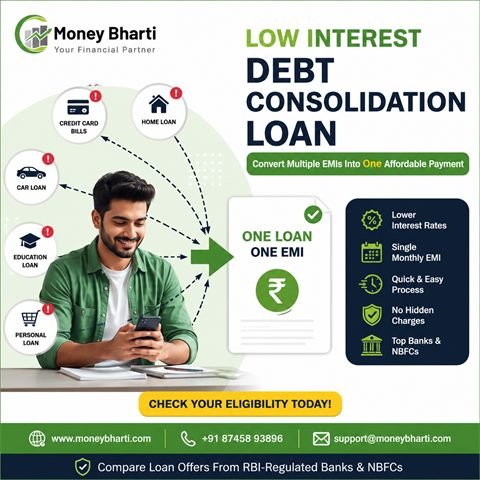
- A debt consolidation loan is a single new loan used to pay off several expensive debts at once, so you end up with one lender, one EMI and one due date.
- It only makes sense if the new loan's interest rate is lower than the blended rate you are paying today.
- In this guide's worked example, merging ₹5 lakh of debt across three lenders cuts the monthly outgo from ₹23,537 to ₹16,727, and saves roughly ₹95,000 after fees.
- The catch is that a longer tenure lowers your EMI but raises total interest, and any prepayment charge on the old loans eats into your savings.
- If overspending caused the debt, consolidation gives relief only if the spending stops too.
Problem-Based Introduction
Picture the 5th of the month. A card bill is due on the 7th, a personal loan EMI on the 10th, and an instant-loan app pulls its instalment on the 15th. One slip and you are paying a late fee plus penal interest, and your credit score takes a hit.
Most people in this spot are not reckless. Small borrowings have simply piled up: a card to bridge a medical bill, an app loan for a festival, a personal loan for a move. Each looked manageable alone. Together they eat a third of the salary before rent is paid.
Consolidation replaces that scattered pile with one structured, time-bound repayment plan.
Loan Overview
| Feature | Details |
|---|---|
| What it is | A new loan that pays off multiple existing debts |
| Usual form | Unsecured personal loan (secured options exist) |
| Typical ticket size | From about ₹50,000 up to ₹40 lakh or more, depending on the lender |
| Tenure | Commonly 1 to 5 years |
| Interest | Fixed or floating, priced on your credit profile |
| Repayment | Equal monthly instalments (EMIs) |
| Main goal | Lower interest cost and simpler management |
Why People Need This Loan
- Credit card debt with revolving balances that carry interest of 3% or more per month
- Instant-loan apps with short tenures and steep effective rates
- Overlapping EMIs that exceed what the monthly budget can handle
- Missed due dates leading to late fees and a falling credit score
- A wish to have a clear end date for being debt-free
Is This Loan Right for You?
It is a good fit if:
- Your existing debts carry rates well above what a bank would offer you today
- Your credit score is healthy enough to qualify for a competitive rate
- Your income is regular and can cover the new EMI comfortably
- You are ready to stop adding fresh unsecured debt
Who Should Avoid This Loan?
- People whose current loans are already cheap, such as home or education loans
- Those with 3 or 4 months left on most debts, where fees outweigh savings
- Borrowers who would treat freed-up card limits as new spending room
- Anyone with an irregular income who cannot commit to a fixed EMI
- People whose only offers come at rates equal to or above their current blended rate
Key Benefits
- Single payment: convert multiple EMIs into a single EMI, with one date, one amount and one lender.
- Interest savings: trading 30–40% card interest for a low-interest debt consolidation loan can save lakhs.
- Defined finish line: a fixed tenure tells you exactly when you will be free of these debts.
- Score recovery: on-time EMIs and lower card utilisation help your credit profile.
- Budget clarity: a predictable EMI makes monthly planning realistic.
Risks You Should Know
- Stretched tenure trap: a smaller EMI can hide a larger total interest bill.
- Upfront costs: processing fee and GST are deducted or charged at the start.
- Relapse risk: clearing cards and then swiping them again puts you in deeper debt than before.
- Temporary score dip: the lender's credit check and a new account can lower your score briefly.
- Collateral risk: with secured versions, default can put your gold or property at stake.
Loan Eligibility
Debt consolidation loan eligibility depends mainly on your credit score, income stability and existing EMI burden.
| Parameter | What lenders usually look for |
|---|---|
| Age | Roughly 21 to 60 years |
| Employment | Stable salaried job or established business |
| Income | Minimum monthly income set by each lender |
| Credit score | 700 or above improves approval and pricing |
| Debt burden | Total EMIs typically capped at 40–50% of income |
| Residency | Indian resident with valid KYC |
Required Documents
- Photo ID and address proof (Aadhaar, PAN, passport, or similar)
- Recent salary slips and 3–6 months of bank statements
- For the self-employed: ITR, business proof and bank statements
- Statements of the debts you want to clear, showing outstanding balances
- Recent photograph and a mobile number linked to Aadhaar for e-KYC
Interest Rates
Personal loan interest rates in India span a wide band, from about 8.75% to 24% a year, and where you land depends on your credit score, income and employment profile. Since a consolidation loan is usually priced like a personal loan, the same band applies. Your job is to land near the bottom of it, and the biggest levers are your credit score and how many lenders you compare.
Bank/NBFC-Wise Interest Rate Comparison
Whether you go to a bank or one of the debt consolidation companies in the NBFC space, compare offers side by side. Published rates below are as of the BankBazaar update dated 4 August 2026. Actual offers are personalised.
| Lender | Published rate (p.a.) | Processing fee |
|---|---|---|
| Bank of Maharashtra | 8.75% | Up to 1% |
| IDFC First Bank | 9.99% onwards | 0% to 3.5% |
| Punjab National Bank | Floating from 10.25%, fixed from 11.25% | 0.35% of loan amount |
| Bank of India | 10.85% onwards | 1%, with a minimum of ₹2,500 and cap of ₹15,000 |
| Yes Bank | 10.85% to 21% | Up to 2.5% |
| IDBI Bank | 11% to 15.5% | 1% |
| IndusInd Bank | 12% onwards | Up to 3.5% |
Rate is only half the picture. A lender with a slightly higher rate but a near-zero fee can beat a "cheaper" one on total cost, so always compare the full cost, not the headline number.
Processing Fees & Hidden Charges
| Charge | What to check |
|---|---|
| Processing fee | Percentage of the loan, plus 18% GST |
| Prepayment/foreclosure on old loans | Fixed-rate loans may carry it; see the RBI section |
| Late payment | Flat fee plus penal interest on overdue EMIs |
| Bounce charges | Levied when an auto-debit fails |
| Bundled insurance | Sometimes added by default; ask for it to be removed if unwanted |
| Documentation/stamp costs | Small but real in some cases |
The Key Fact Statement (see the RBI section) lists every charge, so read it before you sign.
EMI Calculation with a Real Example
Formula: EMI = P × r × (1+r)ⁿ ÷ [(1+r)ⁿ − 1], where P is the principal, r the monthly rate and n the number of months.
Meera's debts (an illustrative case, each with 30 months remaining):
| Debt | Balance | Rate | Monthly EMI |
|---|---|---|---|
| Credit card revolving balance | ₹1,80,000 | 39% | ₹9,483 |
| Personal loan | ₹2,40,000 | 20% | ₹10,232 |
| Instant-loan app | ₹80,000 | 30% | ₹3,822 |
| Total | ₹5,00,000 | ₹23,537 |
Consolidation loan: ₹5,00,000 at 12.5% for 36 months gives an EMI of about ₹16,727.
EMI Comparison (Before vs After)
| Before (3 debts) | After (1 loan) | |
|---|---|---|
| Monthly outgo | ₹23,537 | ₹16,727 |
| Remaining/total tenure | 30 months | 36 months |
| Total repayment | ≈ ₹7,06,095 | ≈ ₹6,02,172 |
| Total interest | ≈ ₹2,06,095 | ≈ ₹1,02,172 |
| Payments to track | 3 | 1 |
Note that the new loan runs 6 months longer. Part of the saving comes from the lower rate and part from the longer tenure, so judge it on total cost, not on EMI alone.
Monthly & Total Savings Example
- Monthly relief: ₹23,537 − ₹16,727 = ₹6,810
- Gross saving over the term: about ₹1,03,923
- Processing fee (1.5% + GST): ₹7,500 + ₹1,350 = ₹8,850
- Net saving: about ₹95,000
That figure assumes there is no foreclosure fee on the old loans. If any of them charges one, subtract it.
Loan Amount & Tenure Options
Same ₹5 lakh at 12.5%:
| Tenure | EMI | Total interest |
|---|---|---|
| 24 months | ≈ ₹23,654 | ≈ ₹67,696 |
| 36 months | ≈ ₹16,727 | ≈ ₹1,02,172 |
| 48 months | ≈ ₹13,290 | ≈ ₹1,37,920 |
| 60 months | ≈ ₹11,249 | ≈ ₹1,74,940 |
A practical rule: pick the shortest tenure whose EMI stays under roughly 40% of your take-home pay, including other loans.
Step-by-Step Application Process
- Build a debt inventory: lender, balance, rate, tenure left, foreclosure terms.
- Pull your credit report and fix any errors.
- Calculate your blended current interest rate.
- Shortlist 3–4 lenders and request their offers and Key Fact Statements.
- Compare total cost (interest plus fees), not just the rate.
- Apply through online debt consolidation services of a registered lender, and complete e-KYC and document upload.
- Review the sanction letter and set up the auto-debit mandate.
- After disbursal, clear every old debt the same day.
- Collect closure letters or no-dues certificates.
- Cut card limits or lock cards you tend to overuse.
Processing Time & Disbursement Timeline
Some lenders now offer an instant debt consolidation loan to pre-approved customers, though your actual turnaround depends on the lender and your profile.
| Lender type | Typical turnaround |
|---|---|
| Existing customer with a pre-approved offer | Same day to 1 day |
| Digital NBFC or private bank | 1–3 days |
| Public sector bank | Around 3–7 days |
| Larger or self-employed cases | Up to about 10 days |
Customer Case Study
(A composite example for illustration, not a real individual.)
Arjun, 34, a logistics coordinator in Jaipur, was juggling two credit cards and a small app loan. After a family medical expense, his monthly obligations reached 55% of his salary. He took a ₹3.6 lakh consolidation loan from his salary bank at a lower rate, paid off all three accounts on the day the funds arrived, and asked the bank to reduce one card's limit. His monthly outgo fell by about ₹4,200, he stopped missing due dates, and within a year he had rebuilt a small emergency buffer that earlier would have been impossible.
Customer Persona Example
| Name | Neha, 27 |
| Work | Freelance designer, variable income |
| Debts | Two cards and a personal loan, about ₹3 lakh in total |
| Pain points | Uneven cash flow, missing due dates during slow months |
| Best approach | Choose a longer tenure to keep the EMI low, and add a co-applicant if her income proof is thin. Then build a two-month buffer before prepaying |
Loan Approval Journey (Timeline)
| Stage | What happens |
|---|---|
| Day 0 | You apply and share documents |
| Day 1 | Lender checks your credit report and verifies income |
| Day 1–2 | Offer is made and you review the sanction letter |
| Day 2–3 | You sign digitally and set up auto-debit |
| Day 3–4 | Funds are disbursed to you or directly to old lenders |
| Day 4–7 | Old accounts closed and closure proof collected |
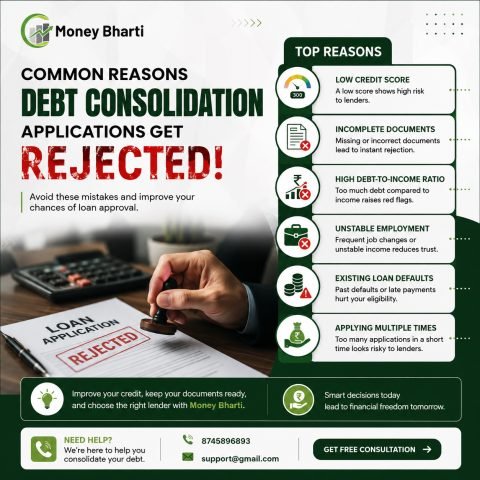
Common Loan Rejection Reasons
- A credit score below the lender's cut-off
- Existing EMIs already consuming too much of your income
- Many recent loan or card applications in a short window
- Mismatched details between documents
- A history of missed payments or settled accounts
- Insufficient or hard-to-verify income
- Employment too new for the lender's comfort
Tips to Increase Approval Chances
- Pay every due date on time for at least three months before applying
- Bring card utilisation below roughly 30% of the limit if you can
- Apply first with the bank where your salary account sits
- Avoid applying to many lenders at once, since each check leaves a mark
- Correct credit report errors before you apply
- Add a co-applicant with steady income if your profile is borderline
- Ask for an amount that keeps your total EMIs within a healthy share of income
Eligibility Score / Approval Score
Run this quick self-check (it is not any lender's official score). Give yourself the points that apply:
| Question | Points |
|---|---|
| Credit score 750 or higher | 25 |
| No missed payment in the last 12 months | 20 |
| Total EMIs under 40% of income | 20 |
| At least 2 years in the same job or business | 15 |
| Fewer than 3 loan or card applications in 6 months | 10 |
| All documents ready and matching | 10 |
75–100: strong candidate; negotiate for the best rate. 50–74: likely approval at an average rate; tidy up weak spots first. Below 50: spend two to three months improving before applying.
Loan Cost Breakdown
For Meera's ₹5 lakh loan at 12.5% over 36 months:
| Component | Amount |
|---|---|
| Principal repaid | ₹5,00,000 |
| Interest paid | ≈ ₹1,02,172 |
| Processing fee incl. GST | ₹8,850 |
| Total cost of the loan | ≈ ₹6,11,022 |
Pros & Cons
| Pros | Cons |
|---|---|
| One payment to remember | Upfront fees reduce savings |
| Potentially far lower interest | Longer tenure can raise total interest |
| Clear debt-free date | Freed-up card limits can tempt new debt |
| Helps rebuild credit through discipline | Brief dip in score from the new inquiry |
| Less stress from collection calls | Secured versions put assets at risk |
Myths vs Facts
| Myth | Fact |
|---|---|
| "Consolidation erases my debt." | It moves your debt into one loan; you still repay it in full. |
| "It always lowers my EMI." | Only if the rate or tenure works in your favour. |
| "It ruins my credit score." | It causes a small, temporary dip; on-time repayment helps over time. |
| "It's the same as settlement." | Settlement, often pitched by debt relief companies, means paying less than owed and damages your record; consolidation does not. |
| "I must close all my cards." | Not required, but keeping them under control is essential. |
Loan Comparison Table (vs Other Options)
Beyond a single loan, various debt consolidation programs exist, so match the option to your situation.
| Option | Best suited for | Watch out for |
|---|---|---|
| Consolidation personal loan | Several high-rate unsecured debts | Fees, tenure creep |
| Card balance transfer | Smaller balances you can clear quickly | Rates jump after the promo period |
| Gold loan | Smaller sums needed fast | Your gold is held as collateral |
| Loan against property | Large amounts, long tenures | Home is at risk on default |
| Debt settlement | Last resort when repayment is impossible | Serious, lasting damage to credit |
Latest RBI Guidelines & Compliance
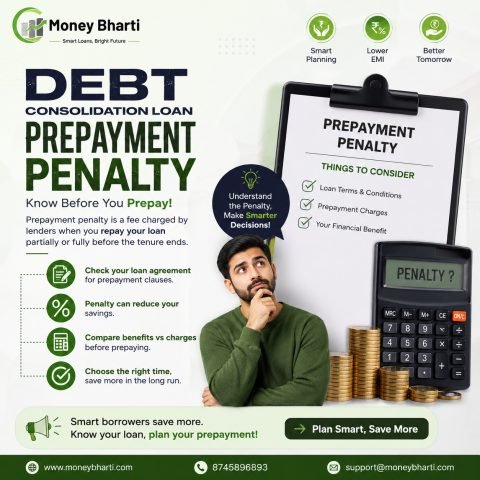
Prepayment charges. From 1 January 2026, prepayment charges are not levied on floating-rate loans sanctioned or renewed on or after that date. The rule targets individual borrowers for non-business purposes. Fixed-rate personal loans can still carry foreclosure fees, which commonly range from 2% to 6% of the outstanding principal. Since many personal loans are fixed-rate, check the fee on every debt you plan to clear.
Key Fact Statement (KFS). Lenders must give you a one-page KFS before you sign, setting out the APR, all fees, total repayment and tenure. Use it to compare offers side by side. Lenders also cannot charge fees that are not disclosed in the KFS.
Faster credit updates. Lenders are moving to weekly credit reporting, with full implementation from 1 July 2026, so your on-time payments should show up in your score sooner than before.
Rules evolve, so confirm the latest circulars on the RBI website before publishing.
Financial Expert Opinion
The common advice from financial planners is simple. Do the arithmetic first: compare your current blended rate and remaining interest to the new loan's total cost. Then treat consolidation as a reset, not a reward: freeze new unsecured borrowing, build a small emergency fund alongside the EMI, and prepay when bonuses or windfalls arrive. If you would like a named expert quote in this article, get it directly from the person with their permission.
Latest Market Trends & Statistics
- Digital, paperless applications with pre-approved offers are shortening approval times.
- Lenders are increasingly bundling top-ups and balance transfers with consolidation products.
- Faster credit reporting makes score improvement more visible to borrowers.
- The gap between the cheapest and costliest lenders is wide, which makes comparison-shopping valuable.
Headline statistics such as national card-debt totals are not included because current figures could not be verified. Pull them from RBI's Financial Stability Report or credit bureau industry reports before adding numbers.
Frequently Asked Questions
1. What exactly is a debt consolidation loan?
It is one loan taken to repay several existing debts, leaving you with a single EMI.
2. Will it hurt my credit score?
You may see a small, short-lived dip from the credit check. Regular repayment usually improves the score over time.
3. Which debts can I merge?
Credit card balances, personal loans and small app or consumer loans are the usual candidates.
4. Should I include my home loan?
Generally no. Home loans are typically cheaper and carry tax benefits you may lose.
5. What score do I need?
Around 700 or above gives you a fair chance at good pricing; higher is better.
6. Is a longer tenure a good idea?
It lowers the EMI but raises total interest. Choose the shortest tenure you can afford.
7. How do I know if I'm really saving money?
Compare the total remaining payments on your old debts with the new loan's total payments plus fees.
8. Are there fees for closing my old loans?
Possibly, on fixed-rate loans. Check each agreement before you clear them.
9. Can I prepay the new consolidation loan?
Yes. For floating-rate loans sanctioned after 1 January 2026, there is no prepayment charge; for fixed-rate loans, read the KFS.
10. Should the lender pay my old creditors directly?
That is safest where offered, since it ensures the money actually goes to the old debts.
11. How long does it take to get the money?
Anywhere from the same day to about a week, depending on the lender.
12. Can self-employed people apply?
Yes, with ITR, bank statements and business proof.
13. What if my application is rejected?
Ask for the reason, fix it over a few months, and reapply rather than applying everywhere at once.
14. Is a co-applicant helpful?
Yes, especially if your income is variable or your score is average.
15. Does consolidation stop recovery calls?
It does once the old dues are cleared and closed, so make sure each one is properly settled.
16. Is it better than a balance transfer?
For larger, mixed debts, usually yes. Balance transfers suit smaller card balances you can clear within the promo window.
17. Can I use it to fund fresh spending?
You can, but doing so defeats the purpose and increases your risk.
18. Is applying online safe?
Yes, if you use a registered bank or NBFC's official app or website and never share OTPs with third parties.
Useful Tools
- EMI calculator: test different amounts, rates and tenures before you apply.
- FOIR calculator: (total monthly EMIs ÷ monthly income) × 100.
- Blended rate calculator: weighted average interest across all your debts.
- Eligibility estimator: maximum loan your income supports.
- Free credit report check: review your score and correct errors early.
- Payoff planner: compare the "highest rate first" and "smallest balance first" strategies.
Financial Terms Glossary
- Blended interest rate: the weighted average rate across all your debts
- Consolidation: merging multiple debts into one
- EMI: fixed monthly instalment of principal plus interest
- FOIR: share of income going toward fixed obligations
- Fixed vs floating rate: rate that stays constant vs one that moves with a benchmark
- Foreclosure: paying off a loan in full before its scheduled end
- KFS: the standardised fact sheet lenders must provide before you commit
- Penal interest: extra interest on overdue amounts
- Revolving credit: borrowing like a credit card, where unpaid balances roll over with interest
- Utilisation: how much of your credit limit you are using
Related Articles
- Debt Consolidation Loan Eligibility: What Lenders Check
- Debt Consolidation Interest Rates Explained
- Balance Transfer Loan: Is It Worth It?
- Debt Consolidation EMI Calculator
- Convert Multiple EMIs into a Single EMI
- Low-Interest Debt Consolidation Options
Conclusion + Clear Call-to-Action
A debt consolidation loan is a tool, not a cure. In Meera's case it turned three draining payments into one manageable EMI and saved roughly ₹95,000, but only because she compared total costs, checked the fees and stopped adding new debt.
Your next step: list every debt you have today, calculate your blended interest rate, and then run the numbers in an EMI calculator against two or three lender offers. If the new loan clearly beats what you pay now, apply. If it does not, focus on paying down the costliest debt first.
Disclaimer: This article is for general information only and is not financial advice. Terms, rates and regulations change; confirm details with the lender and RBI before making decisions.