Diwali season in Ahmedabad usually means shopping, gifting, and a fair bit of credit card spending. For Sonal, a school teacher living near Naranpura, that one festive season three years ago turned into a debt spiral she's still working through — a credit card balance that never seemed to shrink, a personal loan for her brother's wedding contribution, and a small gold loan she took when cash ran short.
Sound familiar? If you're paying three or four different EMIs every month, each with its own due date and interest rate, you already know how draining it can get — not just financially, but mentally.
This is where a debt consolidation loan steps in. It's not a magic fix, but it is a practical tool: you take one new loan, use it to close all your existing debts, and from that point, you're managing just one EMI instead of many. Below, we'll go through exactly how it works in the Ahmedabad market — the eligibility rules, the paperwork, realistic numbers, and the traps to watch out for.
What Exactly Is a Debt Consolidation Loan?
In simple terms, a debt consolidation loan is money borrowed for one purpose only — paying off your existing debts. Rather than sending money to three or four different lenders every month, you use this new loan to shut all those accounts down, and then repay just the new loan.
Here's an easy way to picture it: imagine you owe small amounts to five different shopkeepers in your neighbourhood. Instead of remembering five separate ledgers, you borrow enough from one trusted source, clear all five accounts, and now owe only that one person. That's essentially what consolidation does with your credit card bills, personal loans, and other borrowings.
The catch — and this matters a lot — is that the deal only works if your new loan's interest rate is actually lower than what you were paying before. Credit cards in India routinely charge 36% to 45% annually. Even a "regular" personal loan at 14-16% is a massive upgrade over that.
Why This Matters More in a City Like Ahmedabad
Ahmedabad isn't just one kind of borrower. You've got salaried professionals working in the IT corridor around SG Highway and Prahladnagar, textile and diamond traders in the old city near Ratanpol and Manek Chowk, and small manufacturers scattered across Naroda and Odhav. Each group borrows differently, but the underlying problem is often the same — multiple small debts that quietly cost more together than anyone realises.
A shopkeeper who relies on credit card float during lean months, a young software engineer who took an EMI for a new laptop plus a personal loan for a bike, or a family managing a medical loan alongside a consumer durable loan — all of them are candidates for consolidation, because the goal isn't to borrow more, it's to borrow smarter.
Types of Consolidation Loans You Can Choose From
Not every consolidation loan looks the same. Here are the main routes available to borrowers in Ahmedabad:
- Unsecured personal loan for consolidation — No collateral needed. Approval depends on your income and credit score. Slightly higher interest than secured options, but faster processing.
- Gold-backed consolidation loan — Given how common gold ownership is in Gujarat, pledging gold jewellery is a popular way to get a lower interest rate quickly.
- Loan against property or FD — Works well if you own an asset and want the lowest possible rate, though it takes longer to process.
- Balance transfer — If you just have one expensive loan (not multiple), some lenders will simply "buy out" that loan at a cheaper rate.
- Credit-card-specific consolidation — Certain NBFCs design products purely to close out credit card dues, since that's usually the costliest debt on anyone's list.
The Benefits: Why Bother Consolidating at All?
| Benefit | What It Actually Means for You |
|---|---|
| One EMI | No more checking four apps to remember what's due when |
| Lower blended interest | Especially true if credit cards were a big chunk of your debt |
| Fixed payoff date | Unlike revolving credit card debt, this loan has a defined end |
| Cleaner credit report | Fewer active accounts, lower utilisation — both help your score |
| Less chance of penalty fees | One due date is much harder to forget than four |
There's also a psychological win here that doesn't get talked about enough — knowing exactly when your debt will be zero tends to reduce financial anxiety far more than people expect.
Key Features to Know Before You Apply
| Feature | Typical Range in the Market |
|---|---|
| Loan type | Mostly unsecured; secured options against gold, FD, or property |
| Amount available | ₹50,000 up to ₹25-30 Lakhs |
| Repayment tenure | 1 to 5 years |
| Time to disbursal | 24-48 hours for salaried applicants with clean paperwork |
| Processing charges | Roughly 1-3% of loan amount |
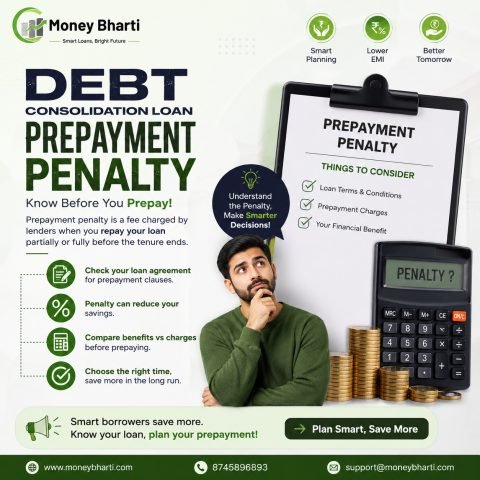
| Early closure | Usually allowed after 6-12 months, subject to charges |
It's worth mentioning that these numbers shift from lender to lender. A public sector bank, a private NBFC, and a digital-first lender can all quote noticeably different terms for the exact same borrower profile — so shopping around genuinely pays off.
Who Qualifies for a Debt Consolidation Loan in Ahmedabad?
Lenders broadly look at the same handful of things, though thresholds differ slightly:
If you're salaried:
- Age between 21 and 58 years
- Monthly income of at least ₹15,000-₹25,000, depending on the lender
- Minimum 6 months in your current job, 1-2 years total work history
- Credit score of 650 or above works in your favour
If you're self-employed or run a business:
- Age between 25 and 65 years
- At least 2 years of steady business operations
- Annual income proof, generally starting around ₹3 Lakhs
- ITR and GST filings that reflect consistent (even if seasonal) income
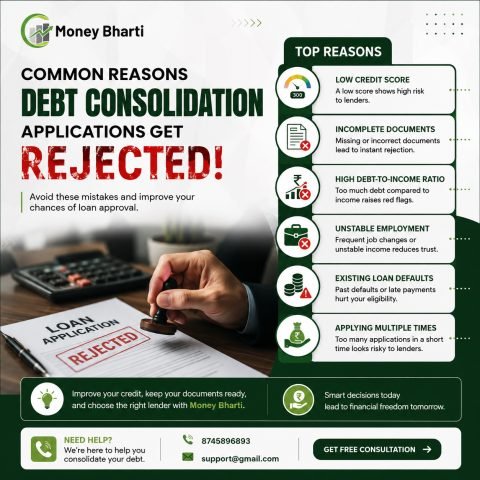
One thing worth clarifying — a dropping credit score because of high credit card usage is not automatically disqualifying. In fact, it's the single most common reason people apply for consolidation loans in the first place. It just means your interest rate may land on the higher end, or a lender might ask for a co-applicant.
Paperwork You'll Need to Keep Ready
Nothing slows down a loan application more than scrambling for documents halfway through. Here's what to keep on hand:
Salaried applicants:
- PAN and Aadhaar card
- Salary slips for the last 3 months
- Bank statements, 3-6 months
- Address proof
- Statements of all debts you want to consolidate
Self-employed applicants:
- PAN, Aadhaar, and business registration proof
- ITR for the last 2 years
- GST returns, where applicable
- Bank statements, 6-12 months (a full year helps if your business is seasonal, which is common in Ahmedabad's textile trade)
- Existing loan and card statements
A small but useful tip: if your income fluctuates by season, provide a longer statement history rather than just the most recent few months. It gives the lender a fuller, fairer picture instead of catching you in a slow month.
What Interest Rate Should You Expect?
| Your Credit Score | Likely Interest Rate |
|---|---|
| 750+ | 10.5% - 14% per year |
| 700-749 | 14% - 18% per year |
| 650-699 | 18% - 24% per year |
| Below 650 | 24%+, or collateral/co-applicant may be required |
A few things quietly influence your final rate beyond the score alone:
- How much of your income already goes toward existing EMIs
- Whether you're an existing customer of the lending bank
- The tenure you choose — shorter tenures sometimes get marginally better pricing
- Whether the loan is secured or unsecured
Don't just compare the interest rate lenders advertise. Ask for the APR (Annual Percentage Rate), since it folds in processing fees and other costs, giving you the real, comparable number.
Example
Let's take Ketan, who works at a private firm near Vastrapur, Ahmedabad, earning ₹52,000 a month. Here's what his debt looked like before consolidating:
| Debt | Amount Owed | Interest Rate | Monthly Payment |
|---|---|---|---|
| Credit Card | ₹90,000 | 41% p.a. | ₹6,200 (minimum due) |
| Personal Loan | ₹1,10,000 | 21% p.a. | ₹5,700 |
| Consumer Loan (Appliances) | ₹35,000 | 24% p.a. | ₹2,100 |
| Total | ₹2,35,000 | — | ₹14,000 |
Ketan's credit score sat at 695 — decent, but not great, mostly dragged down by high credit card usage. He applied for a consolidation loan of ₹2,35,000 at 16% for 36 months.
His new EMI: roughly ₹8,260 a month.
That's close to ₹5,700 saved every single month — money that, over three years, adds up to well over ₹2 Lakhs in reduced interest and simpler cash flow. And unlike his old credit card debt, which technically had no fixed end date, this loan closes automatically after 36 payments.
Not every case looks this favourable, though. If Ketan's only debt had been the personal loan at 21%, and he'd consolidated it into a new loan at 18%, the saving would be smaller — but still worth doing. The math only turns negative if your new rate ends up higher than your blended old rate, which is why comparing before applying really is non-negotiable.
Applying, Step by Step
- Write down every debt you currently owe — amount, interest rate, and monthly payment. This one step alone often reveals how much interest is quietly draining your income.
- Check your credit score through any major bureau or a free app-based check.
- Shortlist a few lenders — mix of a bank, an NBFC, and a digital platform for comparison.
- Submit your application and required documents, most of which can be done fully online now.
- Wait for verification — the lender confirms your income, credit history, and existing debt details.
- Review the sanction letter carefully before accepting — check the rate, tenure, and any hidden charges.
- Once disbursed, use the funds to close your existing accounts, or let the lender pay them directly if that option is available.
- Get written confirmation that each old account is marked "closed," not just "settled" — this distinction matters for your credit report.
- Set up auto-debit for your new, single EMI, and you're done juggling multiple due dates.
Where It Works Well, and Where It Doesn't
Pros:
- Turns multiple confusing payments into one predictable EMI
- Can cut your total interest cost substantially, especially against card debt
- Builds a cleaner, more consistent repayment history
- Gives you a definite date when you'll be completely debt-free
- Lowers your credit utilisation almost as soon as old cards are cleared
Cons:
- If you go back to swiping your (now-cleared) credit cards, you can end up worse off than before
- Processing fees and occasional foreclosure charges add to the cost
- Stretching the tenure to shrink your EMI can mean paying more total interest over time
- A weak credit score can limit which lenders will even consider you
- It treats the symptom (scattered debt), not necessarily the cause (spending habits)
Debt Consolidation Compared to Other Routes
| Route | Works Best When | Effect on Interest | How Much Effort |
|---|---|---|---|
| Consolidation Loan | You have several debts, especially credit cards | Usually reduces blended rate noticeably | Medium |
| Balance Transfer | You have just one expensive loan | Lowers rate on that single loan | Low-medium |
| Dipping Into Savings | Debt amount is small | No new interest, but savings drop | Low |
| Doing Nothing, Paying As Usual | Existing debts are already at low rates | No change | High, ongoing hassle |
| Gold Loan Route | You have idle gold jewellery | Often the cheapest interest available | Low, but asset-dependent |
A Few Mistakes That Trip People Up
- Comparing only the flat interest rate, ignoring processing fees hidden in the fine print
- Consolidating debt but never formally closing the old accounts, leaving temptation open
- Picking the longest tenure purely to shrink the EMI, without checking the total interest paid
- Applying to five lenders in one week, which triggers multiple hard inquiries and dents your score temporarily
- Assuming the loan alone will "fix" finances, without changing the spending behaviour that created the debt
Improving Your Odds of Getting a Good Deal
- Bring your credit card balances down as much as you can before applying — even partial repayment improves your utilisation ratio
- Avoid opening any new credit lines in the months right before applying
- Keep your bank statements tidy, with income clearly visible and regular
- If your own profile is weak, a co-applicant with stronger credit can change your offer significantly
- Get at least three quotes before signing — a couple of percentage points' difference matters a lot over 3-5 years
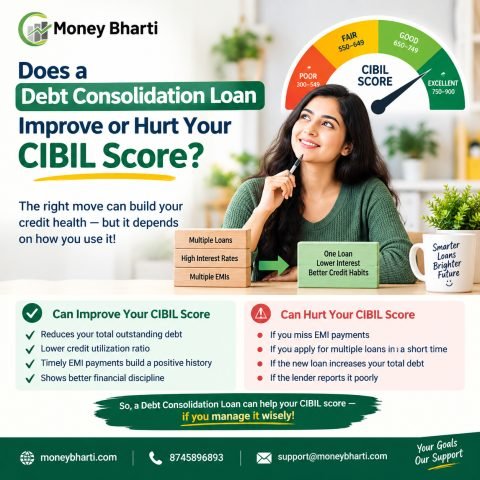
Does This Actually Help or Hurt Your Credit Score?
Short-term, applying triggers a hard inquiry, which can shave a few points off your score temporarily. That part's unavoidable.
But medium to long-term, two things work in your favour: your credit utilisation drops sharply once old cards are cleared, and a single, well-paid instalment loan builds a strong, visible repayment track record — something bureaus weigh heavily.
The one condition for this to actually play out well is discipline. Run your credit cards back up after consolidating, and you're not solving the problem — you're duplicating it.
Looking Beyond Ahmedabad
The rules here aren't wildly different elsewhere in India, though local income expectations shift a bit. Someone comparing a debt consolidation loan in Jaipur or a debt consolidation loan in Delhi will run into broadly the same eligibility and paperwork, just with slightly different minimum income cut-offs given the cost-of-living differences.
Meanwhile, cities like Kolkata and Chennai tend to have a similar spread of banks and NBFCs, so the real deciding factor usually comes down to your own credit profile rather than which city you're applying from.
Frequently Asked Questions
1. My credit score isn't great — can I still get a consolidation loan in Ahmedabad?
Yes, though your options narrow. Some NBFCs work with scores around 600-650, typically at a higher rate or with a co-applicant added to strengthen the application.
2. How is this different from just taking another personal loan?
A personal loan can go toward anything — a trip, a wedding, home repairs. A consolidation loan is specifically meant to close existing debts, and sometimes the lender pays your old creditors directly instead of handing you cash.
3. Does applying for this loan damage my credit score?
There's a small, temporary dip from the credit inquiry. It typically recovers and improves within a few months of consistent, on-time payments.
4. Realistically, how much money can this save me?
Depends entirely on your old interest rates versus the new one. As Ketan's example showed, moving off high-interest credit card debt alone can save thousands of rupees monthly.
5. I run a small trading business in Ahmedabad — can I apply?
Yes. Self-employed applicants qualify with ITR filings, GST returns, or steady bank statements, even if your income varies by season.
6. Are digital lending apps trustworthy for this?
They are, provided they're partnered with RBI-registered banks or NBFCs. Always check registration details, and never pay an upfront fee to an agent before your loan is actually approved.
7. What if I can't pay an EMI on time one month?
You'll face a late fee and a possible credit score hit. If you sense trouble coming, contact your lender before the due date rather than after missing it — most are open to short-term arrangements.
8. Can I pay off this loan early if I get some extra money?
Usually yes, after a lock-in period of 6-12 months, though foreclosure charges may apply. Check this clause before signing.
9. Should I shut down my credit cards completely after this?
Not necessarily. Keeping one card open with a small limit, used sparingly, can help preserve your credit history length. Closing everything isn't always the smarter move.
10. How fast can I actually get the money in Ahmedabad?
With complete paperwork, salaried applicants often see disbursal within 24-48 hours via digital lenders. Traditional banks can take a few extra days.
Final Word
Multiple loans and scattered credit card bills have a way of quietly eating into your income month after month, often more than people realise until they sit down and actually add up the interest. A debt consolidation loan won't erase the debt overnight, but it does something arguably more valuable — it gives you one clear number, one clear date, and a realistic path to becoming debt-free.
The real test isn't taking the loan itself. It's what you do afterward. Keep new spending in check, stick to the EMI schedule, and this single decision can end up saving you far more than just monthly convenience.
Before you sign anything, get quotes from at least three lenders, read the fee structure line by line, and make sure whoever you're borrowing from is RBI-registered. That one habit alone protects you from most of the common pitfalls people run into.
Explore consolidation loan guides for other cities: Delhi | Mumbai | Bangalore | Hyderabad | Chennai | Pune | Kolkata | Jaipur | Gurgaon | Noida
For more on how consolidation works in general, visit our Debt Consolidation Loan page, or browse other financial products at MoneyBharti.