Picture three credit card statements sitting on a table. One shows ₹1,20,000 outstanding. Another shows ₹80,000. A third shows ₹50,000. Every month, payments go out against all three — sometimes the minimum due, sometimes a little more when there's spare cash. And yet, six months later, the total outstanding has barely moved. This is a common (and purely illustrative) situation for many credit card users in India, and it's usually the point at which the word "consolidation" starts to come up.
This isn't a story about one person's finances going wrong. It's simply how revolving credit card debt behaves when interest keeps compounding on an unpaid balance faster than the borrower can pay it down. Multiple cards mean multiple due dates, multiple minimum-due calculations, and multiple interest clocks running at the same time. Keeping track of it becomes a job in itself, and the mental load of juggling due dates often matters as much as the money itself.
Credit card debt consolidation is one way people try to simplify this picture — by combining several outstanding balances into a single repayment obligation, ideally one with a clearer end date and a more predictable cost. But consolidation is not a single product, and it is not automatically cheaper. It's an umbrella term covering several different financial tools: personal loans, balance transfers, EMI conversions, and a few other routes, each with its own costs, eligibility conditions, and trade-offs.
This guide is written for readers in India — salaried and self-employed — who are looking at more than one credit card debt consolidation loan option and trying to work out whether consolidating makes sense, and if so, which route actually fits their situation. There is no single "best" option that works for everyone. The right choice depends on how much is owed, at what cost, over what income base, and — perhaps most importantly — whether the underlying spending pattern that created the debt has been addressed. The goal here is to give you a framework to work through that decision yourself, using your own numbers.
What Is Credit Card Debt Consolidation?
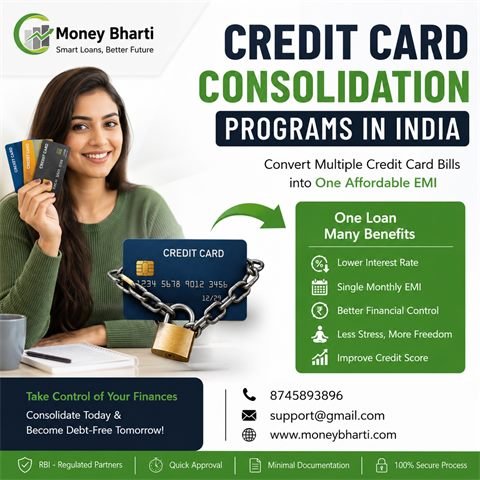
At its core, a debt consolidation loan means taking several separate outstanding balances — say, dues on three different cards — and combining them into one repayment obligation. Instead of three minimum-due amounts, three interest rates, and three due dates, you're left tracking one EMI or one repayment schedule.
That's the mechanical definition. But it's worth being precise about what consolidation does and doesn't do.
Consolidation does not erase debt. If you owe ₹2,25,000 across three cards, consolidating them still means you owe ₹2,25,000 (plus whatever fees are involved in the process) — just structured differently. What can change is the cost of carrying that debt and the shape of the repayment.
Here's a simple way to see the difference between consolidation and simply continuing to pay the minimum due on multiple cards.
Suppose you owe ₹50,000 on a card charging roughly 3.5% per month on the revolving balance (illustrative figure only — actual card interest rates vary by issuer and must be checked on your statement). If you pay only the minimum due — often calculated as a small percentage of the outstanding, subject to a floor amount — a large part of that payment goes toward interest rather than principal in the early months. The outstanding balance shrinks slowly, and new interest keeps accruing on what remains. Under a consolidation loan, by contrast, you typically have a fixed EMI, calculated so that a defined portion goes toward principal every single month, with the loan Fully repaid at the end of a fixed tenure.
The practical benefit isn't just "one payment instead of three." It's the shift from open-ended revolving debt (where there's no guaranteed end date if you keep paying minimums) to a fixed, amortising structure with a visible finish line — provided the new loan's own interest rate and fees don't offset that benefit. That's the qualifier that matters, and we'll come back to it repeatedly through this guide: consolidation only helps if the total cost of the new arrangement is genuinely lower than the cost of continuing as you are, or if the structural benefit (predictability, fewer due dates, forced discipline) is worth more to you than a small cost difference.
Why Credit Card Debt Can Become Difficult to Manage
To understand why consolidation is even worth considering, it helps to understand why credit card debt behaves differently from other kinds of borrowing.
Interest is charged on a revolving basis. Unlike a term loan where interest is calculated on a reducing balance over a fixed period, credit card interest (when you don't pay the full amount by the due date) typically applies from the transaction date itself, and continues to be charged on whatever balance remains unpaid, month after month, for as long as it remains outstanding. The exact method varies slightly between issuers, so it's worth checking your card's Most Important Terms and Conditions (MITC) document for the precise calculation.
The minimum due is designed to keep the account "regular," not to close the debt quickly. Paying only the minimum due avoids a default flag and late payment charges, but it does very little to reduce the principal. A large share of each minimum payment in the early stages typically covers interest and fees, not principal — which is precisely why balances can look almost unchanged after several months of "on-time" payments.
New purchases add to the same running balance. If a card is used for fresh spending while an old balance is still outstanding, the new spending usually starts accruing interest immediately too (since the interest-free period on new purchases generally applies only when the previous statement was paid in full). This is one of the most common ways credit card debt keeps growing even when the cardholder feels like they're "managing" it.
Late payment charges and penal interest add up. Missing a due date — even by a day — can trigger a late fee and sometimes a higher penal interest rate on the outstanding amount, along with a possible impact on credit score if the delay is significant.
GST applies to fees and charges. Processing fees, late payment charges, and other applicable charges on credit cards typically attract GST, which adds a small but real amount to the total cost. This applies to consolidation loan fees as well, so it's worth factoring in when comparing options.
Multiple cards mean multiple compounding clocks. When someone holds three or four cards with outstanding balances, each one is compounding independently, on its own statement cycle, its own due date, and often its own rate. Tracking this manually — and avoiding a missed payment on any single card — becomes a genuine administrative burden, separate from the financial one.
Credit utilisation adds another layer. The proportion of your total credit limit that you're using (utilisation ratio) is a factor that credit bureaus and lenders look at. High utilisation across multiple cards, even without a single missed payment, can affect how your credit profile is viewed.
None of this is meant to alarm — it's simply the mechanics that make revolving credit card debt different from, say, a car loan or a home loan, where the repayment schedule is fixed from day one. Understanding these mechanics is what makes the case for consolidation (or against it, in some situations) clearer.
What Are the Best Credit Card Debt Consolidation Options?
There isn't one "best" consolidation product — there are several legitimate routes, and the right one depends on your numbers. Here's an honest look at each.
1. Personal Loan for Debt Consolidation
How it works: You take a personal loan — typically unsecured, from a bank or NBFC — for an amount that covers your outstanding credit card balances, and use the loan proceeds to pay off the cards. You're then left repaying a single lender through fixed monthly EMIs over an agreed tenure.
When it may make sense: If you have multiple cards with high outstanding balances and revolving interest, and you have a stable, verifiable income that supports a new EMI, a personal loan can convert unpredictable, compounding card debt into a fixed, time-bound repayment.
Advantages:
- Single EMI instead of multiple card payments
- Fixed tenure, so there's a defined end date
- Often (though not always) a lower cost of borrowing than continuing to revolve card balances — this needs to be verified against the actual loan offer, not assumed
- Cards can be paid down to zero, which may help utilisation ratios if the cards are kept open and unused afterward
Disadvantages:
- Processing fees (often a percentage of the loan amount, plus GST) reduce the net benefit
- A poor credit score or unstable income may mean a higher interest rate is offered than expected, which can narrow or eliminate the savings
- Taking on a new loan without addressing the spending habit that built up the card debt can lead to a worse position — new EMI plus fresh card spending
- Prepayment or foreclosure charges may apply depending on the lender and loan type
Eligibility, tenure, EMI: These vary significantly by lender, and depend on income, existing obligations, credit score, and employer/business profile. There's no fixed number that applies to everyone — this is why comparing actual loan offers (not assumed rates) matters more than following a generic percentage figure quoted online.
Credit score considerations: Applying to several lenders in a short span can result in multiple hard enquiries, which may have a temporary effect on your credit score. It's usually more efficient to check eligibility (many lenders offer "soft" eligibility checks that don't affect your score) before making a formal application.
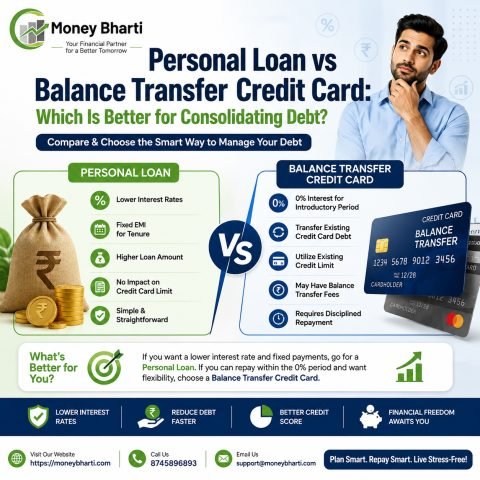
2. Credit Card Balance Transfer
What it is: Some card issuers allow you to transfer the outstanding balance from one credit card to another, or you can explore a dedicated balance transfer loan — often your own existing card, or a new card issued for this purpose — sometimes at a promotional interest rate for a limited period.
Promotional offers: These are usually time-bound (for example, a lower rate for the first few months), after which the standard card interest rate typically applies to any remaining balance. The specific terms — rate, duration, eligible balance — vary by issuer and change over time, so current terms should always be confirmed directly with the issuing bank before relying on them.
Transfer fees: A one-time processing or transfer fee (plus GST) is common and should be factored into the total cost, not treated as negligible.
Risk to be aware of: A balance transfer moves debt from one place to another — it does not, by itself, reduce the debt. If the promotional period ends before the balance is cleared, the remaining amount can revert to a standard (often high) card interest rate, sometimes leaving the borrower worse off than if they'd stayed on the original card, especially after accounting for the transfer fee.
When it can be useful: If the promotional period gives you a genuinely lower rate for long enough that you can realistically clear most or all of the transferred balance within that window, a balance transfer can be a useful short-term tool — provided the fee doesn't outweigh the interest saved.
3. Credit Card EMI Conversion
How it works: Many card issuers allow you to convert either a large existing transaction or your outstanding revolving balance into a structured EMI, repaid over a chosen tenure, generally at a rate lower than the card's standard revolving interest rate (though still typically higher than a personal loan from a bank, in many cases).
Potential benefits: A fixed EMI amount, a defined tenure, and — depending on the issuer's offer — a lower effective rate than continuing to revolve the balance at the standard card rate.
Interest and fees to check: EMI conversion usually comes with a processing fee and sometimes an interest rate that, while lower than the card's revolving rate, may still be higher than what's available through a personal loan elsewhere. The only way to know is to compare the total repayment amount under the EMI conversion offer against your other options.
Why total cost comparison matters: Because EMI conversion is offered directly by the same issuer holding your debt, it's convenient — but convenience isn't the same as lowest cost. It's worth asking the issuer for the total repayment figure (principal + interest + fees) and comparing it against a personal loan quote or a balance transfer offer before deciding. This debt consolidation vs credit card EMI comparison walks through this trade-off in more detail.
4. Existing Lender Restructuring or Repayment Assistance
If your immediate difficulty is a short-term cash-flow problem rather than an unmanageable total balance, it can be worth having a direct conversation with your card issuer about repayment assistance or restructuring options. Some lenders may offer revised repayment plans, particularly in cases of genuine financial hardship, though this is not guaranteed and depends entirely on the lender's internal policy and your specific situation. This route should be explored by contacting the issuer directly — it isn't something that can be assumed or promised in general guidance like this.
5. Self-Funded Debt Payoff: Avalanche and Snowball Methods
If your outstanding balance is manageable relative to your income, and you have some ability to pay more than the minimum, you may not need a consolidation product at all. Two commonly discussed self-funded repayment strategies:
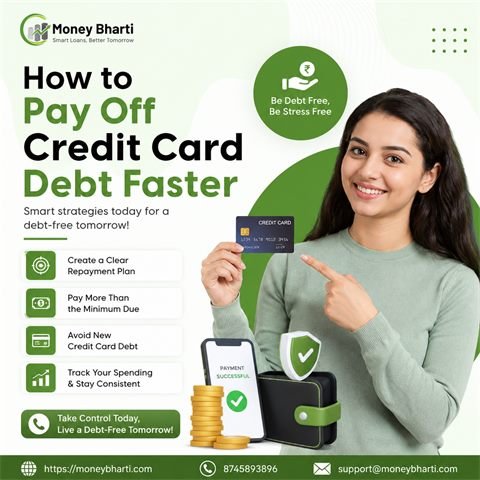
Debt avalanche: Pay the minimum due on all cards, but direct any extra money toward the card with the highest interest rate first. Once that's cleared, move to the next-highest rate, and so on. Mathematically, this minimises the total interest paid over time.
Debt snowball: Pay the minimum due on all cards, but direct extra money toward the card with the smallest outstanding balance first, regardless of interest rate. Once that's cleared, move to the next-smallest balance. This doesn't minimise interest cost, but it can create a psychological sense of progress by closing accounts faster, which some people find easier to sustain.
Neither of these is technically "consolidation" — you're not combining debts into a new product — but they're legitimate alternatives, especially for someone whose total debt is modest enough to be cleared within a reasonable period without taking on a new loan. They cost nothing extra in fees, though they require discipline and consistent extra payments.
Which Credit Card Debt Consolidation Option Is Best for You?
There's no universal answer, but a rough decision framework can help narrow things down. These are general educational guidelines, not personalised financial advice — your actual decision should be based on your own numbers and, ideally, a conversation with a financial advisor or the lender directly.
- Multiple high-cost balances, stable income, reasonably good credit profile: A personal loan may be worth exploring, subject to eligibility and a genuine total-cost comparison against your current situation.
- A short-term promotional balance-transfer offer is available, and you can realistically clear most of the balance within the promotional window: A balance transfer may deserve consideration, factoring in the transfer fee — see this debt consolidation vs balance transfer comparison for a closer look.
- Total outstanding is relatively small compared to your monthly surplus income: Accelerated repayment (avalanche or snowball) may be more sensible than taking on a new loan with its own fees and paperwork.
- You're still adding new spending to your cards each month: Consolidation alone is unlikely to solve the underlying issue — the balance may simply reappear on the freed-up card limits. Addressing the spending pattern matters more than which consolidation product you choose.
- Income is unstable or difficult to document: A new EMI obligation adds risk. It may be worth exploring restructuring with your existing lender or a slower, self-funded repayment plan instead.
Personal Loan vs Credit Card Debt: What Should You Compare?
When weighing a personal loan against a dedicated debt consolidation loan or against continuing with credit card debt, it helps to compare specific line items rather than relying on general impressions.
| What to Compare | Why It Matters |
|---|---|
| Interest rate | The headline rate, but not the whole picture on its own |
| APR / effective cost | Reflects the true annualised cost including fees, where disclosed |
| EMI amount | Determines monthly cash-flow impact |
| Tenure | Longer tenure lowers EMI but can raise total interest paid |
| Processing fee | Usually a percentage of loan amount, plus GST |
| GST/taxes on charges | Applies to fees on both cards and loans |
| Foreclosure/prepayment terms | Affects your ability to close the loan early without penalty |
| Late-payment consequences | Penal charges and potential credit score impact, on both products |
| Total repayment amount | Principal + all interest + all fees, over the full tenure |
| Monthly cash-flow impact | Whether the new EMI is comfortably affordable alongside existing obligations |
A personal loan may have a lower borrowing cost than revolving credit card debt for some eligible borrowers, but the actual economics depend entirely on the lender's specific offer and all applicable charges. It would be inaccurate to say personal loans are always cheaper — a borrower with a weaker credit profile might be offered a personal loan rate that isn't meaningfully better than their card's EMI conversion offer, once fees are included. The only reliable way to know is to get the actual total repayment figure for both options and compare them side by side.
How to Calculate Whether Debt Consolidation Will Actually Save Money
Numbers make this concrete. The following is a purely illustrative example using hypothetical figures — not a real lender's rate or offer. Always use your actual card statements and a real loan quote — Moneybharti's debt consolidation EMI calculator can help you run your own numbers — to do this calculation for yourself.
Illustrative starting position:
- Credit Card A: ₹1,00,000 outstanding
- Credit Card B: ₹75,000 outstanding
- Credit Card C: ₹50,000 outstanding
- Total outstanding: ₹2,25,000
Hypothetical consolidation loan (illustrative assumptions only):
- Loan amount: ₹2,25,000
- Assumed interest rate: 13% per annum (reducing balance) — hypothetical, for illustration only
- Tenure: 24 months
- Approximate EMI: roughly ₹10,700 per month (indicative calculation based on the assumed rate and tenure)
- Total repayment over 24 months: approximately ₹2,57,000
- Processing fee: assume 2% of loan amount = ₹4,500, plus GST
- Approximate total cost of the loan (interest + fees): roughly ₹36,000–₹38,000 over two years
Compare this against continuing to revolve the card balances. If the effective card interest cost is meaningfully higher than 13% per annum on an annualised basis (which is common for revolving credit card debt, though the exact rate depends on each card's terms), and if only minimum payments continue to be made, the total interest paid over an equivalent period — and the time taken to actually clear the balance — could be substantially higher than under the loan scenario above. But this depends entirely on your cards' actual rates, your actual payment behaviour, and whether new spending continues.
The point of this exercise isn't the specific numbers — it's the method. Before choosing consolidation, lay out:
- Your actual current outstanding on each card
- Your actual card interest rate (from your statement or MITC document)
- A realistic estimate of what you'd pay monthly if you didn't consolidate
- The actual loan offer's EMI, tenure, processing fee, and total repayment
- The difference between the two total costs
Only this comparison — done with your real numbers — can tell you whether consolidation will genuinely save you money, or simply restructure the same cost into a different shape.
How to Choose the Best Credit Card Debt Consolidation Loan
If you've decided a consolidation loan is the right route, use this checklist before signing anything:
- Compare total borrowing cost, not just the advertised interest rate — ask for the total repayment figure across the full tenure. This overview of debt consolidation interest rates explains how rates are typically structured.
- Check the processing fee — a percentage of the loan amount, often non-refundable even if you prepay early.
- Check GST and other applicable charges — these add to the fee, not just the headline number.
- Check the tenure — a longer tenure reduces EMI but usually increases total interest paid.
- Check EMI affordability against your actual monthly surplus, not just what a lender approves you for.
- Check foreclosure/prepayment terms — some loans allow free prepayment after a certain period; others charge a fee.
- Check late-payment charges on the new loan — missing an EMI has consequences too.
- Check eligibility criteria upfront — income proof, employment type, credit score thresholds — to avoid wasted applications and unnecessary hard enquiries. This debt consolidation loan eligibility guide covers what lenders typically look for.
- Avoid unnecessary add-ons — optional insurance or protection plans bundled with the loan should be evaluated on their own merit, not accepted by default.
- Read the sanction letter and loan agreement carefully before signing, including the fine print on fees and charges.
- Verify the lender — confirm it's a genuine bank or RBI-registered NBFC before sharing documents or paying any fee.
- Never pay upfront fees to unknown intermediaries promising guaranteed loan approval — this is a common pattern used in loan-related fraud. This checklist of 15 red flags of a bad debt consolidation lender in India is worth reading before you sign anything.
Credit Score and Credit Card Debt Consolidation
A few things worth understanding about how consolidation interacts with your credit profile — start by checking your credit score before applying anywhere:
- Credit utilisation — the percentage of your total credit limit currently in use — is one factor credit bureaus consider. Paying off card balances through a consolidation loan can lower utilisation, which some lenders view favourably, though this isn't guaranteed to move your score by a specific amount.
- Missed payments on either the original cards or the new loan are reported to credit bureaus and can affect your score, regardless of which repayment method you choose.
- Multiple loan applications in a short period can generate several hard enquiries, which may have a small, temporary negative effect. Comparing offers through soft-eligibility checks (where available) before applying formally can help limit this.
- Payment history on the new loan becomes part of your credit report going forward — consistent on-time EMI payments contribute positively over time.
- Closing cards versus keeping them open is a genuine trade-off. Closing a card reduces your total available credit limit, which can raise your utilisation ratio on remaining cards even if your spending doesn't change. Keeping a paid-off card open (and unused, or used lightly and paid in full) can sometimes be more favourable for utilisation — but this depends on your overall credit profile and isn't a universal rule.
Importantly, consolidation itself does not automatically improve or damage your credit score. What matters is how consistently you make payments afterward, and how you manage your credit utilisation going forward. No credible source should promise a specific score improvement from consolidating debt.
Does Debt Consolidation Reduce Your Debt?
This deserves a direct answer: no, not by itself. Consolidation restructures how debt is organised and repaid — it doesn't erase the principal amount you owe.
The potential benefit, when it exists, tends to come from a combination of:
- A lower overall borrowing cost, if the new loan or arrangement genuinely costs less than continuing to revolve card balances
- A fixed repayment schedule with a clear end date, instead of open-ended revolving debt
- Fewer payment dates to track, reducing the risk of missed payments due to sheer administrative complexity
- Reduced temptation to fall into a minimum-payment cycle, since a consolidation loan EMI is typically structured to clear the debt within a fixed period
The most significant risk with consolidation is a well-documented behavioural one: a person clears their credit cards using a consolidation loan, and — because the cards now show ₹0 or low balances again — starts using them for fresh spending. Six months later, they're carrying both the original consolidation loan EMI and a new round of credit card debt. This is arguably the single biggest reason consolidation fails to help in practice, and it has nothing to do with interest rates or loan structures — it's a spending-behaviour issue that consolidation alone cannot fix.
Common Mistakes People Make After Consolidating Credit Card Debt
- Continuing to spend on the now-available credit limit on paid-off cards
- Treating available credit as if it were income or savings
- Choosing a longer loan tenure purely because it lowers the EMI, without checking the higher total interest cost that comes with it
- Focusing only on the monthly EMI figure and ignoring the total repayment amount
- Overlooking processing fees and GST when comparing the "cheaper" option
- Borrowing more than the actual outstanding balance, "just in case," which increases the debt rather than consolidating it
- Applying to several lenders simultaneously, generating multiple hard credit enquiries
- Not maintaining any emergency fund after consolidating, leaving no buffer if a new short-term cash need arises
- Treating consolidation as a fix for the underlying spending pattern, rather than a restructuring tool
- Closing or keeping cards open without understanding the effect on total available credit and utilisation ratio
When Credit Card Debt Consolidation May NOT Be the Best Choice
Consolidation isn't automatically the right move. It may not make sense when:
- The outstanding amount is relatively small and can realistically be cleared within a few months through disciplined repayment, without new borrowing
- The cost of a new loan or balance transfer — once fees are included — isn't meaningfully lower than continuing with the current arrangement
- Income is unstable, making a new fixed EMI a riskier commitment than flexible (if expensive) minimum-due payments
- Spending on credit cards is ongoing and hasn't been addressed — in this case, a new loan simply adds a fixed obligation on top of a problem that hasn't been solved
- The new EMI, once calculated, doesn't comfortably fit within monthly cash flow after essential expenses
- Fees (processing charges, GST, and any other applicable costs) are high enough to offset most or all of the potential interest savings
- Eligibility criteria for a personal loan or balance transfer aren't met, making the exercise moot regardless of preference
In these situations, alternatives like a structured self-funded payoff plan, a direct conversation with the existing lender, or simply taking time to stabilise income before borrowing further, may be more sensible than pursuing consolidation for its own sake.
How to Make a Debt Consolidation Plan
A practical, step-by-step approach:
Step 1: List every credit card balance — write down the exact outstanding amount on each card, from your latest statement, not an estimate.
Step 2: Record applicable interest and charges — the interest rate, any late fees already applied, and other charges on each card, taken from your MITC document or statement.
Step 3: Record the minimum due — on each card, so you know your current baseline monthly obligation.
Step 4: Calculate total outstanding — add up all balances to get one clear number.
Step 5: Check monthly income and essential expenses — rent, groceries, existing EMIs, utilities — to see what's genuinely left over.
Step 6: Determine affordable repayment capacity — how much you can realistically commit each month toward clearing this debt, without straining essential expenses.
Step 7: Compare consolidation options — personal loan, balance transfer, EMI conversion, or self-funded payoff — based on your numbers from Steps 1–6.
Step 8: Compare total repayment, not just EMI — for any loan or EMI conversion offer, ask for the full repayment figure across the tenure.
Step 9: Read the agreement carefully before signing — fees, foreclosure terms, and penal charges especially.
Step 10: Stop unnecessary new borrowing after consolidating — this is the step most often skipped, and it's arguably the one that determines whether consolidation actually helps in the long run.
Credit Card Debt Consolidation for Salaried Employees
This detailed guide on debt consolidation for salaried employees covers the specifics, but broadly, salaried borrowers typically have a few things working in their favour when considering a personal loan for consolidation: a stable, verifiable monthly income, often a salary account relationship with a bank (which can sometimes simplify the application process with that same bank), and a documented employment history. Lenders generally also look at existing EMI obligations relative to income, and at credit history and repayment track record.
That said, none of this guarantees eligibility or a specific interest rate — every lender applies its own criteria, and outcomes vary based on employer category, income level, existing debt, and credit score. It's worth checking eligibility with more than one lender (ideally through soft checks) before committing to a formal application.
Credit Card Debt Consolidation for Self-Employed Borrowers
For self-employed individuals, the process typically involves a different set of documentation: bank statements over a period (commonly the last several months), income tax returns, and sometimes business financials, depending on the lender and loan amount. Lenders assess business cash flow stability alongside personal credit history, since income for self-employed borrowers can be less predictable month to month than a fixed salary.
Eligibility criteria, required documentation, and interest rates vary significantly between lenders for self-employed applicants — there's no universal standard, so it's worth checking directly with a few lenders rather than assuming a fixed set of requirements.
Can You Consolidate Multiple Credit Cards Into One Loan?
Yes, this is one of the most common uses of a personal loan for debt consolidation — using the loan proceeds to pay off several credit card balances at once, leaving a single EMI going forward. If you're also juggling other loan EMIs alongside your cards, a multiple EMI to single EMI loan can combine those too.
Before proceeding, it's worth verifying:
- That the loan amount sanctioned actually covers your total outstanding across all cards you intend to pay off
- That you close out the transfer by actually paying off each card balance promptly once the loan is disbursed (rather than the funds sitting idle while interest continues accruing on the cards)
- That you understand what happens to your card limits afterward, and have a plan to avoid re-accumulating balances on them
- The total cost of the new loan versus continuing with the cards, using your own numbers as outlined earlier in this guide
Is Debt Consolidation Better Than Paying Only the Minimum Due?
For many borrowers, yes — but it's worth understanding exactly why, rather than accepting it as a given.
Paying only the minimum due each month keeps an account in good standing, but because a large portion of that minimum payment often goes toward interest rather than principal in the early stages, the outstanding balance reduces very slowly. A simple illustrative example: if ₹50,000 is outstanding and only minimum payments are made each month, with continued interest accrual on the remaining balance, it can take a considerably longer time — and cost considerably more in total interest — to clear the debt than a structured, fixed-EMI repayment over a defined tenure would.
A consolidation loan (or a disciplined accelerated repayment plan, if a new loan isn't the right fit) generally has a defined end date and a repayment structure where a larger, consistent share of each payment goes toward the principal. This is what typically makes it a faster and often cheaper path to clearing the debt than an indefinite cycle of minimum-due payments — provided, again, that the new arrangement's own costs don't outweigh this benefit.
How Moneybharti Can Help You Understand Your Options
Working through credit card debt consolidation involves comparing multiple products, understanding fee structures, and matching options to your specific financial situation — which can be time-consuming to do from scratch. Moneybharti.com is built as an informational platform to help readers in India understand personal loans, credit cards, and related financial products, so that decisions like this can be made with a clearer picture of what's actually being compared.
This isn't a promise of guaranteed approval, the lowest possible rate, or instant outcomes — those depend entirely on individual eligibility and the specific lender involved. What a resource like Moneybharti can offer is structured, educational information to help you ask the right questions and compare options on a like-for-like basis before you approach a lender directly.
Questions to Ask Before Taking a Debt Consolidation Loan
- What is the total repayment amount across the full tenure — not just the EMI?
- What is the actual interest rate being offered to me, based on my profile?
- What fees apply, and are any of them non-refundable?
- Is GST applicable to any of these fees, and is it included in the quoted figures?
- What happens if I want to prepay or foreclose the loan early?
- What happens if I miss an EMI — what are the charges and consequences?
- Is any insurance or protection plan optional or mandatory with this loan?
- How much should I actually borrow — exactly my outstanding balance, or is there a reason to borrow more or less?
- Will this arrangement genuinely reduce my total cost compared to my current situation, based on real numbers?
- What is my plan for the credit cards once they're paid off — keep them open and unused, or use them cautiously?
Frequently Asked Questions
1. What is the best way to consolidate credit card debt in India? There's no single best way — it depends on your outstanding amount, income, and credit profile. Common routes include a personal loan, a balance transfer, or EMI conversion offered by your card issuer, and each should be compared on total cost, not just the headline rate.
2. Is a personal loan good for credit card debt consolidation? It can be, for borrowers with stable income and a reasonable credit profile, since it typically offers a fixed EMI and a defined end date. Whether it's actually cheaper than your current card debt depends on the specific interest rate and fees offered to you.
3. Can I consolidate debt from multiple credit cards? Yes. A personal loan (or, in some cases, a balance transfer to a single card) can be used to pay off several outstanding card balances, leaving one repayment obligation going forward.
4. Does debt consolidation reduce interest? It can, if the new arrangement's interest rate and fees are genuinely lower than the cost of continuing to revolve your card balances. This isn't automatic — it depends on the actual offer you receive.
5. Does credit card debt consolidation affect CIBIL score? It can affect your score in both directions. Paying off cards can lower your credit utilisation, which is often viewed favourably, while a new loan application generates a hard enquiry, which can have a small, temporary effect. Consistent on-time payments on the new loan support your score over time.
6. Can I consolidate credit card debt without a personal loan? Yes — options like a balance transfer, EMI conversion through your existing card issuer, or a self-funded accelerated repayment plan (avalanche or snowball method) don't require a new personal loan.
7. Is balance transfer better than a personal loan? Neither is universally better. A balance transfer can work well if a genuine promotional rate is available and you can clear most of the balance within that window. A personal loan may suit larger balances needing a longer, fixed repayment structure. Compare total cost in your specific case — this in-depth guide on personal loan vs balance transfer credit card breaks it down further.
8. How much debt should I consolidate? Generally, only what you actually owe across the cards you intend to pay off — borrowing extra "for buffer" increases your debt rather than consolidating it.
9. Should I close my credit cards after consolidation? Not necessarily. Closing a card reduces your total available credit limit, which can raise utilisation on remaining cards. Many people choose to keep paid-off cards open but use them cautiously, though the right approach depends on your overall credit profile and spending discipline.
10. How long does debt consolidation take? This varies by product and lender — a personal loan disbursal can take anywhere from a day to a couple of weeks depending on documentation and lender processes, while EMI conversion with an existing issuer is often faster since they already hold your account.
11. Can self-employed people consolidate credit card debt? Yes, though eligibility typically requires additional documentation such as bank statements and income tax returns, and terms vary by lender.
12. What should I compare before choosing a consolidation loan? Total repayment amount, processing fees and GST, tenure, EMI affordability, foreclosure terms, and eligibility — not just the advertised interest rate.
Conclusion
There is no universal "best" credit card debt consolidation option — only the option that best fits your specific outstanding amount, income, credit profile, and repayment capacity. A personal loan might make sense for one reader with a stable salary and multiple high-cost balances, while a shorter, self-funded repayment plan might be the more sensible choice for another reader whose debt is smaller and more manageable.
What matters, regardless of which route you consider, is comparing total cost — not just the monthly EMI or the headline interest rate — and being honest about your repayment capacity before committing to a new obligation. Fees, GST, tenure, and prepayment terms all affect whether a consolidation option genuinely helps or merely reshuffles the same cost into a different form.
Just as importantly, consolidation on its own doesn't fix the spending pattern that led to the debt in the first place. Clearing your cards and then gradually filling them back up with fresh spending is one of the most common ways this strategy fails to deliver any real benefit. The structural side (choosing the right product) and the behavioural side (changing how the cards are used afterward) both need attention.
Read every loan or card agreement carefully before signing. Compare more than one offer where possible. And make the decision based on your actual financial circumstances — your real statements, your real income, and your real ability to repay — rather than a generic recommendation. If you're trying to make sense of the different options available, Moneybharti.com is meant to be a resource for exactly this kind of research, to help you walk into a lender conversation with a clearer picture of what to ask and what to compare.
Sources to Verify Before Publication
- Reserve Bank of India (RBI) — official guidelines on credit card interest calculation, fair practices, and personal loan regulations (rbi.org.in)
- Official credit bureau sources (e.g., TransUnion CIBIL) — for accurate, current information on credit score factors and reporting practices
- Individual bank/NBFC official websites — for current personal loan interest rates, processing fees, and eligibility criteria
- Individual credit card issuer's Most Important Terms and Conditions (MITC) document — for accurate, card-specific interest calculation and fee details
- RBI's guidelines on digital lending and loan recovery practices — for verifying lender legitimacy and borrower rights