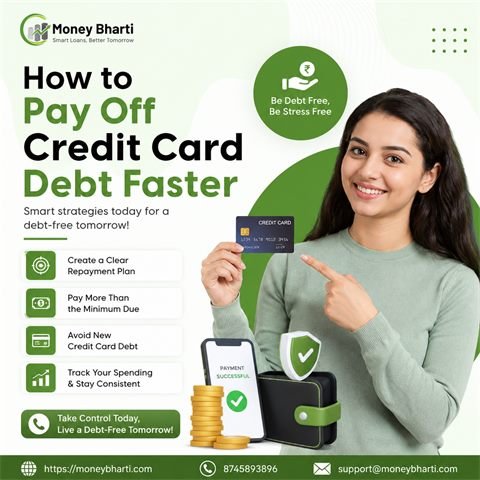
If you've been paying only the "minimum amount due" on your credit card for a few months now, you already know the trap. The bill never really shrinks. Interest keeps piling on top of interest, and one day the outstanding amount looks bigger than what you actually spent.
This is exactly the situation a credit card debt relief program is meant to address. But in India, this term gets used loosely — sometimes it means a proper debt consolidation loan, sometimes it means negotiating a settlement with the bank, and sometimes, unfortunately, it means a shady "debt relief company" that charges a fee upfront and disappears. This article breaks down what real relief options look like, how they work, and which one might actually fit your situation.
Quick Highlights Table
| Parameter | Typical Range in India |
|---|---|
| Who It's For | Anyone with revolving or overdue credit card balances |
| Relief Options | Consolidation loan, balance transfer, settlement, EMI conversion |
| Consolidation Loan Rate | 10.5%–24% p.a. |
| Settlement Impact | Usually reduces amount owed, but hurts credit score for years |
| Loan Amount (Consolidation) | ₹50,000 to ₹40 lakh |
| Tenure | 12 to 60 months |
| Documents | ID proof, address proof, income proof, card statements |
| Processing Time | 24 hours to 5 working days |
Note: These figures are indicative and vary by bank/NBFC, your credit profile, and the option you choose. Always verify current terms directly with the lender or bank before proceeding.
What Is a Credit Card Debt Relief Program?
In the Indian context, "debt relief" for credit cards usually falls into one of four buckets:
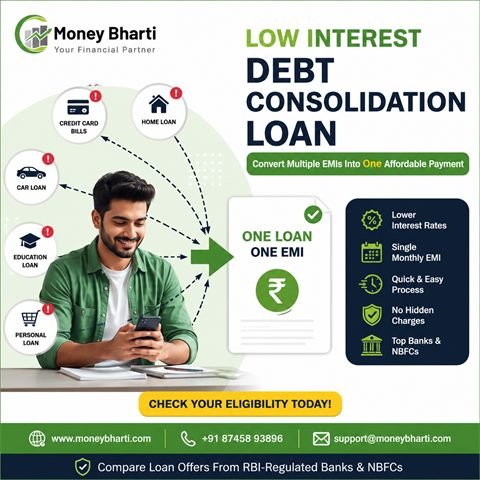
- Debt consolidation loan — You take a personal loan to pay off your card dues in full, and repay this one loan at a lower, fixed interest rate.
- Balance transfer — Some banks let you shift your outstanding balance to a new card or loan at a lower introductory rate.
- EMI conversion — Your own bank converts the outstanding amount into fixed monthly instalments, usually at a rate lower than the card's revolving interest but higher than a personal loan.
- Settlement — You negotiate with the bank to pay a reduced lump sum to close the account. This is usually a last resort, not a first option.
Most people searching for "credit card debt relief" are actually looking for option 1 or 2 — a way to convert expensive, revolving debt into something structured and cheaper. Settlement is a real option too, but it comes with consequences that are often not explained clearly.
Expert Insight: Not every "debt relief company" you see advertised online is a bank or NBFC. Some are private firms that charge you a fee to "negotiate" with your bank on your behalf — something you can usually do yourself, for free, with a phone call and a written request. Before paying anyone, check whether the entity is RBI-registered or simply a facilitator charging for a service you don't need.
Did You Know? Credit card interest in India is charged on a daily reducing balance, compounded monthly, which is why balances can grow so fast even with regular minimum payments. A ₹50,000 balance at 40% annual interest, paid only at the minimum, can take several years to close and cost more in interest than the original amount spent.
Which Relief Option Actually Suits You?
Benefits/Options Infographic — 4 boxes: Consolidation Loan, Balance Transfer, EMI Conversion, Settlement — each with a one-line "best for" tag]
- If you have a stable income and a reasonable credit score: A debt consolidation loan is usually your cheapest, fastest way out. You close the card dues completely and repay one EMI going forward.
- If your existing card just has a high interest rate but you're not behind on payments: A balance transfer to a lower-rate offer can help, at least temporarily.
- If you want to stay with the same bank and avoid a new loan application: EMI conversion offered directly by your card issuer is simpler, though usually costs more than a consolidation loan.
- If you're genuinely unable to pay and have exhausted other options: Settlement may be necessary, but understand it will affect your credit report for years.
Expert Insight: People often jump straight to settlement because it sounds like the fastest fix — "pay less, be done with it." But a settled account is marked as "settled" (not "closed") on your credit report for years, which future lenders read as a red flag. If a consolidation loan is available to you, it is almost always the better long-term choice.
Eligibility for a Credit Card Debt Relief (Consolidation) Loan
| Criteria | Salaried Applicants | Self-Employed Applicants |
|---|---|---|
| Age | 21–60 years | 25–65 years |
| Minimum Income | ₹15,000–₹25,000/month | ₹2–3 lakh annual profit (varies) |
| Work Experience | Minimum 1 year in current job | 2–3 years in business |
| Credit Score | 650+ preferred, 700+ ideal | 650+ preferred, 700+ ideal |
| Existing Card Dues | Should not push total EMIs above 50-60% of income | Same |
| Residence | Indian resident | Indian resident |
Disclaimer: This is a general guide only. Full debt consolidation loan eligibility criteria differ by lender, and meeting these numbers doesn't guarantee approval — each bank or NBFC applies its own internal policy.
Did You Know? If your card dues are already overdue, some lenders may still approve a consolidation loan, but usually at a slightly higher interest rate and with more scrutiny of your bank statements. Applying before you miss a payment — not after — almost always gets you a better rate.
Documents You'll Need
- PAN Card (mandatory)
- Aadhaar Card / Voter ID / Passport (address proof)
- Last 3 months' salary slips (salaried) or last 2 years' ITR (self-employed)
- Bank statements of last 6 months
- Passport-size photographs
- Latest credit card statement(s) showing outstanding balance
Having your card statements ready — not just an approximate number — speeds up processing significantly. See the full lender-wise documents required checklist for edge cases specific to your profile.
How the Relief Process Works, Step by Step
- List every card and balance — Note the outstanding amount and interest rate on each card separately.
- Check your credit score — This decides which lenders will offer you the best interest rate.
- Compare consolidation offers — Look at interest rate, processing fee, and foreclosure charges together, not the rate alone.
- Apply and submit documents — Include your latest card statements so the lender can verify the payoff amount.
- Disbursal and card closure — Once the loan is disbursed, pay off the cards immediately and consider closing or locking them so the balance doesn't build up again.
Expert Insight: Ask the lender to disburse the loan amount directly to your credit card account if that option is available. It removes the temptation — and the risk — of the money sitting in your savings account for even a few days before the cards are cleared.
Comparing Relief Options
| Option | Typical Cost | Impact on Credit Score | Best For |
|---|---|---|---|
| Debt Consolidation Loan | 10.5%–24% p.a. | Improves over time with regular payment | Stable income, multiple card dues |
| Balance Transfer | 0%–15% (introductory) | Neutral to positive | Short-term relief on one card |
| EMI Conversion (by card issuer) | 14%–24% p.a. | Neutral | Staying with the same bank |
| Settlement | One-time reduced payment | Negative for years ("settled" status) | Genuine inability to pay, last resort |
A closer look at debt consolidation vs debt settlement and personal loan vs credit card settlement is worth reading before you decide between the last two options — the difference in long-term outcome is bigger than it first appears.
Example
Sneha, a 29-year-old IT professional in Bangalore, had two credit cards with a combined outstanding of ₹3,20,000, built up gradually through minimum payments over about 18 months. Her effective interest cost across both cards was close to 40% annually, and her minimum-due payments were barely covering the interest.
She applied for a debt consolidation loan of ₹3,20,000 at 13.5% for a 3-year tenure. Her new EMI came to roughly ₹10,900 a month — lower than her combined minimum-due payments, at a fixed rate, with a clear closing date three years out. She also asked her bank to reduce the credit limit on both cards to avoid running up fresh balances.
This is a representative example to illustrate the concept — your actual numbers will depend on your outstanding balance, credit profile, and the lender you choose.
Responsible Borrowing: Cautions Before You Apply
- Don't treat a consolidation loan as "free money." It clears your card dues, but you still owe the full amount — just at a better rate and structure.
- Be wary of any "debt relief agency" asking for an upfront fee. Legitimate lenders don't charge you just to check your eligibility — checking eligibility with a marketplace is typically a free, soft enquiry.
- Understand recovery agent rules if you're already facing collection calls — RBI has clear guidelines on how and when agents can contact you, and knowing your rights during recovery helps you push back on harassment.
- If loan or collection apps are threatening you unfairly, know that there are formal channels — see what qualifies as loan app harassment and how to report it.
- A missed EMI on your new consolidation loan is just as damaging as a missed card payment — the relief only works if the new EMI is paid on time.
Did You Know? Under RBI rules, recovery agents cannot call you before 8 AM or after 7 PM, cannot use threatening language, and must identify themselves clearly. If you're facing harassment over a card or loan default, you have the right to file a formal complaint with the bank and, if unresolved, escalate it to the RBI Banking Ombudsman.
Frequently Asked Questions
Is a "credit card debt relief program" the same as a debt consolidation loan? Often, yes — most legitimate relief options in India work through a consolidation loan or balance transfer. Be cautious of any program that promises to "settle" your debt for a fraction of the amount without explaining the credit score impact.
Will a debt relief program affect my CIBIL score? A consolidation loan, repaid on time, generally helps your score over time by lowering your credit utilisation. A settlement, on the other hand, is reported as "settled" rather than "closed" and can hurt your score for years.
Can I get relief if I've already missed a few card payments? It's harder but not impossible. Some NBFCs still offer consolidation loans to applicants with a low credit score, usually at a higher interest rate. Acting sooner rather than later keeps your options wider.
Are debt relief companies in India regulated? Genuine lenders — banks and NBFCs — are RBI-registered. Many "debt relief" or "debt settlement" firms that advertise online are not lenders at all and are not RBI-regulated; research any debt relief company carefully before paying them anything.
How much can I actually save with a consolidation loan? It depends on the gap between your card's interest rate (often 36-42%) and the loan's rate (often 11-15%). The wider that gap, the more you save — our EMI calculator can show you the monthly and total difference using your own numbers.
Final Thoughts
A credit card debt relief program isn't a single product — it's a category of options, and picking the right one matters more than picking the fastest one. For most salaried and self-employed Indians with a reasonable income, a debt consolidation loan quietly does the job: lower interest, one EMI, and a fixed end date. Settlement should stay a last resort, used only after the other routes have genuinely been ruled out.
Before you commit to anything — especially anything that asks for money upfront — take twenty minutes to list your card balances, check your eligibility, and compare what a proper lender is willing to offer you.
This article is for general informational purposes only and does not constitute financial or legal advice. Loan approval, interest rates, and terms are entirely at the discretion of individual lenders and depend on your credit profile. Please read all loan and settlement documents carefully, and consult a financial advisor for guidance specific to your situation.