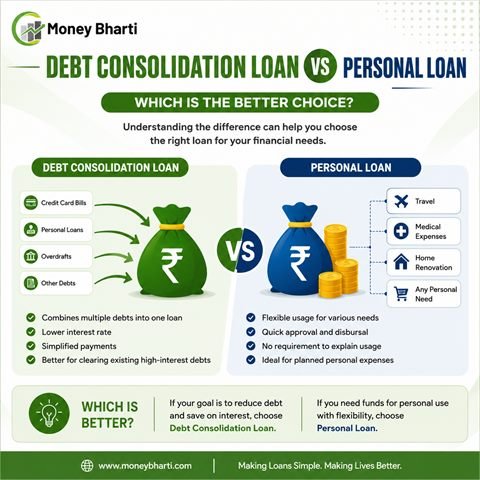
Juggling three EMIs, two credit cards, and a personal loan every month is exhausting — and expensive. Debt consolidation means taking one new personal loan, paying off all your existing debts with it, and being left with a single EMI, usually at a lower blended interest rate. Done right, it can cut your monthly outgo by 15–30% and simplify your financial life. Done wrong — stretched over too many years, or taken without fixing the spending habit that caused the debt — it can cost you more in the long run. This guide walks through eligibility, real EMI math, bank-wise rates, RBI's 2026 rules, and exactly how to apply.
Problem-Based Introduction
It usually starts small. A credit card bill you didn't fully pay off. A two-wheeler loan. Maybe a ₹1.5 lakh personal loan for a wedding expense. None of it feels unmanageable on its own.
Then one Sunday you sit down, open five different apps, and add up the EMIs — and the number is bigger than you expected. Three due dates. Three interest rates, two of them above 30% because they're revolving credit card balances. One missed payment last quarter that dented your CIBIL score. You're not in a crisis, but you're not in control either.
This is the exact situation debt consolidation was built for. Instead of tracking multiple lenders, multiple due dates, and multiple interest rates, you take one personal loan large enough to clear everything else, and you manage one EMI going forward. The question isn't just "can I do this" — it's whether it actually saves you money, and for how many people it genuinely does.
Loan Overview
A debt consolidation loan isn't a separate loan product in India — it's simply a personal loan used for a specific purpose: paying off existing debts (credit cards, personal loans, consumer durable loans, sometimes even a small business loan) instead of funding a new expense.
| Feature | Details |
| Loan type | Unsecured personal loan |
| Typical amount | ₹50,000 – ₹40 lakh (varies by lender and income) |
| Tenure | 12 – 84 months |
| Interest rate (2026) | Starts around 9.99% p.a. for top-tier borrowers; most people see 11%–18% |
| Collateral | None |
| Disbursal | Usually within 24–48 hours for pre-approved or digitally verified customers |
Because it's unsecured, the bank is relying entirely on your income and credit history — which is why your CIBIL score plays such a large role in the rate you're offered.
Why People Need This Loan
Most people don't consolidate debt because of one bad decision — it's usually an accumulation:
- Credit card revolving balances carrying 30%–42% annual interest, silently compounding
- Multiple small loans taken over 2–3 years for different needs (phone, bike, medical expense)
- A missed EMI or two, which triggers penal charges and credit score damage on top of the original debt
- Simple cash-flow fatigue — not being broke, just tired of managing five repayment dates a month
The common thread: the individual debts made sense when taken, but together they've become harder to track and more expensive than necessary.
Is This Loan Right for You?
Consolidation tends to work well when:
- Your combined existing interest rates are higher than the rate you'd get on a new personal loan (this is almost always true if credit card debt is involved)
- You have a stable, verifiable income and can qualify for a decent rate
- You're consolidating debt from past spending, not funding new spending
- You want one predictable EMI instead of several variable minimum payments
- Your CIBIL score is 650 or above, so the new loan's rate isn't punitive
Who Should Avoid This Loan?
Consolidation is not a fix for everyone, and it can make things worse in a few situations:
- If your spending habits haven't changed — many people clear their credit cards with a personal loan, then run the cards up again, ending up with both the new EMI and fresh card debt
- If the new tenure is so long that total interest paid ends up higher than the original debts, even at a lower rate
- If your income is unstable or seasonal, making a fixed EMI riskier than flexible card minimum payments
- If most of your debt is already low-interest (e.g., an education loan at 8-9%) — consolidating that into a costlier personal loan doesn't help
- If you're close to prepaying existing loans anyway within a few months
Key Benefits
- One EMI, one due date — meaningfully reduces the mental load of money management
- Lower blended interest rate, especially when credit card debt is involved
- Improved credit score over time, since a single well-managed EMI reports more predictably than multiple accounts near their limits
- Reduced risk of missed payments, since there's only one date to track
- Fixed repayment horizon — you know exactly when you'll be debt-free, unlike revolving credit card debt
Risks You Should Know
- Longer tenure can mean more total interest, even at a lower rate — always compare total cost, not just the EMI
- Processing fees, GST, and possible foreclosure charges on the old loans can eat into savings
- Temptation to re-borrow on now-empty credit cards
- Credit score dip in the short term due to a new hard inquiry and account
- Unsecured loan = higher rate than secured options (like a loan against property), if you have that option and don't consider it
Loan Eligibility
Typical eligibility criteria used by Indian banks and NBFCs in 2026:
| Criterion | Typical Requirement |
| Age | 21–60 years (salaried), up to 65 for self-employed |
| Minimum monthly income | ₹20,000–₹25,000 (varies by city and lender) |
| CIBIL score | 650+ preferred; 725+ for the best rates |
| Employment | Minimum 1–2 years of work experience, 6+ months with current employer |
| Existing EMI burden (FOIR) | Usually capped at 50–55% of monthly income, including the new EMI |
FOIR (Fixed Obligation to Income Ratio) is the number lenders actually care about most — it tells them how much of your income is already committed to debt.
Required Documents
- PAN card and Aadhaar card
- Latest 3 months' salary slips (salaried) or last 2 years' ITR (self-employed)
- Bank statements for the last 6 months
- Passport-size photographs
- Existing loan statements / credit card statements (to prove what you're consolidating)
- Address proof (utility bill, rent agreement, or Aadhaar)
Most digital lenders now pull salary and bank data via account aggregator consent, cutting physical paperwork significantly. See the full personal loan documents checklist for details.
Interest Rates
As of mid-2026, personal loan interest rates in India generally fall into these bands based on credit profile:
- CIBIL 750+ (Excellent): rates can start as low as 9.99% p.a. from top private banks for pre-approved customers HDFC Bank and ICICI Bank offer personal loans starting at 9.99% p.a. for pre-approved customers with CIBIL scores above 750, while public sector banks like SBI start from 10.00% p.a.
- CIBIL 650–749 (Good): most mainstream lenders price loans between 12% and 18%
- CIBIL below 650: options narrow, and NBFCs and alternative lenders may charge 18%–36% to offset the higher risk
NBFCs generally approve faster and are more flexible on eligibility, but they typically charge 14–16% p.a. for the same loan compared to top private banks that offer sharper pricing to their best customers.
Bank/NBFC Wise Interest Rate Comparison
| Lender | Starting Rate (p.a.) | Notes |
| HDFC Bank | 9.99% | Best for pre-approved, high-CIBIL salaried customers |
| ICICI Bank | 9.99% | Similar positioning to HDFC |
| Axis Bank | ~9.99%–10.5% | Competitive for existing account holders |
| IndusInd Bank | ~9.99%–10.5% | Fast digital processing |
| SBI (Xpress Credit) | 10.00%–11.45% | Best for government/PSU salaried employees |
| IDFC FIRST Bank | From 10.49% | Good for 700+ CIBIL borrowers IDFC FIRST Bank currently advertises a starting rate of 10.49% for qualified borrowers |
| Poonawalla Fincorp | From 9.99% | Competitive NBFC pricing Poonawalla Fincorp advertises a starting rate of 9.99% for qualified borrowers |
| Bajaj Finserv | 14%–16% (typical NBFC range) | Faster disbursal, more flexible eligibility |
| Tata Capital | 14%–16% (typical NBFC range) | Good for thinner credit files |
Rates change frequently and depend heavily on individual profile — always confirm the current rate directly with the lender before applying.
Processing Fees & Hidden Charges
- Processing fee: typically 1%–3% of loan amount (some lenders cap it, e.g., HDFC Bank caps its processing fee at Rs. 6,500)
- GST on processing fee: 18%, added on top
- Foreclosure/prepayment charges on old loans: many older fixed-rate loans and credit cards charge 2%–4% to close early — factor this into your savings calculation
- Stamp duty: varies by state, usually a small percentage
- Loan cancellation or bounce charges: apply if an EMI fails
Under RBI's 2026 rules, these can no longer be hidden — more on that below.
EMI Calculation with Real Example
Example: Suppose you're consolidating the following into one personal loan:
| Existing Debt | Outstanding | Rate | Monthly Payment |
| Credit Card 1 | ₹1,20,000 | 36% p.a. | ₹6,500 (min due, revolving) |
| Credit Card 2 | ₹80,000 | 33% p.a. | ₹4,200 (min due, revolving) |
| Personal Loan | ₹1,00,000 | 16% p.a. | ₹3,850 |
| Total | ₹3,00,000 | — | ₹14,550/month |
New consolidation loan: ₹3,00,000 at 13% p.a. for 3 years (36 months)
EMI formula: EMI = [P × R × (1+R)^N] / [(1+R)^N − 1], where R is the monthly rate.
- P = ₹3,00,000, R = 13%/12 = 1.083%, N = 36
- New EMI ≈ ₹10,110/month
EMI Comparison (Before vs After)
| Before Consolidation | After Consolidation | |
| Monthly outgo | ₹14,550 | ₹10,110 |
| Number of payments to track | 3 | 1 |
| Blended effective rate | ~29% (dragged up by cards) | 13% |
| Time to become debt-free | Unclear (revolving cards) | Fixed: 36 months |
Monthly saving: ₹4,440
Monthly & Total Savings Example
- Monthly saving: ₹4,440
- Over 36 months: ₹1,59,840 in reduced monthly outflow
- Even after accounting for a processing fee of ~₹6,000–9,000 and any foreclosure charges on the old personal loan (~₹2,000–4,000), the net saving remains substantial — largely because the credit card debt, at 33–36%, was the biggest drag on the old numbers.
The bulk of consolidation savings almost always comes from clearing high-interest revolving credit card debt, not from refinancing an existing personal loan that was already reasonably priced.
Loan Amount & Tenure Options
- Loan amount: ₹50,000 up to ₹40 lakh, depending on lender, income, and existing obligations
- Tenure: 12 to 84 months (some NBFCs go up to 96 months)
- Sweet spot for consolidation: most financial planners suggest keeping tenure between 24–48 months — long enough to keep the EMI manageable, short enough that total interest doesn't erode the savings from a lower rate
Step-by-Step Application Process
- List every existing debt — outstanding amount, interest rate, and remaining tenure
- Check your CIBIL score to know which rate bracket you're likely to fall into
- Compare offers from at least 3–4 banks/NBFCs, including any pre-approved offer in your existing bank's app
- Apply online or via branch with income and KYC documents
- Receive the Key Fact Statement (KFS) — mandatory under RBI's 2026 rules — and review the all-inclusive APR before signing
- Get the loan sanctioned and disbursed to your account
- Immediately pay off the existing debts — don't let the money sit and get spent elsewhere
- Close old accounts/cards formally or reduce their limits to avoid temptation
- Set up auto-debit for the new EMI to avoid missed payments
Processing Time & Disbursement Timeline
| Stage | Typical Time |
| Application to approval | Same day to 2 working days (digital lenders); 3–5 days (traditional banks) |
| Document verification | 1–2 days |
| Disbursal after approval | 24–48 hours, often instant for pre-approved customers |
| Old debt closure | Same day as disbursal, if you act immediately |
Salaried employees with a salary account at the lending bank generally see the fastest turnaround.
Real Customer Case Study
Rohan, a 32-year-old marketing manager in Pune, had accumulated ₹4.2 lakh across two credit cards and a two-wheeler loan after a medical emergency in the family. His combined monthly payments were touching ₹19,000, and one card was consistently near its limit, which had started to pull his CIBIL score down from 740 to 690.
He consolidated everything into a single ₹4.2 lakh personal loan at 12.5% p.a. over 3 years, bringing his EMI down to roughly ₹14,050. More importantly, he closed one credit card entirely and kept the second with a reduced limit purely for emergencies. Fourteen months in, his CIBIL score had recovered past 720, largely because his credit utilization dropped sharply once the revolving balances were gone.
Customer Persona Example
"The Multi-EMI Professional"
- Age: 28–40, salaried, urban
- Income: ₹40,000–₹1,20,000/month
- Debt profile: 2–3 credit cards, 1 personal or consumer loan
- Trigger for consolidation: rising minimum-due amounts, a missed payment, or simple EMI fatigue
- Primary goal: simplify repayment and reduce interest, not necessarily borrow more
Loan Approval Journey (Timeline)
- Day 0: Application submitted with documents
- Day 0–1: Credit bureau pull and income verification
- Day 1–2: Underwriting decision and rate offer
- Day 2: KFS shared, borrower reviews and accepts
- Day 2–3: Loan agreement e-signed
- Day 3: Disbursal to bank account
- Day 3 (same day): Borrower pays off existing debts
Common Loan Rejection Reasons
- CIBIL score below the lender's minimum threshold (often 650–700)
- FOIR exceeding the lender's comfort limit (too much existing debt relative to income)
- Frequent recent loan enquiries (multiple hard pulls in a short window)
- Unstable employment history or job change within the last 6 months
- Mismatch between declared income and bank statement patterns
- Existing overdue or defaulted accounts, even small ones
Tips to Increase Approval Chances
- Check your CIBIL report for errors before applying — disputes take time to resolve
- Avoid multiple applications in a short window; each hard inquiry can shave a few points off your score
- Pay down at least one card partially before applying, to improve FOIR
- Apply where you already have a relationship (salary account, existing loan with clean repayment)
- Time it right — apply once your CIBIL score has stabilized after any recent missed payment, not immediately after
- Be accurate on income declarations — mismatches trigger manual review or rejection
Eligibility Score / Approval Score
A simple self-check most lenders effectively use behind the scenes:
| Factor | Weight |
| CIBIL Score | ~35% |
| Income stability & level | ~25% |
| FOIR (existing obligations vs income) | ~25% |
| Employment tenure | ~10% |
| Banking relationship / past repayment history | ~5% |
If you score well on the first three, you're very likely to get approved at a competitive rate.
Loan Cost Breakdown
For a ₹3,00,000 loan at 13% p.a. over 36 months:
| Component | Approx. Amount |
| Principal | ₹3,00,000 |
| Total interest over tenure | ~₹63,960 |
| Processing fee (2% + GST) | ~₹7,080 |
| Foreclosure charge on old loan (if any) | ~₹2,000–4,000 |
| Total cost of the new loan | ~₹3,73,000–3,75,000 |
Compare this to what the old debts would have cost if left running at their original (higher, blended) rates — in most credit-card-heavy cases, consolidation still comes out well ahead.
Pros & Cons
Pros
- Lower blended interest rate
- Single EMI, easier tracking
- Fixed payoff date
- Potential credit score improvement over time
- Reduced risk of missed payments and penal charges
Cons
- Processing fees and possible foreclosure charges
- Longer tenure can increase total interest paid
- Risk of re-accumulating credit card debt if spending habits don't change
- Short-term dip in credit score from a new hard inquiry
- Doesn't address the underlying cause of the debt
Myths vs Facts
| Myth | Fact |
| "Debt consolidation erases my debt" | It restructures it — you still owe the full amount, just under one loan |
| "It always saves money" | Only if the new rate and tenure are genuinely better than your blended old cost |
| "It will hurt my credit score permanently" | There's usually a small, temporary dip; long-term, disciplined repayment tends to improve it |
| "Only people in financial trouble consolidate loans" | Many financially healthy people do it simply to simplify and reduce interest cost |
| "NBFCs are always more expensive than banks" | Not always — some NBFCs offer competitive rates to strong borrowers, especially when banks are slower to approve |
Loan Comparison Table (vs Other Loans)
| Loan Type | Interest Rate | Collateral | Best For |
| Personal Loan (Consolidation) | 10%–18% | None | Unsecured debt, credit cards, small loans |
| Loan Against Property | 8%–12% | Property | Larger amounts, lower rate, if you own property |
| Gold Loan | 9%–14% | Gold | Quick, smaller amounts, short tenure |
| Credit Card Balance Transfer | 0%–15% (promotional, then reverts high) | None | Very short-term, if you can repay before promo ends |
| Top-up Loan (on existing home loan) | 8.5%–11% | Property (existing) | Home loan holders needing extra funds |
If you own property and the amount is large, a loan against property will almost always beat an unsecured personal loan on rate — the trade-off is a longer, more document-heavy process.
Latest RBI Guidelines & Compliance
RBI's Digital Lending Directions, issued in May 2025 and effective from January 1, 2026, materially changed the borrower experience for personal loans, including consolidation loans:
- A mandatory, standardised Key Fact Statement (KFS) must be shared before any loan agreement is signed, disclosing the Annual Percentage Rate covering all costs
- Real-time credit bureau reporting is now required, along with direct fund transfers and a public directory of registered digital lending apps
- A regulated cooling-off period is now built into the process, giving borrowers a window to reconsider after loan approval
- For floating-rate personal loans, prepayment or foreclosure penalties are prohibited, which is directly useful if you plan to close your consolidation loan early
- Automatic credit limit increases are no longer allowed — any enhancement now requires an explicit request from the borrower
Practically, this means: before you sign anything in 2026, you should be handed a one-page document showing the true, all-inclusive cost of the loan — read it before you sign.
Financial Expert Opinion
Financial advisors generally frame debt consolidation as a tool, not a solution. The consistent advice: consolidation only works if it's paired with a change in spending behavior — otherwise, borrowers often end up back in card debt within 12–18 months, now carrying the new EMI on top. The recommendation most planners repeat is to consolidate, then either close or freeze the credit cards that caused the problem, rather than simply reducing their limits and continuing to use them.
Latest Market Trends & Statistics
- Digital lending is projected to represent 62% of all new personal loans by 2026, meaning more borrowers are applying and getting approved entirely online
- Personal loan disbursals reached ₹8.5 lakh crore in FY24, reflecting sustained demand for unsecured personal credit in India
- The RBI repo rate has held steady at 6.25% since January 2026, which is why several top private banks have converged around the same 9.99% starting rate for their best customers
- Rate competition among top-tier private banks has intensified in 2026, with several lenders offering processing fee waivers during festival and post-festival periods to attract consolidation and refinancing customers
Frequently Asked Questions
1. Is debt consolidation the same as a debt settlement? No. Consolidation means taking a new loan to pay off old debts in full. Settlement means negotiating to pay less than what you owe, which damages your credit score far more severely.
2. Will consolidating loans hurt my CIBIL score? There's usually a small, short-term dip from the new hard inquiry. Over time, a single well-managed EMI and lower credit utilization typically help your score recover and improve.
3. Can I consolidate a home loan into a personal loan? Generally not advisable — home loans carry much lower interest rates than personal loans, so consolidating one into the other increases your cost.
4. What CIBIL score do I need for the best consolidation rate? 750 and above generally qualifies you for the lowest advertised rates from top private banks.
5. Can self-employed individuals get a consolidation loan? Yes, though documentation (ITRs, business proof) is more extensive, and rates may be slightly higher than for salaried applicants.
6. Is there a minimum amount of debt needed to consolidate? No fixed minimum, but it's usually only worthwhile when you have at least two or more debts with meaningfully different, higher interest rates.
7. What happens if I miss an EMI on the new consolidation loan? Same consequences as any personal loan — late fees, credit score impact, and potential recovery action if it continues.
8. Can I foreclose the consolidation loan early? Yes, and under 2026 RBI rules, floating-rate personal loans cannot carry prepayment penalties. Fixed-rate loans may still have charges — check before signing.
9. Should I close my credit cards after consolidating? Closing or significantly reducing the limit on the card that caused the debt is usually recommended, to prevent re-accumulation.
10. How long does approval take? For pre-approved or digitally verified salaried customers, often same-day to 48 hours.
11. Does a consolidation loan show up as a new loan or a "settlement" in my credit report? It shows as a fresh personal loan account. The old accounts show as closed/paid in full, which is positive for your report.
12. Is a longer tenure always worse? Not always — a longer tenure lowers your EMI and improves monthly cash flow, but usually increases total interest paid. It's a trade-off, not a mistake.
13. Can NBFCs offer better consolidation terms than banks? For borrowers with thinner credit files or slightly lower scores, yes — NBFCs are often more flexible, though typically at a higher rate than top-tier bank offers.
14. What is FOIR and why does it matter here? FOIR (Fixed Obligation to Income Ratio) measures how much of your income already goes toward debt. Lenders use it to decide how much more you can safely borrow.
15. Can I consolidate debt if I've missed a payment recently? It's possible but harder — a recent missed payment can lower your score and push you into a higher rate bracket, or trigger rejection depending on the lender's policy.
16. Is it better to consolidate through my existing bank? Often yes, since existing relationship customers get faster approval and sometimes preferential rates — but it's still worth comparing at least 2–3 offers.
17. What documents change if I'm consolidating credit card debt specifically? You'll typically need the latest statement for each card to prove the outstanding amount being paid off.
Useful Tools
- EMI Calculator — to compare your current combined EMIs against a projected consolidated EMI at different rates and tenures
- FOIR Calculator — to check how much new EMI you can realistically take on
- CIBIL Score Check — free annual report available via cibil.com; several lender apps also offer free periodic checks
- Eligibility Calculator — most bank/NBFC websites offer this based on income and existing obligations
Downloadable Resources
- Debt Consolidation Checklist (PDF): list of every current debt, rate, outstanding balance, and remaining tenure — fill this in before comparing any new loan offer
- Pre-Application Document Checklist (PDF): PAN, Aadhaar, salary slips, bank statements, existing loan/card statements
Info-graphic / Visual Explanation
Suggested visual: a simple "before vs after" flow diagram — showing 3–4 separate debt boxes (credit card, personal loan, consumer loan) with their individual interest rates funnelling into a single "Consolidation Loan" box with one blended rate and one EMI arrow pointing to "Debt-Free Date."
Financial Terms Glossary
- APR (Annual Percentage Rate): The true annual cost of a loan, including interest and all fees
- CIBIL Score: A three-digit number (300–900) reflecting your credit history and repayment behavior
- EMI (Equated Monthly Instalment): The fixed monthly payment covering both principal and interest
- FOIR (Fixed Obligation to Income Ratio): The percentage of income already committed to existing debt obligations
- Foreclosure/Prepayment Charge: A fee for closing a loan before its scheduled tenure ends
- KFS (Key Fact Statement): A mandatory, standardised one-page disclosure of a loan's full cost, now required under RBI's 2026 rules
- Revolving Credit: Credit (like a credit card) that can be reused as it's repaid, unlike a fixed-term loan
- Tenure: The total repayment period of a loan
Related Reading
- Personal Loan vs Debt Consolidation Loan: Which One Is Right for You?
- How Your CIBIL Score Affects Your Personal Loan Interest Rate
- Credit Card Debt vs Personal Loan: Understanding the True Cost of Revolving Credit
- RBI's 2026 Digital Lending Rules: What Every Borrower Should Know
Conclusion
Consolidating multiple loans into one personal loan isn't a magic fix — it's a restructuring tool. It works best when the math genuinely favors you (usually because high-interest credit card debt is involved), when you can qualify for a meaningfully lower rate, and when you pair it with a real change in spending habits rather than just a lower monthly number. Before you apply, lay out every existing debt with its rate and balance, compare at least three lender offers, and read the Key Fact Statement carefully — it now legally has to show you the whole picture.
Next step: Pull your free CIBIL report, list out your current debts and their rates, and use an EMI calculator to see what a consolidated loan would actually cost you before you commit.
Disclaimer: Interest rates, fees, and RBI regulations mentioned are indicative and current as of mid-2026. Rates vary by lender and individual profile — always verify current terms directly with the bank or NBFC before applying.