If your salary account has started feeling like a passage-way — money comes in, and within three days it's gone to five different EMIs and two credit cards — you're not alone. This is one of the most common money problems in Indian households today, especially in cities where credit cards, personal loans, and "buy now pay later" apps are used freely.
A personal loan for debt consolidation is one of the simplest tools to fix this mess. Instead of juggling multiple due dates, multiple interest rates, and multiple lenders calling you, you take one new loan, pay off all your existing debts with it, and are left with just one EMI to track.
This article walks you through how it works, who is eligible, what it costs, and how to use it responsibly — without any sales pitch, just practical information.
| Parameter | Typical Range in India |
|---|---|
| Eligibility | Salaried & self-employed, 21–60 years |
| Minimum Income | ₹15,000–₹25,000/month (varies by city and lender) |
| Loan Amount | ₹50,000 to ₹40 lakh |
| Interest Rate | 10.5% to 24% per annum (based on credit score & lender) |
| Tenure | 12 to 60 months |
| Documents | ID proof, address proof, income proof, bank statements |
| Processing Time | 24 hours to 5 working days |
Note: These figures are indicative and vary by bank/NBFC, city, and your credit profile. Always check the latest terms directly with the lender before applying.
What Exactly Is a Debt Consolidation Personal Loan?
In simple words, it's a loan you take specifically to close your other loans and credit card dues. Say you owe:
- ₹1,50,000 on Credit Card A (interest around 38% annually)
- ₹80,000 on Credit Card B (interest around 42% annually)
- ₹1,00,000 personal loan (interest around 16%)
Instead of paying three separate EMIs at three different rates, you take one consolidation loan of around ₹3,30,000 at, say, 13-14%, pay off all three, and now you owe just one lender at one lower rate.
The math is simple, but the impact on your monthly stress is not small.
Expert Insight: Credit card debt is usually the most expensive debt an average Indian carries. Even if your personal loan interest looks "high" at 14-15%, it is still almost one-third the cost of unpaid credit card dues. Consolidation isn't about getting the cheapest loan — it's about replacing expensive debt with cheaper debt.
Did You Know? RBI data has repeatedly shown that credit card outstanding balances in India carry among the highest effective interest rates of any retail credit product — often higher than personal loans, gold loans, and even some unsecured business loans.
Benefits of Consolidating Your Debts
Benefits Infographic - 4-6 icons in a row: Lower Interest, Single EMI, Better Credit Score Over Time, Less Mental Load, Predictable Tenure, No More Calls from Multiple Lenders]
- One EMI instead of many — Easier to plan your monthly budget when there's a single deduction date.
- Potentially lower overall interest — Especially if you're replacing credit card debt.
- Fixed tenure — Credit card debt can drag on for years if you only pay the minimum due. A personal loan has a clear end date.
- Improved credit score over time — Reducing your credit utilisation ratio (how much of your credit limit you're using) generally helps your CIBIL score.
- Reduced mental load — There's real value in not having five due dates to remember every month.
Expert Insight: Many people only look at the EMI amount and forget to compare total interest outgo over the full tenure. A lower EMI over a longer tenure can sometimes cost you more in total interest. Always compare the total repayment amount, not just the monthly figure.
Eligibility Criteria for a Debt Consolidation Loan
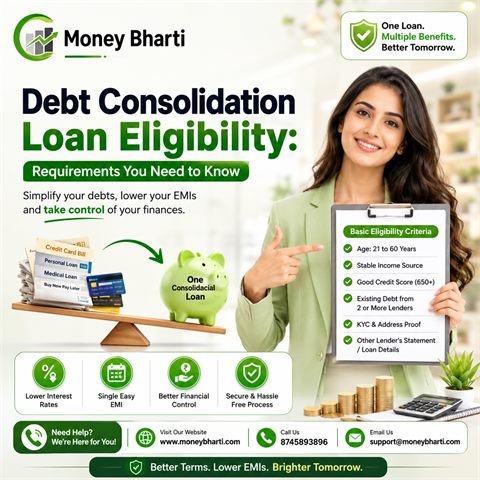
Before you shortlist a lender, it helps to check the full debt consolidation loan eligibility criteria in detail — the summary below covers only the basics.
Eligibility Table — clean two-column design]
| Criteria | Salaried Applicants | Self-Employed Applicants |
|---|---|---|
| Age | 21–60 years | 25–65 years |
| Minimum Income | ₹15,000–₹25,000/month | ₹2–3 lakh annual profit (varies) |
| Work Experience | Minimum 1 year in current job | 2–3 years in business |
| Credit Score | 650+ preferred, 700+ ideal | 650+ preferred, 700+ ideal |
| Existing EMIs | Should not exceed 50-60% of monthly income (including new loan) | Same |
| Residence | Indian resident | Indian resident |
Disclaimer: Actual eligibility depends entirely on the individual lender's internal policy. Two banks can reject or approve the same applicant differently. This table is only a general guide, not a guarantee of approval.
Did You Know? Most lenders in India check your Fixed Obligation to Income Ratio (FOIR) before approving any loan. If your total EMIs (old + new) cross about 50-55% of your monthly take-home salary, approval becomes difficult — this is one of the most common reasons for rejection, even with a decent credit score.
Documents Required
Documents Checklist
- PAN Card (mandatory)
- Aadhaar Card / Voter ID / Passport (address proof)
- Last 3 months' salary slips (salaried) or last 2 years' ITR (self-employed)
- Bank statements of last 6 months
- Passport-size photographs
- Statement or closure letters of existing loans/credit cards (helps speed up processing)
Keeping these ready before you apply usually cuts down processing time significantly. See the complete, lender-wise documents required checklist for any edge cases specific to your profile.
How the Process Works, Step by Step
Process Diagram — 5-step horizontal flow]
- Check your existing debt — List every loan and card, its outstanding amount, and interest rate.
- Check your credit score — A score above 700 usually gets you better rates.
- Compare lenders — Look at interest rate, processing fee, and prepayment charges together, not just the rate.
- Apply and submit documents — Most banks and NBFCs now allow full online application.
- Loan disbursal and closure — Once approved, the amount is credited to your account. Use it immediately to close old debts — don't let it sit and get spent elsewhere.
Expert Insight: Step 5 is where many people slip. The whole purpose of consolidation fails if you take the new loan, pay off old cards, and then start using those same cards again. Consider asking the bank to close the old cards, or at least keep them locked away, once dues are cleared.
Comparing Consolidation Loan vs Other Options
A consolidation loan isn't the only route out of multiple debts — a balance transfer loan or a loan against property can also work, depending on your situation. Here's how they stack up.
Comparison Table — side by side
| Option | Typical Interest | Best For | Watch Out For |
|---|---|---|---|
| Debt Consolidation Personal Loan | 10.5%–24% p.a. | Multiple high-interest debts | Requires decent credit score |
| Balance Transfer on Credit Card | 0%–15% (introductory) | Short-term relief | Rate jumps after offer period ends |
| Loan Against Property | 8%–12% p.a. | Large debt amounts | Risk of losing property on default |
| Gold Loan | 9%–15% p.a. | Quick, smaller amounts | Loses relevance for large debt totals |
[TABLE END]
Example
Rahul, a 32-year-old marketing executive in Pune, had three credit cards and one personal loan, together adding up to about ₹4,50,000 in outstanding debt, with EMIs and minimum payments totalling nearly ₹22,000 a month across different average interest rates of 30-40%.
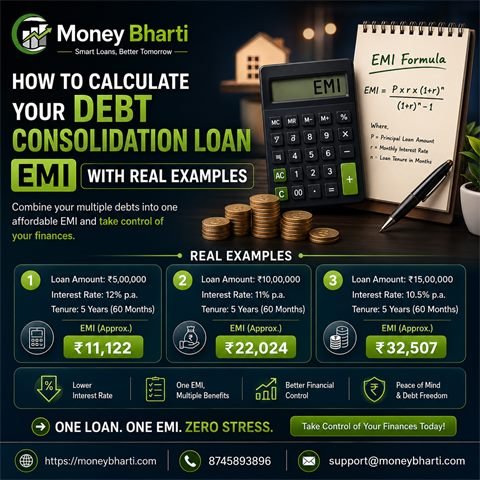
He took a debt consolidation personal loan of ₹4,50,000 at 14% interest for a 3-year tenure. His new single EMI came to approximately ₹15,400 a month — lower than before, at one fixed rate, with a clear end date three years away.
This is a representative example to explain the concept — your actual numbers will depend on your credit profile, income, and the lender you choose.
Responsible Borrowing: Cautions Before You Apply
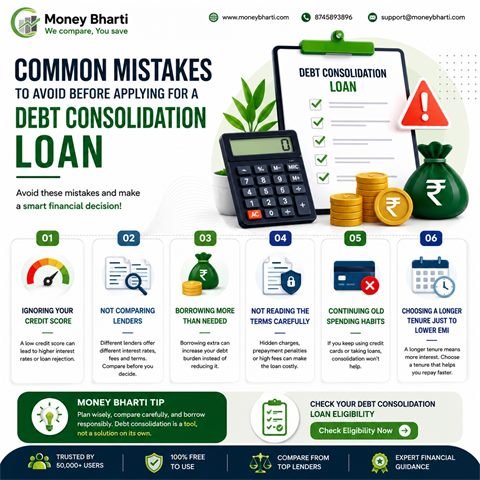
- Don't consolidate to free up credit limit and spend more. This is the single biggest reason consolidation fails — people clear cards and then run them up again.
- Check the prepayment/foreclosure charges before signing. Some loans allow free prepayment after 12 months; others charge a fee throughout.
- Read the processing fee and hidden charges — some offers with an attractive interest rate recover the cost through a high processing fee.
- Don't borrow more than what's needed to close existing debt. Extra "buffer" amount often gets spent unnecessarily.
- A missed EMI on a consolidation loan hurts your credit score just like any other loan — treat it with the same seriousness as your old debts. If you're already struggling with a due date, read what to do if you cannot pay your EMI before it snowballs.
Did You Know? Under RBI's guidelines, lenders in India are required to disclose the Annual Percentage Rate (APR), which includes processing fees and other charges — not just the headline interest rate. Always ask for the APR, not just the "interest rate," when comparing offers.
Frequently Asked Questions
Is a debt consolidation loan the same as a regular personal loan? Yes, structurally it is a personal loan. The difference is only in purpose — you're using it specifically to pay off other debts rather than for a new expense.
Will taking a consolidation loan affect my credit score? In the short term, a hard inquiry may cause a small, temporary dip. Over time, as your credit utilisation drops and you pay the new EMI on time, your score typically improves.
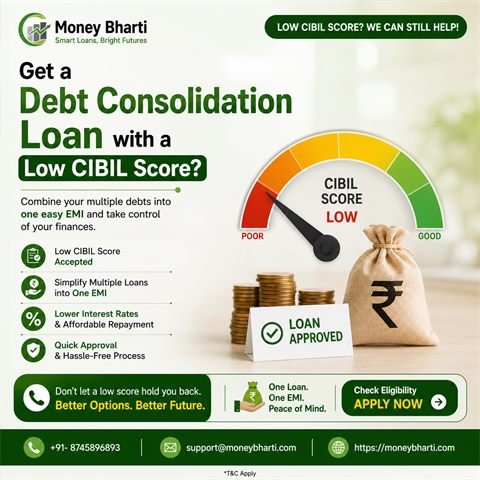
Can I get a consolidation loan with a low credit score? It's possible but harder, and the interest rate offered will usually be on the higher side. Some NBFCs are more flexible than banks in this regard.
Is collateral required? Most debt consolidation personal loans in India are unsecured, meaning no collateral is needed. Secured options like loan against property exist for larger amounts.
How much can I actually save by consolidating? It depends on the gap between your old average interest rate and the new loan's rate. The bigger the gap (for example, moving from 36% credit card debt to a 13% personal loan), the more you save.
Final Thoughts
A personal loan for debt consolidation isn't a magic fix — it's a tool. Used well, it can simplify your finances, reduce your interest burden, and give you a clear timeline to become debt-free. Used carelessly, it can just become one more loan added to the pile.
Before applying, sit down with your actual numbers, compare at least two or three lenders, and be honest with yourself about your spending habits going forward. That's really the difference between consolidation that works and consolidation that doesn't.
"Confused about which lender offers the best consolidation rate for your profile? Check your eligibility with MoneyBharti in under 2 minutes."