Quick Summary
- Bank rates for debt consolidation (personal loans) currently run roughly 10%–16% p.a.; NBFCs run 11%–28% p.a. depending on your credit profile.
- HDFC Bank and SBI currently sit near the floor of the market, around 9.99%–10.00% p.a., but only for borrowers with a strong CIBIL score (usually 750+).
- NBFCs like Bajaj Finance, Tata Capital, and Navi are worth checking if your score is in the 650–725 range, where banks tend to get stricter.
- New RBI digital lending rules (effective January 2026, revised again in March 2026) now require every lender to show you a standard Key Fact Statement before you sign — use it to actually compare offers.
- Don't chase the advertised rate alone. Processing fees, foreclosure charges, and your actual quoted rate (usually 2–5% above the headline figure) matter just as much.
If you want the basics first, our complete guide to debt consolidation loans covers how the process works end to end.
Problem-Based Introduction
If you're reading this, there's a decent chance you've got more than one EMI running right now — maybe a personal loan, a couple of credit cards, and something else stacked on top. Every lender's website says "lowest interest rate," every comparison article lists the same five names, and none of them tell you which one will actually approve you, at what rate, with what catch.
That's really the problem with most "best banks for X" lists — they're written once and left untouched for two years while rates quietly move. This one is different in one respect: it reflects where rates and RBI rules actually stand in the middle of 2026, not what they were when repo rate cuts were still happening. If your goal is to combine multiple debts into one manageable EMI, here's what the market genuinely looks like right now, lender by lender.
Loan Overview
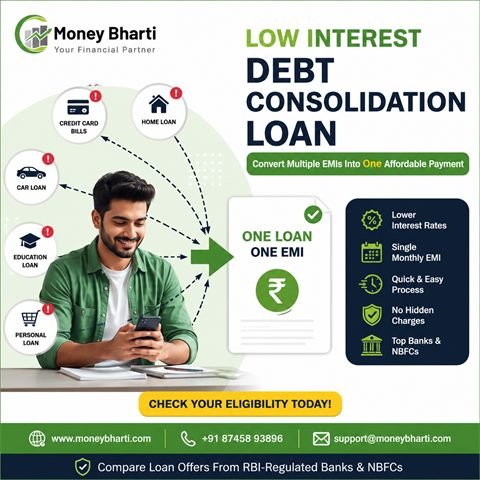
A debt consolidation loan is, in most cases, simply a personal loan taken with the specific purpose of paying off multiple existing debts — credit cards, older personal loans, consumer durable EMIs — and replacing them with a single new loan, ideally at a lower rate. It's unsecured in most cases (no collateral needed), disbursed as a lump sum, and repaid through fixed monthly EMIs over a chosen tenure. Some lenders also offer secured versions against gold or property, usually at a lower rate but with the asset at risk. For a full breakdown of how this compares to a standard personal loan, see our detailed comparison.
Why People Need This Loan?
Most people don't plan for five EMIs — it builds up gradually. A credit card here, an EMI purchase there, a personal loan for an emergency. Individually, each one seemed manageable when taken. Together, they mean multiple due dates, multiple interest rates (often much higher on revolving credit card balances), and a growing sense that despite paying every month, the total debt isn't actually shrinking. Consolidation exists to fix exactly that — one EMI, one due date, and usually a lower blended interest rate.
Is This Loan Right For You?
It's a reasonably good fit if:
- You're juggling three or more debts with different due dates
- A meaningful chunk of your existing debt is high-interest (credit cards, especially)
- Your income is stable enough to support a fixed EMI for the new loan's tenure
- Your credit score is at least in the "fair" range (approximately 650+)
Who Should Avoid This Loan?
- If most of your existing debt is already at a low interest rate, consolidating could actually increase your total cost through fees and a longer tenure.
- If your income is irregular or currently unstable, adding one large fixed EMI can be riskier than managing smaller, flexible payments.
- If the root issue is ongoing overspending rather than the debt structure itself, consolidation without a change in spending habits often just delays the same problem.
- If you're very close to closing most of your existing debts anyway, the fees involved may not be worth it.
Key Benefits
- A single EMI and due date instead of several
- A potentially lower blended interest rate, especially if credit card debt is involved
- Easier to track and budget around one fixed monthly outflow
- Can improve your credit utilisation ratio once revolving credit card balances are cleared
- Predictable payoff date, unlike open-ended revolving credit
Risks You Should Know
- A longer tenure can quietly increase your total interest paid, even at a lower rate
- Processing fees and foreclosure charges can offset some of the expected savings
- If old credit cards are kept open and used again after being paid off, you can end up with the new loan and fresh debt
- A hard credit inquiry from the new loan application causes a small, temporary dip in your credit score
Loan Eligibility
Typical criteria across most banks and NBFCs in 2026:
| Criteria | Typical Requirement |
| Age | 21–60 years (salaried), up to 65 for self-employed in some cases |
| Minimum Income | ₹15,000–₹25,000/month (varies by lender and city) |
| CIBIL Score | 650+ for NBFCs; 700–750+ preferred at most banks for the best rate |
| Employment | Salaried (private/govt) or self-employed with stable income proof |
| Work Experience | 1–2 years minimum, varies by lender |
Use our eligibility checker to see where you stand before applying.
Required Documents
- PAN Card and Aadhaar Card (KYC)
- Last 3–6 months' salary slips (salaried) or ITRs for the last 2 years (self-employed)
- Bank statements for the last 3–6 months
- Existing loan/credit card statements (needed specifically for consolidation)
- A recent passport-size photograph
- Address proof, if not already linked to Aadhaar
Interest Rates
As of mid-2026, personal and consolidation loan rates broadly fall into these bands:
- Banks: roughly 10%–16% p.a., with the lowest rates reserved for CIBIL 750+ applicants with a stable salaried background
- NBFCs: roughly 11%–28% p.a., depending heavily on credit profile and lender risk appetite
- Digital lending apps: anywhere from 14% up to 30%+ p.a. for weaker credit profiles, given the higher risk these lenders typically absorb
The RBI's repo rate sits at 5.25% after a cumulative 125 basis point cut through 2025, and has held steady since February 2026 — so the "big drop" already happened, and current 2026 pricing largely reflects that adjustment working through the system. Read more in our dedicated piece on debt consolidation loan interest rate trends in 2026.
Bank/NBFC Wise Interest Rate Comparison
| Lender | Type | Starting Rate (p.a.) | Notes |
| HDFC Bank | Bank | ~9.99% | Best rate for pre-approved, high-CIBIL customers |
| SBI | Bank (PSU) | ~10.00% | Processing fee up to 1.5% |
| ICICI Bank | Bank | ~10.45% | Strong digital application process |
| Kotak Mahindra Bank | Bank | ~10.50% | Competitive for existing account holders |
| Axis Bank | Bank | ~10.99% | Good for salaried professionals |
| IndusInd Bank | Bank | ~10.99% | Fast disbursal for pre-approved offers |
| Tata Capital | NBFC | ~10.99% | Flexible tenure options |
| Bajaj Finance | NBFC | ~11%–13% | Large loan amounts available |
| Navi | NBFC/Digital | ~9.9%–14% | Fully digital, quick approval |
| Poonawalla Fincorp | NBFC | ~11%+ | Known for quick processing |
| MoneyView | NBFC/Digital | ~14%+ | Accepts CIBIL scores from 650 |
| KreditBee | Digital Lender | ~14%–29.95% | Higher rates, easier approval |
| CASHe | Digital Lender | ~27%–33% | Short-tenure, higher-risk profile lending |
Rates are starting/best-case figures and can change monthly. Always confirm the current rate directly with the lender, and compare using a personal loan interest rate calculator before deciding.
Processing Fees & Hidden Charges
- Processing fee: typically 0%–3% of the loan amount, plus 18% GST on the fee itself
- Foreclosure/prepayment charges: varies widely — some lenders now offer zero foreclosure charges on floating-rate loans under the revised RBI rules, but fixed-rate loans may still carry a charge
- Late payment penalty: usually 1%–2% per month on the overdue amount
- Loan insurance: often offered as an add-on; it's optional in most cases even if presented as a default inclusion, so it's worth checking before accepting
- Documentation/legal charges: occasionally applied by NBFCs, usually a flat fee
Always ask for the effective interest rate — the interest rate plus fees combined — rather than comparing the headline rate alone.
EMI Calculation
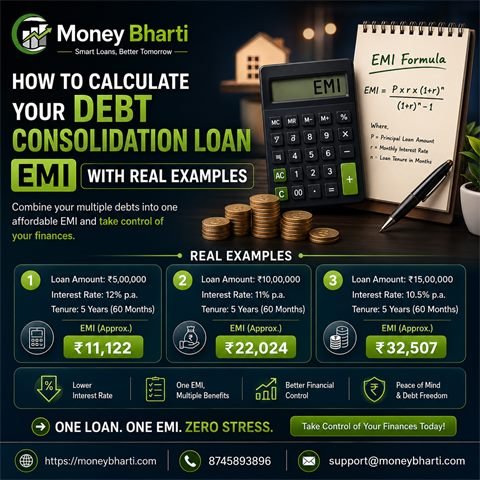
Say you consolidate ₹5,00,000 of existing debt into a new loan at 13% p.a. over 4 years (48 months).
Using the standard EMI formula, the approximate monthly EMI works out to around ₹13,400, with total interest paid over the tenure of roughly ₹1,43,000, bringing the total repayment to around ₹6,43,000.
If the same amount had instead stayed spread across a typical credit-card-heavy debt mix averaging 28% p.a., the interest cost alone over a comparable period would be substantially higher — often more than double, depending on how much of the ₹5,00,000 was sitting on revolving credit card balances.
(Figures are illustrative and rounded. Use our EMI calculator to get an exact number for your loan amount, rate, and tenure.)
EMI Comparison (Before vs After)
| Before Consolidation | After Consolidation | |
| Number of EMIs | 3–5 separate | 1 |
| Blended Interest Rate | ~24%–30% (credit-card heavy) | ~11%–16% |
| Monthly Tracking | Multiple due dates | Single due date |
| Total Interest (illustrative, ₹5L over 4 yrs) | Significantly higher | ~₹1.4L (at 13% p.a.) |
Monthly & Total Savings Example
Continuing the example above: if your existing blended monthly outflow across multiple debts was running close to ₹18,000–₹20,000 (a mix of minimum credit card payments and EMIs), consolidating into a single ₹13,400 EMI could free up several thousand rupees a month — while also putting you on a fixed payoff timeline instead of an open-ended one. Over the full tenure, the total interest saved compared to continuing on high-interest revolving credit could run into tens of thousands of rupees, depending on exactly how much of the original debt was credit-card based.
Loan Amount & Tenure Options
| Lender Type | Typical Loan Amount Range | Typical Tenure |
| Banks | ₹50,000 – ₹40,00,000 | 12–84 months |
| NBFCs | ₹5,000 – ₹55,00,000 | 3–96 months |
| Digital Lenders | ₹5,000 – ₹5,00,000 | 3–36 months |
Longer tenures reduce your EMI but increase total interest paid — always weigh both before choosing.
Step-by-Step Application Process
- Check your CIBIL score and calculate your total existing debt and blended interest rate.
- Use an eligibility checker to shortlist lenders you're likely to qualify with.
- Compare pre-qualified rate offers from 3–4 banks/NBFCs (most pre-qualification checks are soft inquiries and don't hurt your score).
- Choose a lender and submit the application with KYC, income, and existing loan/credit card statements.
- Review the Key Fact Statement (KFS) carefully — this is now mandatory under RBI's 2026 digital lending rules.
- Accept the offer, complete e-sign/verification, and receive disbursal directly into your bank account.
- Immediately use the disbursed amount to close your existing debts (if the lender hasn't already paid them directly).
- Set up auto-debit for your new EMI from day one.
Processing Time & Disbursement Timeline
- Digital lenders/NBFCs: often same-day to 48 hours for pre-approved or clean-profile applicants
- Private banks: typically 2–5 working days
- Public sector banks: usually 5–10 working days, sometimes longer depending on branch verification
Under the RBI's revised digital lending framework, disbursal must go directly to the borrower's bank account — no routing through third-party lending service providers — which has generally made the process faster and more transparent than a few years ago.
Customer Case Study
Consider someone managing five separate repayments — a personal loan, two credit cards, a phone EMI, and a two-wheeler loan — totalling roughly ₹6,80,000, at a blended interest rate close to 28% p.a. (driven largely by the credit card balances). After comparing offers, they consolidated into a single loan at 15% p.a. over 4 years. The result: one EMI instead of five, a lower blended rate, and a clear payoff date. The one mistake made along the way — using a "paid off" credit card again a few months later — is a common trap, and it's worth reading in full in our detailed case study on combining 5 loans into 1 EMI.
Customer Persona Example
Profile: The Multi-EMI Salaried Professional
- Age: 28–40
- Monthly income: ₹40,000–₹80,000
- Existing debt: 3–5 sources, credit cards forming the highest-interest chunk
- CIBIL score: 680–740 (decent, not exceptional)
- Primary goal: simplify repayment and reduce the credit card interest burden specifically
This is the profile that tends to benefit most clearly from consolidation — enough income to qualify for a reasonable rate, but enough high-interest debt that the savings are real rather than marginal.
Loan Approval Journey (Timeline)
- Day 0: Application submitted with documents
- Day 0–1: Initial eligibility and credit bureau check (now reported in near real-time under the RBI's 2026 rules)
- Day 1–3: Income and document verification
- Day 2–5: Key Fact Statement shared, final rate confirmed
- Day 3–7: Approval and e-sign of loan agreement
- Day 3–10: Disbursal to bank account (faster for NBFCs/digital lenders, slower for PSU banks)
Common Loan Rejection Reasons
- CIBIL score below the lender's minimum threshold (often 650–700)
- High existing debt-to-income ratio (most lenders prefer this under roughly 40%–50%)
- Inconsistent or undeclared existing loans, which now surface faster due to real-time credit bureau reporting
- Frequent job changes or less than the minimum required work experience
- Multiple loan applications submitted within a short window, which can itself look like financial distress to a lender
Tips to Increase Approval Chances
- Check your CIBIL score before applying and dispute any errors first
- Pay down at least a portion of existing credit card balances if possible, to lower your utilisation ratio
- Avoid applying to five lenders simultaneously — space out applications or rely on soft-inquiry pre-qualification checks
- Keep income documentation updated and consistent across what you declare to different lenders
- Consider a co-applicant with a stronger income or credit profile if your own profile is borderline
Eligibility Score / Approval Score
Most lenders now use an internal scoring model combining your CIBIL score, income stability, existing debt-to-income ratio, and repayment history to arrive at an approval decision — beyond just a single credit score number. As a rough self-check:
| Factor | Strong | Moderate | Weak |
| CIBIL Score | 750+ | 650–749 | Below 650 |
| Debt-to-Income Ratio | Under 35% | 35%–50% | Above 50% |
| Employment Stability | 2+ years, same employer | 1–2 years | Under 1 year / frequent changes |
If you fall mostly in the "Strong" column, you're likely to see close-to-headline rates. Mostly "Moderate" or "Weak," and NBFCs or digital lenders may be more realistic than top-tier banks.
AI Loan Eligibility Prediction
Several lenders now use AI-based underwriting models — factoring in transaction patterns, repayment history, and alternative data points beyond the traditional CIBIL score — to predict approval likelihood and offer instant, pre-qualified rates. This is particularly common among NBFCs and digital lenders, and it's part of why someone with a moderate credit score can sometimes get approved faster through a digital lender than a traditional bank, even if the rate is a bit higher.
Before You Apply Checklist
- [ ] Checked your current CIBIL score
- [ ] Listed all existing debts with their exact outstanding amounts and interest rates
- [ ] Calculated your blended existing interest rate
- [ ] Compared pre-qualified offers from at least 3 lenders
- [ ] Confirmed the effective rate (interest + fees) for each offer
- [ ] Reviewed the Key Fact Statement for the shortlisted lender
- [ ] Decided what happens to old credit cards once they're paid off
- [ ] Set up a plan to avoid running up new debt after consolidating
Loan Suitability Score
Rate yourself on the following (1 point each) to get a rough sense of fit:
- I have 3 or more active debts right now
- At least one of my debts carries an interest rate above 24% p.a.
- My income has been stable for the past 12 months
- My CIBIL score is 650 or above
- I don't plan to use paid-off credit cards for regular spending afterward
4–5 points: Consolidation is likely to genuinely help. 2–3 points: Worth comparing carefully before deciding. 0–1 point: You may be better served by other options first — see our personal loan vs debt consolidation loan comparison.
Loan Cost Breakdown
For a ₹5,00,000 loan at 13% p.a. over 4 years, a realistic full cost breakdown looks roughly like this:
| Component | Approximate Cost |
| Principal | ₹5,00,000 |
| Total Interest (48 months) | ~₹1,43,000 |
| Processing Fee (1.5% + GST) | ~₹8,850 |
| Total Cost | ~₹6,51,850 |
Pros & Cons
Pros
- Single EMI, simpler tracking
- Often a lower blended interest rate
- Fixed, predictable payoff timeline
- Can improve credit utilisation once cards are cleared
Cons
- Doesn't reduce the actual amount owed
- Longer tenure can increase total interest despite a lower rate
- Processing fees and charges apply
- Risk of accumulating new debt if spending habits don't change
Myths vs Facts
| Myth | Fact |
| Debt consolidation erases your debt | It restructures debt into one loan — the amount owed doesn't reduce automatically |
| A lower EMI always means you're saving money | Not necessarily — a longer tenure can mean more total interest despite a smaller EMI |
| Only people with bad credit need consolidation | Many salaried professionals with decent credit use it simply to simplify multiple payments |
| Applying to multiple lenders always hurts your score | Soft-inquiry pre-qualification checks generally don't affect your score; only formal applications do |
| NBFCs are always riskier than banks | NBFCs are RBI-regulated too; rates are usually higher due to risk-based pricing, not because they're unsafe |
Loan Comparison Table (vs Other Loans)
| Option | Best For | Key Trade-off |
| Debt Consolidation Loan | Multiple high-interest debts, stable income | Longer tenure can hide the true total cost |
| Balance Transfer Credit Card | Smaller, short-term card debt | Promotional rate often rises after a few months |
| Debt Snowball/Avalanche (DIY) | Disciplined borrowers who can self-manage | Takes longer, no lower blended rate |
| Debt Settlement | Very high debt with negotiating lenders | Significant credit score damage |
Latest RBI Guidelines & Compliance
The RBI's Digital Lending Directions, originally issued in May 2025 and effective from January 1, 2026, reshaped how personal and consolidation loans are approved and managed. Key points relevant to borrowers:
- A mandatory, standardised Key Fact Statement (KFS) must be shown before you sign, listing the all-in effective cost of the loan
- Real-time credit bureau reporting — your new loan appears in your credit report within days, not weeks or months
- Direct disbursal only into the borrower's bank account, with no routing through third-party intermediaries
- A cooling-off period allowing you to exit the loan early by paying only the principal and proportionate interest, without a prepayment penalty
- Recovery practice restrictions — agents cannot contact you before 8 AM or after 7 PM, cannot contact non-co-borrower family members, and cannot use social media to share default status
- A revised Master Direction supplement issued in March 2026 further tightened KFS formatting and collection practice compliance
- All digital lending apps must be registered on the RBI's CIMS portal — an unregistered app is, by definition, not authorised to lend
These rules apply to banks, NBFCs, and their lending partners alike, so it's worth confirming your shortlisted lender is compliant before applying.
Financial Expert Opinion
Financial advisors generally frame debt consolidation as a tool, not a fix. The consistent advice across the industry: compare the total cost over the full tenure rather than the EMI or headline rate alone, prioritise consolidating high-interest debt (credit cards specifically) rather than everything by default, and treat the underlying spending pattern as equally important as the loan itself — since a consolidation loan taken without addressing that pattern often just delays the same problem by a year or two.
Latest Market Trends & Statistics
- Digital lending is projected to account for roughly 62% of new personal loans in India by 2026, reflecting the continued shift away from purely branch-based applications.
- Personal loan disbursals in India crossed ₹8.5 lakh crore in FY24, underlining how large and mainstream this category has become.
- RBI's 125 basis point repo rate cut through 2025 has largely worked its way into current bank pricing, with rates holding broadly steady through the first half of 2026.
- Most borrowers report being quoted rates 2%–5% above the headline advertised rate, since the lowest figures are reserved for the strongest credit profiles.
Frequently Asked Questions
1. What is a debt consolidation loan? It's typically a personal loan taken specifically to pay off multiple existing debts, replacing them with one loan and a single EMI.
2. Is a debt consolidation loan the same as a balance transfer? Not quite. A balance transfer usually moves one type of debt (often a credit card) to a lower-rate card or loan, while consolidation combines multiple different debts into one.
3. Which bank offers the lowest interest rate for debt consolidation in 2026? HDFC Bank and SBI currently offer among the lowest starting rates (around 9.99%–10.00% p.a.), but only for applicants with strong credit profiles.
4. Can I consolidate debt with a CIBIL score below 650? It's harder through banks, but some NBFCs and digital lenders work with scores in the 600s, usually at a higher interest rate.
5. Will taking a consolidation loan hurt my credit score? There's usually a small, temporary dip from the new credit inquiry, which typically recovers within a few months of on-time payments.
6. How much can I borrow for debt consolidation? This depends on the lender and your income, but amounts commonly range from ₹50,000 up to ₹40–55 lakh at the top end.
7. Are NBFCs safe compared to banks? Yes — NBFCs are regulated by the RBI as well. Rates tend to be higher due to risk-based pricing, not because they're inherently unsafe.
8. Is there a prepayment penalty if I want to close the loan early? Under the RBI's revised rules, floating-rate loans generally cannot carry a prepayment penalty. Fixed-rate loans may still have one — always check before signing.
9. How long does approval and disbursal usually take? Digital lenders and NBFCs are often the fastest (same day to 48 hours for clean profiles), while PSU banks can take a week or more.
10. Can self-employed individuals apply for a debt consolidation loan? Yes, typically with ITRs for the last two years and bank statements as income proof, though eligibility criteria can be stricter than for salaried applicants.
11. What documents do I need to consolidate credit card debt specifically? Your recent credit card statements showing the outstanding balance, along with standard KYC and income documents.
12. Does the lender pay off my old debts directly, or do I have to do it myself? This varies by lender — some disburse directly to close old accounts, others disburse to you and expect you to close the old debts yourself. Confirm this before applying.
13. What is a Key Fact Statement (KFS)? A standardised, RBI-mandated document that every lender must now show you before you sign, listing the loan's full effective cost, including all fees.
14. Can I negotiate a better rate with my existing bank? Yes — if you already have a salary account or clean repayment history with a bank, it's worth asking directly; relationship discounts of 25–50 basis points are common but usually aren't offered automatically.
15. What happens if I miss an EMI on my consolidation loan? Expect a late payment penalty (usually 1%–2% per month on the overdue amount) and a negative mark on your credit report, which is now reported to bureaus in near real-time.
16. Should I close my old credit cards after consolidating? Not necessarily — keeping them open (unused) can actually help your credit utilisation ratio. The key is not using them for regular spending again.
17. Is debt consolidation worth it if my existing debt is mostly low-interest? Probably not — if your blended existing rate is already close to what a new consolidation loan would offer, the fees involved may outweigh the benefit.
Useful Tools (EMI, Eligibility, FOIR, etc.)
- EMI Calculator — estimate your monthly payment and total interest before applying
- Loan Eligibility Checker — see which lenders you're likely to qualify with
- FOIR Calculator — check your fixed obligation-to-income ratio, a key factor lenders use in approval decisions
- CIBIL Score Check — check and understand your current credit score before applying
Financial Terms Glossary
- CIBIL Score: A three-digit credit score (300–900) reflecting your credit repayment history.
- FOIR (Fixed Obligation to Income Ratio): The percentage of your income going toward existing fixed debt obligations.
- KFS (Key Fact Statement): A mandatory, standardised disclosure of a loan's full effective cost.
- Effective Interest Rate: The true cost of a loan including interest plus all applicable fees.
- Foreclosure Charge: A fee charged for closing a loan before the end of its tenure.
- Debt-to-Income Ratio: Total monthly debt payments divided by monthly income.
- Blended Interest Rate: The weighted average interest rate across multiple existing debts.
Related Articles
- 10 Questions to Ask Before Applying for a Debt Consolidation Loan
- How One Person Combined 5 Loans Into a Single EMI: A Case Study
- Debt Consolidation Loan Interest Rates in 2026: What's Changed?
- Personal Loan vs Debt Consolidation Loan: Which Is Right for You?
- Bank vs NBFC Personal Loan: Full Comparison
Conclusion
There isn't a single "best" bank or NBFC for debt consolidation in 2026 — there's a best fit for your specific credit profile, existing debt mix, and income. If your CIBIL score is strong, HDFC Bank and SBI currently offer the most competitive starting rates. If your profile sits in the moderate range, NBFCs like Tata Capital, Bajaj Finance, or Navi are realistically worth comparing before assuming you won't qualify at a bank. What matters more than any single name on this list is comparing the effective cost — rate plus fees — across at least three offers before deciding.
Next step: Check your eligibility, compare personalised rate offers from a few lenders using the EMI calculator and eligibility checker, and read the Key Fact Statement carefully before signing anything.