If your salary account feels like a railway platform where money just arrives and leaves within minutes, you're not alone. Between a personal loan EMI, a credit card minimum due, maybe a consumer loan for that phone or fridge, and a couple of due dates that never seem to align with your salary date — EMI stress is one of the most common financial problems Indian borrowers deal with today.
The good news is that this problem usually has a fairly simple fix, and it's called debt consolidation. In plain terms, it means combining everything you owe into a single loan with one EMI, ideally at a lower interest rate and a repayment plan that actually fits your monthly budget.
In this article, we'll walk through why your EMIs are so high in the first place, what debt consolidation actually means, how it brings your monthly payment down, a real example calculation, who should consider it, what to check before applying, and the documents and eligibility involved. By the end, you'll have a clear picture of whether a Debt Consolidation Loan is the right move for you.
Why Are Your Monthly EMIs So High?
Before jumping to solutions, it helps to understand why the EMI burden builds up in the first place. Usually, it's not one single loan — it's a combination of factors stacking on top of each other.
Multiple personal loans running at the same time. Many borrowers take a second or third personal loan before fully closing the first one, especially for medical expenses, weddings, or emergencies. Each new loan adds its own EMI on top of the existing ones.
Credit card outstanding balances. Credit cards feel harmless because the minimum due looks small, but the actual interest rate on the outstanding amount is often 36-45% annually. That outstanding quietly grows every month if you're only paying the minimum.
High interest rate loans. If a loan was taken when your credit score was lower, or through a lender that charges a premium for quick disbursal, you could be paying a noticeably higher rate than what you'd qualify for today.
Short repayment tenure. A loan taken over 12-18 months will naturally have a heavier EMI than the same amount spread over 36-48 months. Shorter tenures are great for saving on total interest, but they can strain your monthly cash flow.
Different EMI dates. When your loans are spread across different lenders, your due dates rarely line up with your salary credit date. This forces you to keep a cash buffer running through the month just to avoid missing a payment, which adds unnecessary financial pressure.
Individually, none of these feel unmanageable. But stacked together, they can eat up 40-50% of a monthly salary, leaving very little room for savings or emergencies.
What Is Debt Consolidation?
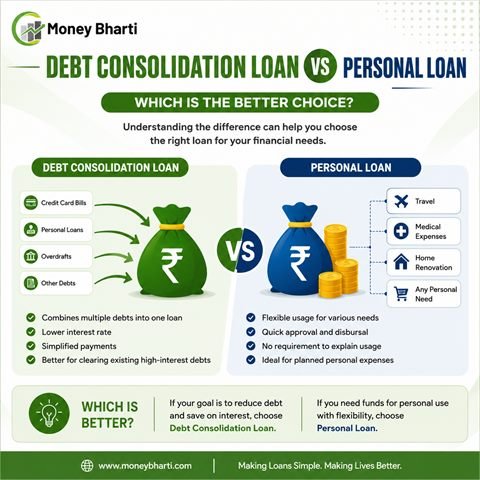
Debt consolidation is exactly what it sounds like — you take a new loan and use it to pay off all your existing loans and credit card dues in one go. What's left afterward is a single loan, with a single EMI, a single due date, and a single lender to deal with.
Think about it this way:
Loan 1 (Personal Loan)     ₹7,000
Loan 2 (Consumer Loan)     ₹5,000
Loan 3 (Another Personal)  ₹4,000
Credit Card Outstanding    ₹6,000
            ↓
    Debt Consolidation Loan
            ↓
     One EMI: ₹16,000 (example)
Instead of tracking four different payments across four different dates, you now have one predictable EMI to plan around. That alone makes budgeting significantly easier — but the real benefit goes further than convenience, which brings us to how this actually reduces your monthly outgo.
How Debt Consolidation Helps Reduce Monthly EMI
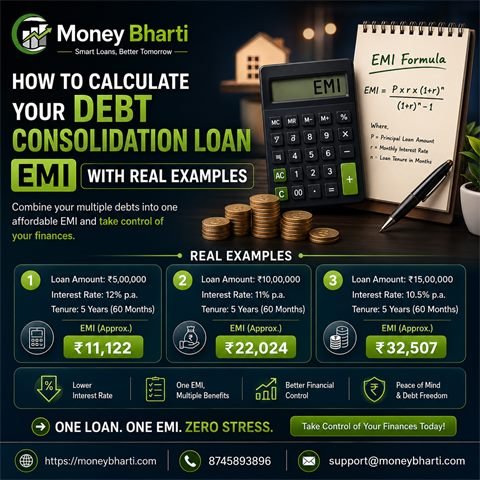
Lower Interest Rate This is usually the single biggest factor. Credit card debt and older high-interest loans often carry rates well above 30%, while a well-structured Debt Consolidation Loan can bring your blended rate down to somewhere between 11% and 18%, depending on your credit profile. Lower interest directly translates into a lower EMI on the same outstanding amount.
Longer Repayment Tenure Spreading your total debt over a longer, more comfortable tenure reduces the monthly figure. This needs to be balanced carefully — a longer tenure without a lower rate can sometimes mean paying more in total interest — but when structured well, it's one of the most effective EMI-reduction levers available.
One EMI Instead of Multiple EMIs Multiple EMIs across multiple lenders often come with their own set of processing charges, late fees, and administrative costs. Consolidating into one loan removes this duplication and simplifies your monthly financial commitment into a single number.
Better Cash Flow With one predictable EMI instead of several unpredictable ones scattered through the month, it's far easier to plan your salary around rent, groceries, savings, and other expenses without constantly shuffling money between accounts.
Easier Budget Management A single due date, a single lender, and one number to track means less mental load every month. For most borrowers, this alone is worth a lot — financial stress isn't only about the amount owed, it's also about the complexity of managing it.
Example Calculation
Numbers make this much easier to understand, so here's a realistic example of what consolidation can look like.
Before Consolidation
| Existing Loans | EMI |
| Personal Loan | ₹8,000 |
| Credit Card | ₹6,000 |
| Consumer Loan | ₹5,000 |
| Total EMI | ₹19,000 |
After Consolidation
| New Loan | EMI |
| Consolidated Loan | ₹14,500 |
Monthly Saving: ₹4,500
That's roughly ₹4,500 freed up every single month — money that can go into savings, an emergency fund, or simply reduce the pressure of living paycheck to paycheck. Over a year, that's ₹54,000 back in your pocket, without changing your income at all.
Who Should Consider Debt Consolidation?
Debt consolidation isn't limited to any one type of borrower. It tends to make sense for:
- Salaried employees juggling a personal loan alongside credit card dues, especially where EMIs are eating a large share of take-home pay.
- Self-employed individuals managing business-related borrowing alongside personal expenses, where cash flow can be uneven month to month.
- Anyone with multiple EMIs running simultaneously across different lenders and due dates.
- Credit card users carrying a revolving balance that keeps growing due to high interest.
- High-interest borrowers who took loans in the past at rates that no longer reflect their current, improved credit profile.
If more than one of these applies to you, it's worth at least running the numbers to see what consolidation could save you.
Benefits of Reducing Monthly EMI
Lowering your EMI burden has effects that go well beyond the immediate relief of a smaller number on your bank statement.
- Better savings. Freed-up monthly cash can go directly into an emergency fund, SIPs, or a savings account instead of disappearing into interest payments.
- Improved financial planning. With one predictable EMI, it's far easier to build a monthly budget you can actually stick to.
- Less stress. Fewer due dates and fewer lenders to track means less mental clutter and fewer anxious moments around salary day.
- Better repayment history. A single, manageable EMI is easier to pay on time consistently, which builds a stronger repayment track record over time.
- Chance to improve your CIBIL Score. Timely repayment of a consolidated loan, combined with lower credit utilisation on your cards, can gradually improve your credit score.
- Avoid late payment penalties. With fewer due dates to juggle, the odds of accidentally missing one drop significantly, saving you both penalty charges and credit score damage.
Things to Consider Before Choosing Debt Consolidation
Before signing up for any consolidation loan, a few things are worth checking carefully:
Compare interest rates. Don't accept the first offer you get — rates for the same profile can vary by several percentage points between lenders. It's worth comparing multiple offers before committing.
Check processing fees. Most consolidation loans come with a processing fee of around 1-3%. Factor this into your overall cost calculation rather than looking only at the EMI.
Choose the correct tenure. A longer tenure lowers your EMI but can increase total interest paid. Pick a tenure that balances monthly affordability with total cost.
Avoid unnecessary borrowing. Only consolidate what you actually owe. Taking a larger loan amount than needed "just in case" defeats the purpose of debt reduction.
Check foreclosure charges. If you plan to prepay the consolidated loan later, confirm foreclosure or prepayment charges upfront so there are no surprises.
Eligibility for Debt Consolidation Loan
While exact criteria vary by lender, most Debt Consolidation Loans in India look at:
- Age — typically between 21 and 60 years at the time of application.
- Income — a stable monthly income, whether salaried or self-employed, that comfortably supports the new EMI.
- Employment — a minimum period of continuous employment or business operation, often 1-2 years.
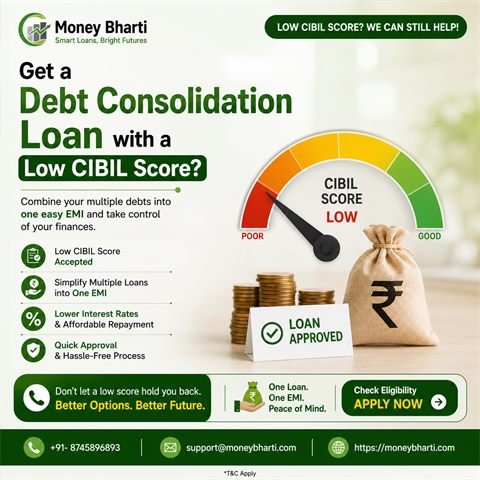
- CIBIL Score — generally 650 and above, though some lenders work with lower scores at a higher interest rate.
- Existing liabilities — the total outstanding across your current loans and cards, which determines the consolidation loan amount required.
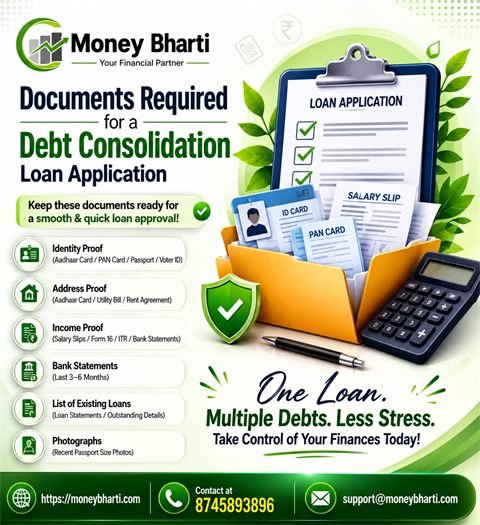
Documents Required
Getting your documentation ready in advance speeds up the approval process considerably. You'll typically need:
- Aadhaar Card
- PAN Card
- Salary Slips (usually the last 3 months)
- Bank Statement (usually the last 3-6 months)
- Address Proof
- Passport Size Photograph
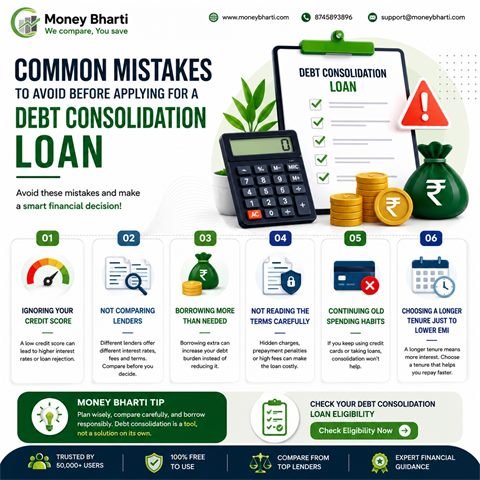
Common Mistakes to Avoid
A few missteps can turn a smart financial decision into a frustrating one:
- Closing old loans incorrectly. Always get a formal closure or NOC document after clearing an existing loan — don't just assume it's closed.
- Missing an EMI. Even one missed payment on the new consolidated loan can undo the credit score benefit you were hoping to build.
- Taking new credit cards. Applying for fresh credit right after consolidating defeats the purpose and can quickly rebuild the same debt cycle.
- Borrowing more money than needed. Consolidation should reduce your total debt exposure, not become an opportunity to borrow extra.
- Ignoring loan terms. Always read the fine print on interest type (fixed vs floating), fees, and penalty clauses before signing.
Frequently Asked Questions
Can debt consolidation reduce EMI? Yes. By combining multiple loans into one at a lower interest rate and a suitable tenure, your total monthly EMI typically comes down compared to servicing several loans separately.
Does it reduce interest? In most cases, yes — especially if you're moving away from high-interest credit card debt toward a lower-rate personal loan or consolidation loan.
Is debt consolidation good for salaried employees? Yes, it's particularly useful for salaried employees managing multiple EMIs, since it simplifies repayment into one predictable monthly outgo aligned better with salary timing.
Can low CIBIL users apply? Some lenders do accept lower CIBIL scores, though usually at a higher interest rate or with a secured option like a loan against property or gold.
How much EMI can be reduced? This depends on your existing interest rates and the new consolidated rate, but many borrowers see a reduction of 15-30% in their total monthly EMI.
Is collateral required? Not necessarily. Many Debt Consolidation Loans are unsecured personal loans. However, secured options (against property, gold, or FD) are available and often come with lower interest rates.
Will my credit score improve? Over time, yes — provided you pay the new EMI on time consistently and avoid building up fresh debt on the accounts you just cleared.
How long is the repayment period? Repayment tenures for consolidation loans typically range from 12 months to 5 years, depending on the lender and the loan amount.
Is there a minimum loan amount for consolidation? This varies by lender, but most consolidation loans start from around ₹50,000 and go up depending on your total existing liabilities and income.
Can I consolidate credit card debt alone, without other loans? Yes. Many borrowers use a consolidation loan purely to pay off high-interest credit card balances, even if they don't have other running loans.
Conclusion
High EMIs rarely come from one bad decision — they usually build up gradually, loan by loan, card by card, until the monthly burden feels heavier than it should. Debt consolidation offers a practical way to bring that back under control: one loan, one EMI, a lower interest rate, and a repayment plan that actually fits your budget.
That said, the right consolidation loan depends entirely on your specific rates, tenure, and existing liabilities — which is exactly why it's worth comparing your options before applying anywhere. You can check your eligibility and compare Debt Consolidation Loan offers on MoneyBharti to see exactly how much your EMI could come down, based on your actual numbers.