Managing three different EMIs, each with its own due date, is more stressful than most people admit. You pay off the credit card on the 5th, the personal loan EMI hits your account on the 10th, and somewhere in between there's a consumer durable loan you almost forgot about. Miss even one payment and you're looking at late fees, a dent in your credit score, and a fresh round of anxiety every month-end.
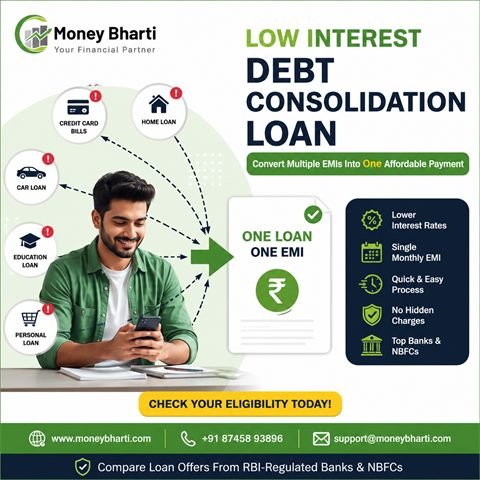
This is exactly the problem a debt consolidation loan is built to solve. Instead of juggling multiple loans with different interest rates and repayment dates, you take one new loan, use it to pay off all your existing debts, and are left with a single EMI to track. Sounds simple — and in most cases, it genuinely is. But is it the right move for you? Let's break down the real reasons people in India are choosing debt consolidation loans, along with the honest downsides you shouldn't ignore.
What Is a Debt Consolidation Loan?
In plain terms, a debt consolidation loan is a new loan you take specifically to pay off two or more existing debts. If you're comparing this against your other borrowing options, it also helps to see how a debt consolidation loan differs from a personal loan. Once those old debts are cleared, you're left owing money to just one lender, at one interest rate, with one EMI date.
Here's how it typically looks on paper:
- Credit card outstanding: ₹2,00,000
- Personal loan: ₹3,00,000
- Consumer durable loan: ₹1,00,000
Total debt: ₹6,00,000 spread across three lenders, three interest rates, three due dates.
After consolidation, this becomes a single loan of ₹6,00,000, repaid through one EMI, to one lender. Nothing about the amount you owe magically disappears — you're still repaying the same principal (plus interest) — but how you repay it becomes far more manageable.
Who Should Choose Debt Consolidation?
Debt consolidation isn't for everyone, and it's worth being honest about that upfront. It tends to make the most sense if you recognise yourself in a few of these situations:
- You're juggling multiple EMIs and struggling to keep track of due dates
- A big chunk of your debt sits on high-interest credit cards (often 30–42% annually)
- You've paid late payment charges more than once in the last year
- Your monthly cash flow feels tight even though your income hasn't dropped
- You want one clear repayment plan instead of several scattered ones
If most of these sound familiar, read on — this is where debt consolidation tends to actually help. Not sure if you qualify? Check the debt consolidation loan eligibility criteria before you go further.
Top Reasons to Choose a Debt Consolidation Loan
1. One Monthly EMI Instead of Multiple Payments
This is the most obvious benefit, but it's also the one that makes the biggest day-to-day difference. Instead of mentally tracking three or four due dates, you have exactly one. That alone cuts down the chances of a missed payment, which in turn protects you from late fees and credit score damage.
2. Lower Overall Interest Cost
Credit cards in India routinely charge 30% or more per year, and unsecured personal loans from smaller NBFCs can go up to 22–24%. A debt consolidation loan, especially one backed by a decent credit score, often comes in at 12–16%.
| Current Loan | Interest Rate |
| Credit Card | 36% |
| Personal Loan | 18% |
| Consumer Loan | 22% |
| Debt Consolidation Loan | 12–16% |
Even a difference of 10–15 percentage points, applied across lakhs of rupees, adds up to real savings over the loan tenure. You can check the current debt consolidation interest rates to see how much you could actually save.
3. Better Monthly Cash Flow
When your EMIs are scattered and add up to a large chunk of your salary, there's often nothing left for savings, let alone emergencies. A consolidated loan, with a potentially lower combined EMI, frees up cash every month — money that can go toward a savings account, an emergency fund, or simply breathing room in your budget.
4. Easier Financial Management
There's a mental cost to managing multiple loans that doesn't show up on any statement. No more logging into four different apps to check balances, no more guessing which lender's due date is closest. One loan means one statement, one login, one number to remember.
5. Reduces Stress and Financial Anxiety
This one doesn't get talked about enough, but it matters. Constantly worrying about which EMI is due next, whether you'll have enough in your account, and whether you're falling behind — this takes a toll. Simplifying your debt into one manageable payment genuinely reduces that background stress, and that's not a small thing.
6. Can Improve Your Credit Score Over Time
Paying multiple EMIs on time is hard; paying one is easier — and consistency is exactly what credit scoring models reward. Additionally, once your credit card balances are paid off through consolidation, your credit utilisation ratio drops, which itself gives your CIBIL score a boost. Over several months of disciplined repayment, many borrowers see a noticeable improvement.
7. Avoid Late Payment Charges
Late fees on credit cards and personal loans aren't small — they can range from ₹500 to a percentage of the outstanding amount, and they stack up if you're managing several loans at once. Simplifying to one EMI, one date, reduces the chances of this happening by accident.
8. Fixed Interest Rate and Predictable EMI
Credit card interest is typically compounding and can change based on your usage. A debt consolidation loan, on the other hand, usually comes with a fixed interest rate and a fixed EMI for the entire tenure. You know exactly what you're paying every month, for the entire duration — no surprises.
9. Potentially Faster Debt Repayment
Without consolidation, your payments are often split unevenly across debts, and high-interest ones (like credit cards) tend to eat up more in interest than principal. With a single, well-structured loan, a larger share of each EMI can go toward reducing the actual principal, which — if you keep the tenure disciplined — can mean becoming debt-free sooner than expected. Curious how this works in practice? Here's a simple breakdown of how to consolidate multiple loans into one EMI.
10. Better Financial Planning Overall
Once your debt is streamlined into one predictable EMI, it becomes far easier to plan the rest of your finances — budgeting, building an emergency fund, or even starting a small SIP. Financial planning is nearly impossible when you don't have a clear picture of your monthly outflows, and consolidation gives you exactly that clarity.
11. Possibility of a Lower EMI
Depending on the tenure you choose, your new combined EMI can end up lower than the sum of your old EMIs. This is particularly true if you extend the tenure slightly in exchange for a lower rate — though this is a trade-off worth thinking through carefully (more on that below). Run the numbers yourself using the debt consolidation EMI calculator before deciding on a tenure.
12. One Loan, One Lender, One Point of Contact
Dealing with customer support across three different lenders, each with their own process for statements, complaints, or foreclosure, is a hassle most people underestimate. With one lender, tracking your loan, requesting statements, or resolving an issue becomes far simpler.
Example
Take Rahul, a 32-year-old working professional in Pune. Before consolidation, his monthly repayment looked like this:
- Credit card outstanding: ₹1,80,000
- Personal loan: ₹2,50,000
- Consumer loan: ₹80,000
- Combined monthly EMI: ₹18,500
After taking a debt consolidation loan to pay off all three:
- New single EMI: ₹13,900
- Monthly savings: ₹4,600
That's nearly ₹55,000 a year freed up — money Rahul now puts toward an emergency fund instead of scrambling to keep up with three different due dates. Like Rahul, if most of your debt is on cards, it's worth looking specifically at credit card consolidation programs.
Advantages at a Glance
| Feature | Benefit |
| Single EMI | Simpler repayment, fewer missed payments |
| Lower interest rate | Saves money over the loan tenure |
| Better cash flow | More breathing room in your monthly budget |
| Improved credit score | Better eligibility for future loans |
| Reduced stress | More peace of mind, less financial anxiety |
Are There Any Drawbacks?
A fair article won't pretend debt consolidation is perfect for everyone — because it isn't. A few things worth knowing before you commit:
- Longer tenure can mean more total interest. A lower EMI often comes from stretching the tenure, which can mean you pay more in total interest even at a lower rate. Do the full math, not just the monthly number.
- Processing fees apply. Most lenders charge a processing fee on the new loan, so factor that into your savings calculation.
- Your credit score affects the rate you get. A weak credit history may mean the new loan isn't actually cheaper than what you're paying now.
- The real risk is new debt. If old credit cards get paid off and then used again without a change in spending habits, you can end up with the consolidation loan and fresh credit card debt — a worse position than before.
Tips Before You Apply
- Compare offers across at least 3–4 lenders, not just your existing bank
- Read the loan terms carefully, especially around prepayment and foreclosure charges
- Use an EMI calculator to compare your current total outflow against the proposed new EMI
- Avoid borrowing more than what's needed to clear your existing debts
- Have a clear plan for not accumulating new high-interest debt after consolidation
- Keep the documents required for a debt consolidation loan ready in advance to speed up approval
Frequently Asked Questions
1. What is a debt consolidation loan? It's a single loan taken to pay off multiple existing debts, leaving you with one EMI instead of several.
2. Who should apply for a debt consolidation loan? Anyone managing multiple high-interest debts, especially credit card balances, who wants a simpler and potentially cheaper repayment structure.
3. Can debt consolidation improve my CIBIL score? Yes, over time — timely EMI payments and lower credit utilisation both contribute positively to your credit score.
4. Can self-employed individuals apply for a debt consolidation loan? Yes, most lenders offer these loans to self-employed applicants, though income proof and documentation requirements may differ from salaried applicants.
5. What documents are typically required? ID proof, address proof, income proof (salary slips or ITR), bank statements, and existing loan statements.
6. What interest rate can I expect? This varies by lender and your credit profile, but it's generally lower than credit card rates and comparable to or better than unsecured personal loan rates.
7. Can I consolidate credit card debt specifically? Yes, credit card debt is one of the most common reasons people take a debt consolidation loan, given how high credit card interest rates typically are.
8. How long is the repayment tenure? This depends on the lender and loan amount, but tenures generally range from 1 to 5 years.
9. Does taking a debt consolidation loan affect my credit score negatively? There may be a small, short-term dip due to the new credit inquiry, but responsible repayment usually improves your score over time.
10. Can I apply for a debt consolidation loan online? Yes, most lenders now offer a fully online application process, from document upload to disbursal.
Conclusion
A debt consolidation loan won't make your debt disappear, but it can make it a lot easier to manage — one EMI, one due date, and often a lower overall interest cost. For a lot of borrowers dealing with the mental load of multiple loans, that simplicity alone is worth considering.
Before you apply, compare lenders, calculate the total cost (not just the monthly EMI), and be honest with yourself about your spending habits going forward. Done right, a debt consolidation loan can be the first real step toward becoming debt-free. Ready to take the next step? Check your debt consolidation loan options with MoneyBharti today.