Rohan had four credit cards, one personal loan, and a phone EMI running at the same time. Every month felt like a juggling act. He finally took a debt consolidation loan to merge everything into one payment. Six months later, he had two credit cards active again, plus the new loan. He hadn't got out of debt — he had walked straight into a new debt trap, just wearing a different name.
This happens to a lot of people in India. A debt consolidation loan can genuinely simplify your finances, lower your interest burden, and give you one clean EMI to track. But the same loan that's meant to rescue you can pull you deeper into debt if you're not careful. This article shows you exactly how that trap forms, and how to avoid debt consolidation loan mistakes that lead you right back to where you started — or somewhere worse.
What is a Debt Consolidation Loan?
A debt consolidation loan is a single loan you take to pay off multiple existing debts — credit card bills, personal loans, or other EMIs. Instead of tracking five due dates and five interest rates, you now have one loan, one EMI, and one lender to deal with. It's essentially a multiple EMI to single EMI loan that brings all your repayments under one roof.
Banks and NBFCs in India offer this as a personal loan for debt consolidation, though some also structure it as a top-up on an existing loan or a loan against property, depending on the amount and your eligibility. Many lenders now also offer online debt consolidation services, so the entire process, from application to disbursal, can be done without visiting a branch.
Benefits of Debt Consolidation
Done right, consolidation can genuinely improve your financial situation. Here's what it offers:
- One EMI instead of many – easier to track, easier to budget around
- Potentially lower interest rate – especially if you're moving away from high-interest credit card debt
- Improved credit score over time – timely payment of one loan is easier to manage than juggling several
- Reduced mental stress – fewer calls from recovery agents, fewer due dates to remember
- Better negotiating power – some lenders offer better terms to consolidate a large amount than to service small individual debts
If you need funds quickly, look for lenders offering an instant debt consolidation loan, since many now approve and disburse within a couple of days once your documents are verified. It also helps to compare structured debt consolidation programs rather than picking the first offer you come across.
Key Features
| Feature | Typical Range in India |
|---|---|
| Loan Amount | ₹50,000 to ₹40 lakh |
| Tenure | 1 to 7 years |
| Interest Rate | 10.5% to 24% per annum |
| Processing Fee | 1% to 3% of loan amount |
| Collateral | Usually not required (unsecured) |
| Disbursal Time | 1 to 5 working days |
These numbers vary by lender, your credit score, and your income profile, so always check current rates before applying.
Eligibility Criteria
Most Indian lenders look at similar factors when you check debt consolidation loan eligibility:
- Age between 21 and 60 years (salaried) or up to 65 (self-employed)
- Minimum monthly income of ₹15,000 to ₹25,000, depending on the city and lender
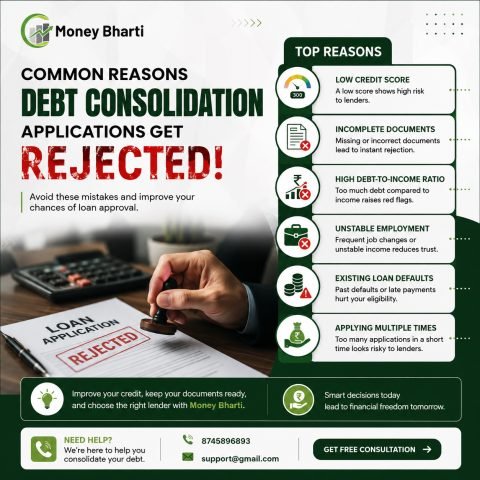
- Credit score of 700 or above for the best rates
- Stable employment history, usually 1 to 2 years with the current employer
- Existing debt-to-income ratio within the lender's acceptable limit
If your credit score has already dropped due to missed payments, you may still qualify, but expect a higher interest rate. Lenders also run separate norms for debt consolidation for salaried employees, which are usually a bit easier to meet than for self-employed applicants.
Documents Required
Keep these ready before you apply, so the process doesn't stall midway:
- PAN card and Aadhaar card
- Recent salary slips (last 3 months) or ITR for self-employed applicants
- Bank statements (last 6 months)
- Existing loan statements or credit card bills you want to consolidate
- Passport-size photographs
- Address proof
Interest Rate: What Actually Affects It
Debt consolidation interest rates aren't fixed by luck — a few things directly move the number:
- Credit score – anything above 750 usually gets you the best offers
- Income stability – salaried employees at reputed companies often get preferential rates
- Existing relationship with the bank – if you already have a savings account or loan there, some lenders shave off a bit
- Loan amount and tenure – shorter tenures sometimes carry slightly lower rates
- Type of consolidation – secured loans (against property or fixed deposit) usually cost less than unsecured personal loans
Comparing lenders is worth the effort here — hunting for low interest debt consolidation offers before you apply can save you a meaningful amount over the loan tenure.
Example
Priya had three debts:
- Credit card 1: ₹1.5 lakh at 36% annual interest
- Credit card 2: ₹80,000 at 40% annual interest
- Personal loan: ₹2 lakh at 18% annual interest
Her combined EMI outgo was close to ₹18,000 a month, and most of it was going toward interest, not principal.
She took a credit card debt consolidation loan of ₹4.3 lakh at 14% interest for 4 years. Her new EMI came to around ₹11,700. She worked this out beforehand using a debt consolidation EMI calculator, which helped her pick a tenure she could comfortably manage. She saved roughly ₹6,000 a month and, more importantly, finally saw her principal reduce with every payment instead of watching interest eat it up.
This is the outcome consolidation is meant to deliver — but it only works if the mistakes below are avoided.
Step-by-Step Process to Apply
- List every existing debt – amount, interest rate, and remaining tenure for each
- Check your credit score – this decides which lenders will even consider you
- Compare offers from 3 to 4 lenders – don't apply to all at once; too many inquiries can hurt your score
- Calculate the total cost – include processing fees, not just the interest rate
- Apply with complete documentation – incomplete files are the most common reason for delay
- Use the loan only to close existing debts – transfer the amount directly, don't let it sit in your account
- Close the old accounts formally – get closure letters or NOCs from previous lenders
- Set up auto-debit for the new EMI – to avoid missing the very payment you consolidated everything for
Common Mistakes to Avoid Before Taking a Debt Consolidation Loan
This is the part most articles skip over, and it's the part that matters most.
1. Not Closing the Old Credit Cards
This is the single biggest mistake. People consolidate their credit card debt, feel relieved, and then start using the same "cleared" cards again. Within a year, they're paying two debts — the consolidation loan and a fresh pile of credit card dues.
If a card is fully paid off through consolidation, close it or at least keep it away from daily use.
2. Choosing a Longer Tenure Just to Lower the EMI
A longer tenure does make the monthly EMI smaller, but it also means paying more interest over the life of the loan. Someone consolidating ₹5 lakh over 7 years instead of 4 years might save ₹3,000 a month but end up paying over ₹1 lakh more in total interest. Match the tenure to what you can actually afford, not just what looks comfortable today.
3. Ignoring the Processing Fee and Hidden Charges
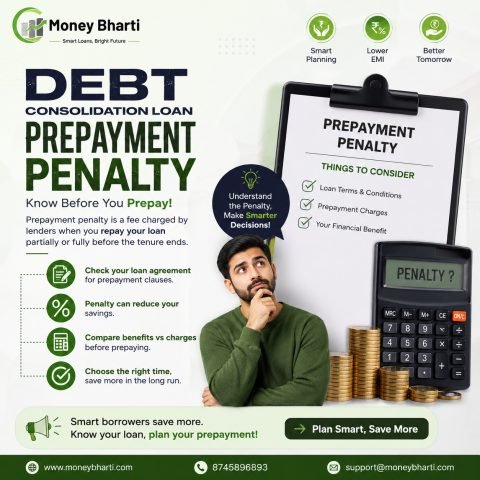
A loan advertised at a low interest rate can still work out expensive once you add processing fees, prepayment penalties, and documentation charges. Always ask for the total cost, not just the headline interest rate.
4. Not Comparing Enough Lenders
Many borrowers accept the first offer they get, often from their existing bank, without checking what an NBFC or another bank might offer for the same profile. It's worth shortlisting a few reliable debt consolidation companies and comparing their rates side by side. A difference of even 3% to 4% in interest rate can change the total repayment by a significant amount.
5. Consolidating Debt Without Fixing the Spending Habit
A consolidation loan treats the symptom, not the cause. If overspending or lack of budgeting caused the original debt, the same pattern will likely repeat unless it's addressed directly — through a budget, an emergency fund, or simply tracking monthly expenses.
6. Taking a Secured Loan Without Understanding the Risk
Some borrowers consolidate through a loan against property or a loan against fixed deposit to get a lower rate, without fully registering that their asset is now on the line. Missing payments on a secured loan carries far more serious consequences than missing an unsecured one.
7. Applying to Multiple Lenders at Once
Every loan application triggers a hard inquiry on your credit report. Applying to five lenders in the same week can pull your credit score down right when you need it to look its best.
8. Not Reading the Loan Agreement Carefully
Foreclosure charges, part-payment rules, and penal interest on missed EMIs are often buried in the fine print. Reading these before signing prevents surprises later, especially if you plan to close the loan early once your finances improve.
9. Using the Loan Amount for Anything Other Than Debt Repayment
Some borrowers take a slightly larger loan than needed and use the extra amount for other expenses. This defeats the entire purpose and adds new debt on top of what was meant to reduce it.
10. Not Checking the Impact on Credit Score in the Short Term
Right after consolidation, your credit score might dip slightly due to the new hard inquiry and a new account. This is normal and typically recovers within a few months of regular payments, but it's worth knowing in advance so it doesn't cause panic.
Pros and Cons at a Glance
| Pros | Cons |
|---|---|
| Single EMI, easier tracking | Longer tenure can mean more total interest |
| Often lower overall interest rate | Processing fees and charges add to cost |
| Can improve credit score over time | Risk of falling back into debt if spending isn't controlled |
| Reduces stress of multiple due dates | Secured loans put an asset at risk |
| Clear payoff timeline | Short-term dip in credit score |
Debt Consolidation Loan vs Balance Transfer vs Debt Settlement
| Factor | Debt Consolidation Loan | Balance Transfer | Debt Settlement |
|---|---|---|---|
| What it does | Combines multiple debts into one loan | Moves credit card balance to a lower-rate card | Negotiates to pay less than owed |
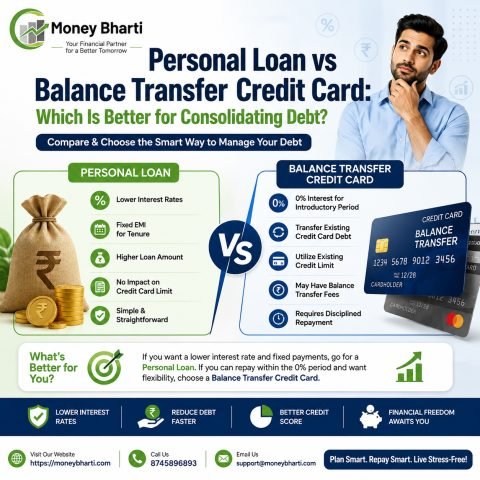
| Impact on credit score | Neutral to positive if managed well | Neutral | Significantly negative |
| Best suited for | Multiple debts, stable income | Single high-interest credit card | Severe financial distress |
| Risk level | Moderate | Low | High (lender may report as "settled," not "closed") |
If your situation has gone beyond what a consolidation loan can fix, it's worth knowing that debt relief companies offer settlement-based options too — though these should generally be a last resort, given the credit score impact shown above.
Frequently Asked Questions
Is a debt consolidation loan a good idea in India? It can be, if your combined existing interest rate is higher than what the new loan offers and you commit to not accumulating fresh debt on the accounts you close.
Will taking a debt consolidation loan hurt my credit score? There's usually a small, short-term dip due to the credit inquiry and new account. Regular, on-time payments typically restore and improve the score within a few months.
Can I consolidate debt with a low credit score? Yes, but expect higher interest rates or a requirement for collateral. Some NBFCs work with lower credit scores than traditional banks.
Should I close all my credit cards after consolidation? Not necessarily all, but any card whose balance you've cleared through the loan should either be closed or kept unused, so you don't accumulate the same debt twice.
How much can I save through debt consolidation? It depends on the interest rate difference between your old debts and the new loan. A drop from 36% to 14%, for example, can mean substantial monthly and long-term savings, as shown in Priya's example above.
Conclusion
A debt consolidation loan isn't a shortcut out of debt — it's a tool that works only if you use it with discipline. The math can genuinely work in your favour: lower interest, one EMI, and a clear end date. But the moment old credit cards get reused or a longer tenure is chosen just for comfort, the trap closes again, only this time with a bigger loan attached.
Before you sign anything, sit down with your actual numbers — every debt, every rate, every fee — and compare at least three lenders. Ask yourself honestly whether the spending habit that led to the debt has actually changed. If the answer is yes, and the math checks out, a debt consolidation loan can be the reset your finances need, instead of one more trap to climb out of.